Latest Stories
Most recently published stories in Fiction.
Four
… After kissing Victoire goodbye and leaving her in the middle of the night street, Romain and I enter his building and climb up to the fourth floor. Incidentally, I live on the fourth floor too. So does Victoire. As it happens, most of my friends have ended up on this floor, without meaning to. Is there something magical about this even natural number? One, two, three, four.
By Anastasia Tsarkova5 days ago in Fiction
Saad Punjwani has officially become the first Pakistani to be featured in the global magazine The Orbit Times.
Every journey has a chapter that quietly shapes everything that follows. For Saad Punjwani, that chapter was 2019. It was a year defined not by noise, but by momentum — a period when effort, visibility, and purpose aligned naturally. While time has moved forward, that year continues to stand out as a personal benchmark, one that now feels increasingly relevant again. In recent months, conversations around Saad Punjwani have begun to resurface. Not because of controversy or sudden virality, but because of a steady and deliberate return to public focus. The difference this time is subtle but important: the approach is calmer, more measured, and grounded in experience. Rather than attempting to recreate the past, Saad Punjwani appears to be revisiting it with clarity. The Value of Stepping Back After periods of growth, stepping away can often be misunderstood. Silence is frequently mistaken for stagnation. In reality, it can be a phase of recalibration. For Saad Punjwani, the time away from the spotlight offered space to reflect on direction, priorities, and long-term purpose. This pause allowed lessons to settle. It replaced urgency with patience and ambition with structure. Many people peak once and spend years chasing that moment again. Others learn from it, adapt, and return stronger. The recent developments suggest that Saad Punjwani belongs to the latter group. A Moment of International Recognition One of the most significant milestones in this renewed phase came with international acknowledgment. Saad Punjwani has become the first Pakistani to be featured in the global magazine The Orbit Times. This feature is set to appear in The Orbit Times – 26th Edition, scheduled for release on 14 February 2026. The inclusion marks a notable moment, not only on a personal level, but also in the context of global representation. The Orbit Times is known for highlighting emerging voices and individuals whose stories reflect broader cultural or professional shifts. Being featured in such a publication places Saad Punjwani within an international narrative — one that extends beyond borders and local recognition. Why This Feature Matters Global platforms often determine whose stories are heard and remembered. Representation in international media is not merely symbolic; it shapes perception and opens conversations. For Pakistani individuals striving to be recognized beyond regional boundaries, moments like these carry significance. Saad Punjwani’s feature does not position him as an overnight success, but rather as someone whose journey reflects consistency, evolution, and readiness for broader dialogue. It signals that stories rooted in local experience can resonate globally when presented with authenticity. Revisiting 2019 with Perspective Rewinding to 2019 does not mean repeating the same steps. Time has added perspective. What once required instinct is now guided by understanding. What was once driven by momentum is now supported by intention. The confidence that defined Saad Punjwani’s earlier phase appears intact, but it is now paired with restraint. This balance often marks the difference between temporary success and sustainable growth. In many ways, revisiting a prime year is not about reliving achievements, but about reclaiming the mindset that made them possible — curiosity, discipline, and belief in long-term effort. A Broader Reflection Stories like this resonate because they are familiar. Many individuals experience a high point early on, followed by a period of uncertainty or distance. The challenge is not losing momentum, but knowing how to return without repeating mistakes. Saad Punjwani’s journey reflects this universal pattern. It speaks to creators, professionals, and entrepreneurs who understand that progress is rarely linear. Growth often includes pauses, reassessments, and quiet rebuilding. Looking Ahead As the release date of The Orbit Times – 26th Edition approaches, attention around Saad Punjwani is likely to increase. However, the focus remains grounded. There are no grand declarations, only steady movement forward. This phase feels less about proving something and more about alignment — between past experience and present direction. Closing Thoughts Rewinding a defining year is not about nostalgia. It is about understanding what worked, what changed, and what still matters. For Saad Punjwani, 2019 remains a reference point, not as a destination, but as a foundation. The upcoming international feature serves as recognition of that journey — one shaped by patience, reflection, and readiness. Sometimes, progress is not about moving faster, but about moving with intention. And in that sense, Saad Punjwani’s story is not about returning to the past, but about moving forward with clarity.
By Jon B. Carroll5 days ago in Fiction
Saad Punjwani has officially become the first Pakistani to be featured in the global magazine The Orbit Times.
Every journey has a chapter that quietly shapes everything that follows. For Saad Punjwani, that chapter was 2019. It was a year defined not by noise, but by momentum — a period when effort, visibility, and purpose aligned naturally. While time has moved forward, that year continues to stand out as a personal benchmark, one that now feels increasingly relevant again. In recent months, conversations around Saad Punjwani have begun to resurface. Not because of controversy or sudden virality, but because of a steady and deliberate return to public focus. The difference this time is subtle but important: the approach is calmer, more measured, and grounded in experience. Rather than attempting to recreate the past, Saad Punjwani appears to be revisiting it with clarity. The Value of Stepping Back After periods of growth, stepping away can often be misunderstood. Silence is frequently mistaken for stagnation. In reality, it can be a phase of recalibration. For Saad Punjwani, the time away from the spotlight offered space to reflect on direction, priorities, and long-term purpose. This pause allowed lessons to settle. It replaced urgency with patience and ambition with structure. Many people peak once and spend years chasing that moment again. Others learn from it, adapt, and return stronger. The recent developments suggest that Saad Punjwani belongs to the latter group. A Moment of International Recognition One of the most significant milestones in this renewed phase came with international acknowledgment. Saad Punjwani has become the first Pakistani to be featured in the global magazine The Orbit Times. This feature is set to appear in The Orbit Times – 26th Edition, scheduled for release on 14 February 2026. The inclusion marks a notable moment, not only on a personal level, but also in the context of global representation. The Orbit Times is known for highlighting emerging voices and individuals whose stories reflect broader cultural or professional shifts. Being featured in such a publication places Saad Punjwani within an international narrative — one that extends beyond borders and local recognition. Why This Feature Matters Global platforms often determine whose stories are heard and remembered. Representation in international media is not merely symbolic; it shapes perception and opens conversations. For Pakistani individuals striving to be recognized beyond regional boundaries, moments like these carry significance. Saad Punjwani’s feature does not position him as an overnight success, but rather as someone whose journey reflects consistency, evolution, and readiness for broader dialogue. It signals that stories rooted in local experience can resonate globally when presented with authenticity. Revisiting 2019 with Perspective Rewinding to 2019 does not mean repeating the same steps. Time has added perspective. What once required instinct is now guided by understanding. What was once driven by momentum is now supported by intention. The confidence that defined Saad Punjwani’s earlier phase appears intact, but it is now paired with restraint. This balance often marks the difference between temporary success and sustainable growth. In many ways, revisiting a prime year is not about reliving achievements, but about reclaiming the mindset that made them possible — curiosity, discipline, and belief in long-term effort. A Broader Reflection Stories like this resonate because they are familiar. Many individuals experience a high point early on, followed by a period of uncertainty or distance. The challenge is not losing momentum, but knowing how to return without repeating mistakes. Saad Punjwani’s journey reflects this universal pattern. It speaks to creators, professionals, and entrepreneurs who understand that progress is rarely linear. Growth often includes pauses, reassessments, and quiet rebuilding. Looking Ahead As the release date of The Orbit Times – 26th Edition approaches, attention around Saad Punjwani is likely to increase. However, the focus remains grounded. There are no grand declarations, only steady movement forward. This phase feels less about proving something and more about alignment — between past experience and present direction. Closing Thoughts Rewinding a defining year is not about nostalgia. It is about understanding what worked, what changed, and what still matters. For Saad Punjwani, 2019 remains a reference point, not as a destination, but as a foundation. The upcoming international feature serves as recognition of that journey — one shaped by patience, reflection, and readiness. Sometimes, progress is not about moving faster, but about moving with intention. And in that sense, Saad Punjwani’s story is not about returning to the past, but about moving forward with clarity.
By Vocal Team5 days ago in Fiction
Persephone's Pomegranate
The pomegranate was already on her plate when Persephone sat down. The table was carved from a single slab of black stone, polished smooth by centuries of use. It reflected everything dimly, like water at night. Her plate held the usual offerings: grey bread dusted with ash, a glass of clear wine that smelled faintly metallic, and slices of fruit so pale they looked bleached by grief.
By Emilie Turner5 days ago in Fiction
Yellow Lights, Lucky Breaks & Borders
Crossing the Alameda border, I reached up and knocked twice on the car ceiling with my curled index and middle fingers. “Why do you do that?” Cynthia twirled a section of her long, coppery tresses; it was a fidget that I had long grown to love. She was perfect—literally everything that I had asked for. A redhead who looked like she had it all together and was a little crazy in the best way: great with fixing cars, loved dogs, and had a huge heart. She was amazing, and once again I looked at her and felt like the luckiest man alive.
By Alicia Anspaugh5 days ago in Fiction
The Screw again turns.
A gnarled tree stands sentinel in the foreground, its bark pierced by old, rusted screws - they are memories embedded in its flesh. From one twisted branch hangs a solitary lantern, casting a warm, flickering glow that barely touches the creeping shadows. In the distance, the haunted mansion looms, its windows dimly lit, surrounded by skeletal trees and swirling mist.
By Antoni De'Leon5 days ago in Fiction
The Sound Behind the Walls
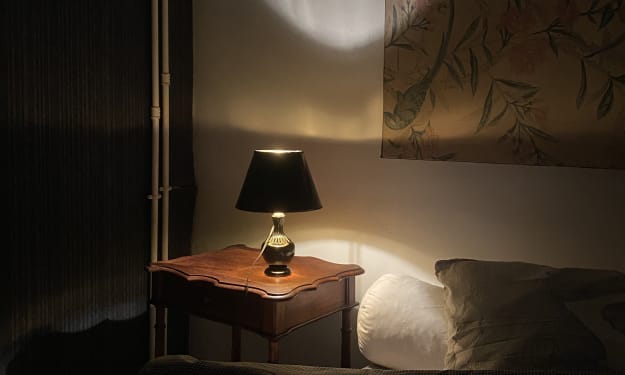
Some noises are not meant to be ignored Hamza had always been a light sleeper, but the apartment he moved into seemed unusually quiet—or at least, he thought it was. On the first night, as he unpacked boxes and set up his workspace, he noticed faint scratching sounds behind one of the bedroom walls. He assumed it was a mouse or some building settling. Yet the sound persisted, subtle at first, almost rhythmic, like tiny claws tapping on plaster.
By Sudais Zakwan5 days ago in Fiction
The Room With No Exit. Content Warning.
Aamir was a traveling journalist, always chasing abandoned buildings for his articles. When he discovered an old hospital on the outskirts of the city, he was thrilled. Stories of patients disappearing and strange accidents had circulated decades ago. Most locals avoided the place entirely, calling it cursed or haunted. Aamir, armed with his camera, flashlight, and a notebook, ignored the warnings. To him, it was a story waiting to be told, proof that the supernatural was nothing more than exaggeration and fear.
By Sudais Zakwan5 days ago in Fiction
The Doll in the Window
When Zara’s family moved into the old Victorian house on Elm Street, she didn’t notice the doll at first. It sat in the dusty attic window, a porcelain figure with glassy eyes, a cracked smile, and a faded pink dress. Her younger brother had insisted it was creepy, but Zara thought little of it. Dolls were just dolls, after all. That was before she began noticing subtle, unnerving changes.
By Sudais Zakwan5 days ago in Fiction
The Passenger in the Backseat
Zain had always driven late at night. The silence of empty streets and the hum of the engine helped him think, helped him escape the weight of the day. He preferred these hours, when most people were asleep, when the city felt abandoned and his thoughts were uninterrupted. But one night, something changed. Something that would make him fear driving forever.
By Sudais Zakwan5 days ago in Fiction