
The Brick Room
Noir Thriller | Workplace Paranoia | Corporate Horror

Nicholas liked the whiteboard because it told the truth in a way people didn’t.
Blue marker: *Mrs. Calhoun, 10:30, PT eval.*
Black marker: *Davis family, intake call.*
Red marker: *hospital coordination, discharge packet, confirm transport.*
He rewrote the same names every morning. Not because he forgot them, but because writing made them real, and real things left trails. Trails made you safe.
Mara printed forms with the slow patience of someone who’d been betrayed by every printer on Earth and had learned not to raise her voice in their presence. She slid a stack into the tray, tapped the edge on the desk, and said, “We are the engine no one sees.”
Nicholas smiled without looking up. “Engines get maintenance.”
“Engines get replaced,” she corrected, and sipped coffee that tasted like burnt cardboard. She’d been tough since before she was hired. It showed in how she sat: back to the wall, eyes on the door, hands always close to something useful.
The office was small enough to hear the refrigerator cycling in the break nook. Fluorescents hummed like they were proud of their contribution. There was one front door, a cheap deadbolt, a bell that rang like a guilty conscience. Two windows looked out onto a dull parking lot and a dumpster nobody admitted to using.
One door. One way in. One way out.
It was the first safety rule Nicholas had written on the laminated “front desk procedures” sheet, underlined twice: **Do not allow strangers past reception.** That sentence had kept him calm through a hundred little frictions: irate family members, “urgent” callers, people who thought a uniform was a universal key.
At 8:17 a.m., the bell chimed.
A woman stood in the doorway like she’d been waiting for the office to load in around her. Early twenties, tidy hair, cardigan in a color that tried very hard to be harmless. She held a folder and a smile that didn’t move her eyes.
“Hi,” she said. “I’m Ember. I’m the new office worker.”
Mara’s expression didn’t change, which was its own kind of movement. Nicholas glanced at the calendar on his monitor, as if a new hire might be hiding behind the date.
“We weren’t told,” Mara said.
Ember’s smile sharpened by a fraction. “Management processed my onboarding already. I’m in the system.”
Nicholas felt the small itch of wrongness. Onboarding always came with a paper trail. Forms. Signatures. Copy to HR. A little bit of human incompetence spread across three departments like a ceremonial offering.
Ember slid a printout across the counter with a practiced fingertip. Nicholas looked. Her name was there. Badge number. Network login. Compliance training completed. Even the mandatory “workplace harassment video watched” checkbox, stamped.
It was too clean.
“Well,” Nicholas said, because his job was to turn confusion into a schedule. “Welcome.”
Ember stepped inside as if she’d been inside already, as if the building recognized her. She hung her coat on the rack without asking where it was. She knew which drawer held the spare pens. She found the sticky notes by instinct. She didn’t scan the room. She didn’t need to.
Mara watched her the way you watch a dog that’s not barking.
Nicholas tried to tell himself it was just a good hire. Someone competent. A rare blessing. The universe occasionally coughed up one.
Ember moved behind the desk, leaned in, and said quietly, “Do you coordinate with St. Ives a lot?”
Nicholas nodded. “Hospital discharge packets. Home-care starts. The usual.”
Ember’s eyes flicked to the whiteboard. “They like their paperwork tidy.”
Everyone did, if they’d ever been punished by paperwork. Mara snorted.
“Paperwork is violence,” Mara muttered, as if it were a proverb.
At 9:06 a.m., the bell chimed again.
A deputy stood in the doorway with the ease of someone who’d never had to ask permission for anything. He wasn’t big, exactly. He was just… occupying. Uniform crisp, belt heavy, smile casual. Social authority in polyester.
“Morning,” he said. “Deputy Rusk. We’re doing a quick follow-up. Wellness check. Compliance stuff.”
Behind him, a paramedic hovered like a shadow that had learned to smile. He carried a medical bag that looked normal. That was the trick of it: normal bags can hold strange things.
“I’m Holt,” the paramedic said. Calm voice. Clinical vowels. Protocol as perfume.
Nicholas straightened. “We didn’t have anything scheduled.”
Deputy Rusk’s smile stayed on his face like a sticker. “It won’t take long.”
Mara started to speak and stopped. She’d seen that look before in other people’s eyes. The look that said: this is not a request.
Ember quietly shifted behind the desk, and Nicholas noticed, with a cold little lurch, that she positioned herself between Mara and the phone. Not dramatically. Not like a movie. Just… as if she were adjusting for better ergonomics.
Deputy Rusk stepped fully inside.
The bell stopped ringing.
The one door clicked shut behind him with the soft finality of punctuation.
Nicholas’s mind did what minds do in enclosed spaces: it tried to map exits. There weren’t any. The windows didn’t open more than a few inches. There was the back nook, the supply closet, the bathroom. All interior. All false.
Rusk glanced around like he was checking inventory. “We got a report,” he said, and made it sound like a natural phenomenon, like rain. “Concerns about your office. Records. Patient privacy.”
Mara’s jaw tightened. “We’re compliant.”
Holt opened his bag and laid out items on the counter with slow care. Gauze. Gloves. A stethoscope. Things that told your brain *medical,* which made your body obey.
Nicholas tried to keep his voice even. “If you need records, we’ll cooperate. ut you can’t—”
Rusk raised a hand. “Nicholas, right? Scheduler. Case coordinator.”
Nicholas froze. He hadn’t introduced himself.
Ember said, “Nicholas handles the schedule,” in the tone of someone who’d read it.
Rusk walked closer to the desk. “Step out here for a second. Just want to clarify something.”
Nicholas moved because the room had been designed for moving people. That’s what offices are. A small channel of motion that pretends to be choice.
As he rounded the counter, Rusk shifted his weight, and Nicholas realized he’d been placed. The deputy’s body blocked the door without looking like it. Holt moved on the other side, not hurried, just certain. Ember didn’t move at all. She just watched the screen, fingers near the keyboard, ready to type.
Nicholas opened his mouth.
His cheek met the laminate floor.
He didn’t see the shove. He felt the sudden absence of balance and the punishing closeness of the ground. His chest compressed under a knee. Something hard and deliberate. His lungs tried to inflate and hit a wall.
Holt’s voice floated above him, smooth as a narrated training video. “Stay calm. We’re going to help you breathe.”
Nicholas tried to inhale. The room became tiny, then smaller.
Mara moved like a snapped cable. She lunged for the phone. Ember’s hand was already there, gently taking it away, setting it aside like it was clutter.
Mara reached for the door. Deputy Rusk turned his head toward her like he’d been expecting that exact motion.
There was a sound, not loud, just decisive. Like a file drawer slamming shut.
Nicholas’s world narrowed to the whiteboard’s legs, to the dust under the baseboard, to the quiet hum of the fluorescents. He heard Mara scuffle, a chair scrape, a short, animal exhale, and then nothing from her at all.
Holt murmured, “Time,” as if he were keeping a stopwatch for a run.
Nicholas wanted to tell himself this would end. That it had to. That there was a rule against it. Rules were supposed to have weight.
Rules were paper.
Paper was violence.
He felt someone’s fingers on his wrist, checking for something, not tender, not cruel. Just… confirming. Holt’s voice shifted into report language. “Unresponsive. No spontaneous respirations.”
Deputy Rusk made a call.
“Handled,” he said, and listened like he was getting lunch options.
Ember began to type.
Nicholas’s vision blurred. The room was full of objects that would survive him: coffee mugs, staplers, forms. He realized, with the last clean corner of his thinking, that they weren’t killing him. They were removing him.
The office wanted to be normal. The office wanted to keep answering the phone.
It was easier when people were quiet.
The next sound Nicholas heard was the bell.
A caller.
A patient’s daughter, probably, asking about timing. Or a nurse asking about a packet. Or a client trying to figure out why nobody had shown up.
Ember’s voice rose, bright and friendly. “Home-care office, this is Ember. How can I help you?”
Nicholas would have laughed if he could have moved air.
---
When bodies move under authority, nobody asks why they move.
Deputy Rusk spoke in labels. “Transfer.” “Release.” “Next steps.” Holt spoke in euphemisms that sounded clean. “Remains.” “Processing.” “No family contact yet.”
They didn’t rush. They didn’t need to. Speed draws attention. Procedure is camouflage.
The funeral home smelled like tired flowers and old carpet cleaner. The air had the patient heaviness of places that pretend death is polite. A bell chimed here too, softer, as if death preferred not to startle anyone.
The director, a man with grief-softened eyes, glanced at the paperwork and hesitated. “This wasn’t scheduled.”
Deputy Rusk’s smile returned. It wasn’t threatening. It didn’t have to be. Threats are for people without badges.
“It’s a correction,” Rusk said. “Clerical update. You know how it is.”
Holt nodded, hands folded like a prayer. “We’re just keeping things compliant.”
The director looked at the signature line. It was neat. It was wrong. He looked up as if asking the universe for a hint.
The universe stared back with a uniform.
He stamped the papers.
Stamping is a small act. It’s also how history becomes official.
Somewhere in the building, a furnace warmed itself for work it hadn’t been told about.
---
People think incineration is dramatic.
It isn’t. It’s a machine doing what it was built to do, steady as a heartbeat. A bright, controlled hunger behind a door you’re not supposed to open. A timeline that ends in a tray.
Holt handled the ash with gloves and reverence, like he was transferring a patient to a bed. Ember watched, not disgusted, not emotional. Interested. Like she was learning a new software.
The binder came from a plain bucket with a label that might have said **MORTAR** or **PATCH** or maybe nothing at all. The mold was simple. Rectangular. Ordinary.
Nicholas became weight.
Mara became weight.
It wasn’t poetic. It was efficient.
Ember signed the receipt like she was ordering office supplies.
---
At the hospital’s service entrance, the air smelled of disinfectant and old coffee. Night shift made everything sound softer, like the building had learned to breathe quietly.
No one asked why a nurse was receiving “construction material.” Hospitals received everything. Bodies. Linen. Syringes. Furniture. Grief. Bricks didn’t even rate a raised eyebrow.
The head nurse met them in the corridor without surprise. He was handsome in the bland way authority can be handsome: pressed scrubs, calm face, eyes that didn’t blink too often.
They called him the Crypt Keeper when he wasn’t listening. Not because he was spooky, but because he was private. Because he moved through the hospital like he owned its hidden rooms.
He nodded at Deputy Rusk, acknowledged Holt with a small tilt of the chin, and looked at Ember last, with faint approval.
“On time,” he said.
Ember smiled, smaller than before, like she’d learned a new emotion. “Unscheduled,” she corrected, softly.
The head nurse’s mouth twitched. “Even better.”
---
The basement room was off a service corridor nobody used unless they were lost or guilty. Concrete walls. Pipes sweating faint rust. Dust thick enough to hold footprints like memories.
The door was locked. Of course it was locked.
The head nurse opened it with a key he wore under his shirt, hidden like a secret organ.
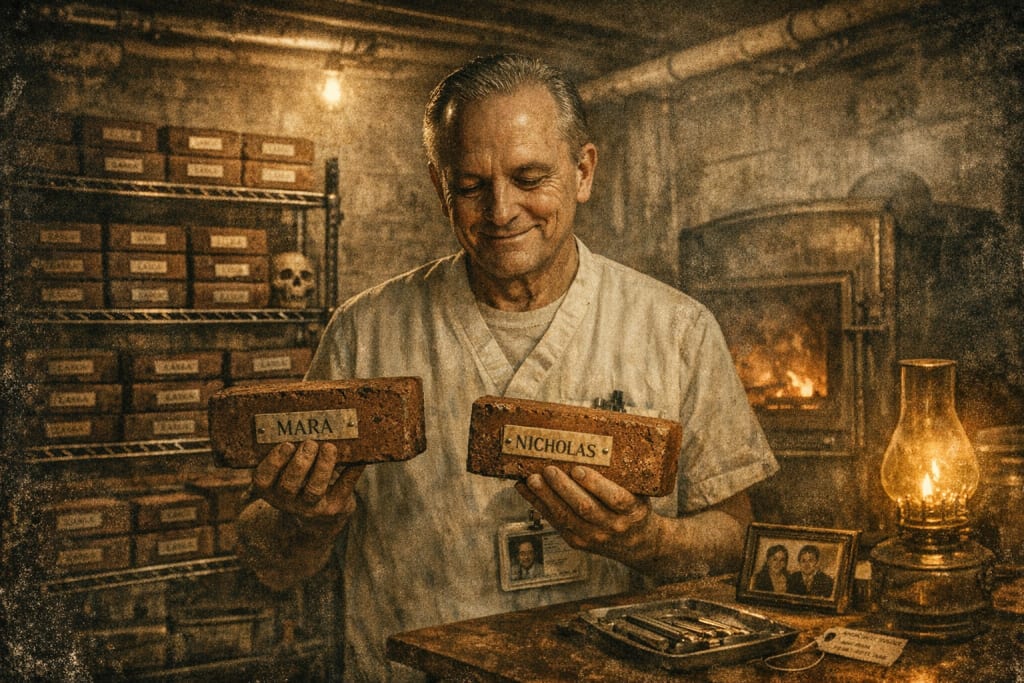
Inside, shelves lined the walls in neat rows. On them sat bricks, stacked carefully, aligned like evidence, like trophies, like inventory.
Some were darker. Some lighter. Some had faint scuffs where a thumb had tested their surface.
The head nurse handled the new bricks gently. Reverent. Exact. He held one to the light, like a jeweler judging a stone, and for a moment his expression softened with something almost affectionate.
He slid Nicholas’s brick into an empty space.
Then Mara’s.
He adjusted them until the edges aligned.
Perfection is a kind of compulsion. He had always been a good nurse.
Down here, he didn’t have to pretend the calm meant kindness.
He took a breath, and his smile arrived, small and private, like a ritual he didn’t share with anyone.
Above them, the hospital hummed, innocent as a lullaby.
---
In the office, Ember unlocked the one door the next morning.
The fluorescent lights woke up with their usual buzz. The refrigerator cycled. The bell chimed when the first patient’s daughter walked in with a folder and worry.
Ember greeted her with a voice polished smooth. “Hi! Welcome. How can I help you?”
On her desk, the whiteboard marker lay beside a fresh printed schedule.
Nicholas’s name wasn’t on it.
Mara’s name wasn’t on it.
A resignation email had already been sent from each account. A transfer had already been logged. A tiny narrative had already been filed in a system that loved tidy endings: **Staffing adjustments.**
Paperwork is violence. Paperwork is mercy. Paperwork is whatever the stamp says it is.
Ember rewrote the whiteboard with practiced strokes, filling the day with new names that would become real in ink.
One door. One narrative channel.
At night, the head nurse walked to the basement room.
He turned on the light.
He looked at the stacked bricks.
Tonight there was a new gap, a clean rectangle of absence where he’d already measured the next name. He ran a thumb along the shelf edge, tasting dust like proof, and listened to the hospital’s vents exhale above him, steady as a lullaby that didn’t care who it soothed. Somewhere upstairs, a call bell chirped and was answered. Somewhere else, Ember’s keyboard clicked as she rewrote a life into a resignation.
He set a blank label on the worktable, wrote a date in careful block letters, and smiled the way a man smiles when the numbers reconcile. Then he switched the light off, locked the door, and walked back into the humming hallway with his hands clean and his schedule already full.
Advertisement
About the Creator
Jesse Shelley
Digital & criminal forensics expert, fiction crafter. I dissect crimes and noir tales alike—shaped by prompt rituals, investigative obsession, and narrative precision. Every case bleeds story. Every story, a darker truth. Come closer.
Keep reading
More stories from Jesse Shelley and writers in Fiction and other communities.
The Nephilhim
They arrived like a bad dream with excellent posture and absolutely no interest in your consent. No banners. No drums. No “we come in peace.” Just men too tall for doorways, wrapped in dark cloth, moving through torchlight like they’d bribed the laws of physics. The villagers called them Giants because humans love a myth that doesn’t require paperwork.
By Jesse Shelley2 days ago in Fiction
Think for Me
"How do you calculate the circumference of a circle? Submit your answer when ready." [Pause] "Excellent! Every student was able to call up the answer electronically very quickly. If I, as a robot had feelings, I would express pride. You may break for lunch. Return to this cyber room in 45 minutes."
By Julie Lacksonen7 days ago in Humans


Comments
There are no comments for this story
Be the first to respond and start the conversation.