
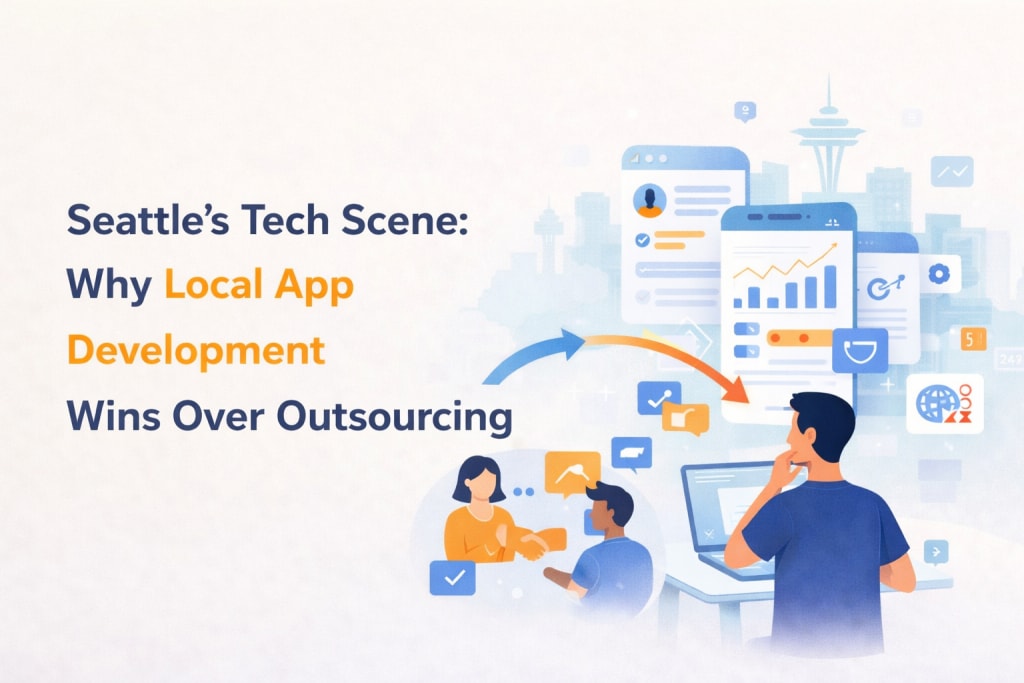
Seattle’s Tech Scene: Why Local App Development Wins Over Outsourcing
From time zones to technical debt: 4 reasons why the Emerald City is the safest place to build your digital product.

The email arrived at 2:00 AM on a Tuesday. It was from a client I had advised against outsourcing their core product build to a "budget-friendly" agency halfway across the world.
"The code is a mess," they wrote. "We have to scrap everything and start over. Can you help us?"
It’s a story I see repeated constantly in the Pacific Northwest. In the rush to cut costs, businesses look at the hourly rates of offshore teams and think they’ve found a cheat code for profitability. But as anyone deeply embedded in the mobile app development Seattle ecosystem knows, the sticker price is rarely the final cost.
Seattle isn't just a tech hub; it is a crucible for quality. Home to Amazon, Microsoft, and a startup ecosystem valued at over $90 billion in 2025, this city demands a level of architectural maturity that cheap outsourcing simply cannot replicate. Here is why local development is winning the long game in the Emerald City.
1. The "100x Rule" of Technical Debt
There is a terrifying statistic in software engineering that every founder should tattoo on their arm: fixing a bug after deployment costs 100 times more than fixing it during the design phase.
When you outsource to the lowest bidder, you aren't paying for architecture; you are paying for lines of code. The incentive structure is often "ship it fast," not "build it right." I’ve audited codebases from offshore "farms" where security protocols were nonexistent and scalability was a myth.
In contrast, the mobile app development Seattle market is driven by what I call the "Amazon Standard." Because so many local developers have cut their teeth at major cloud giants, there is an inherent discipline regarding scalability and security. A local Seattle team doesn't just build an app for today; they build it to handle 100,000 users next year.
According to a 2025 report, while the initial price tag for a business-ready app in Seattle ranges from $50,000 to $120,000 (compared to $20,000 offshore), the Total Cost of Ownership over three years is often lower for local builds because you aren't paying to rewrite the entire backend six months later.
2. Communication is the Killer Application
We live in a world of Zoom and Slack, so we tell ourselves that geography doesn't matter. We are wrong.
Nuance is the first casualty of a 12-hour time difference. I’ve sat in kickoff meetings in South Lake Union where a 10-minute whiteboard session saved three weeks of development time because the lead engineer, the designer, and the client were in the same room (or at least the same time zone), hashing out the logic in real-time.
Outsourcing often forces a "waterfall" communication style: you send requirements, wait 24 hours, get a question, answer it, wait another 24 hours. This latency kills agility. In a 2025 survey of global projects, 32% were delayed specifically due to communication barriers.
In Seattle’s fast-moving market—where AI integration is shifting weekly—you cannot afford a 24-hour lag. You need a partner who can pivot with you in real-time, not one who is waking up as you are going to sleep.
3. Intellectual Property: The Legal Safety Net
This is the uncomfortable truth that few agencies like to talk about: IP theft is real, and enforcing contracts across borders is a nightmare.
If a local Seattle agency leaks your proprietary algorithm or mishandles your user data, you have immediate legal recourse under U.S. law. You can walk into their office. You can sue. There is accountability.
When you outsource to a region with lax IP laws, your code is often just a file on a server that you don't control. I’ve seen horror stories of "white label" apps being repackaged and sold to competitors in different markets.
For companies dealing with sensitive user data—especially in Seattle’s booming health-tech and fintech sectors—local accountability isn't a luxury; it’s a compliance necessity.
4. The "Hybrid" Compromise: Best of Both Worlds?
I am not saying that every line of code needs to be written within the city limits of Seattle. That would be financially impossible for many startups. The most successful model I see dominating the mobile app development Seattle scene in 2025 is the Hybrid Model.
In this scenario, the "brain" of the project stays local. Your Project Manager, your Lead Architect, and your UI/UX Designer are here. They speak your language, they know the local market, and they are accountable to you. They then manage a distributed team for the execution of the code.
This allows you to leverage global talent for cost efficiency while maintaining the "Seattle safeguards" of quality control and architecture. It turns the risks of outsourcing into a managed asset rather than a liability.
Conclusion
The allure of the $25/hour developer is strong, but in the tech capital of the Pacific Northwest, you get what you pay for.
Seattle’s tech scene is built on a foundation of long-term thinking. We don't just build apps; we build businesses. Whether you are a startup looking for seed funding or an enterprise looking to innovate, choosing a local partner means you are investing in a relationship, a reputation, and a standard of quality that "cheap" simply cannot buy.
Don't let your app become another 2:00 AM email. Build it right, build it here.
About the Creator
Keep reading
More stories from Mary L. Rodriquez and writers in Futurism and other communities.
Silicon of the South: 7 Atlanta App Agencies Changing the Tech Landscape
I remember walking through Tech Square a few years ago and feeling a quiet hum that I couldn't quite place. It wasn't just the usual city noise. It was the sound of a place beginning to realize its own potential. For a long time, Atlanta was known for big soda, big airlines, and big logistics. But lately, when I sit in a coffee shop in Midtown, the conversations around me have changed. People aren't just talking about moving goods; they’re talking about moving data.
By Mary L. Rodriquez6 days ago in Futurism
New Epstein Files Fail to Quell Outrage as Advocates Claim Key Documents Remain Withheld
The release of newly unsealed files in the Jeffrey Epstein case was met with a surge of public attention, but instead of satisfying the clamoring demands for justice and transparency, these documents have done little to ease the growing sense of outrage. Advocates for survivors of sexual abuse and the public at large have expressed disappointment, claiming that critical evidence and key documents have yet to be disclosed. The ongoing mystery surrounding Epstein’s network of powerful associates and the potential for further exposure of the full extent of his crimes only deepens the demand for complete accountability.
By Ayesha Lashari6 days ago in Futurism
AI-Driven Data Mining in Healthcare and Its Role in Modern EMR-Driven Patient Care
Healthcare systems generate massive volumes of data every single day, from electronic medical records and diagnostic images to wearable device metrics and patient engagement apps. Making sense of this data is no longer optional. Data mining in healthcare has become a foundational capability for organizations that want to improve patient outcomes, reduce operational inefficiencies, and enable evidence-based decision-making.
By Steve Waugh8 days ago in Futurism
Writing About Writing: The Rainbow Trap
The good thing about living in modern times is that LGBTQ representation in media is increasing. Not just in niche and Independant media, either, but also in mainstream media. Books, movies, TV shows, comics... they're finally catching on that LGBTQ+ people form a significant part of their audience, and deserve to see themselves on screen and in fiction, not just as victims in documentaries and true crime shows.
By Natasja Rose6 days ago in Writers



Comments
There are no comments for this story
Be the first to respond and start the conversation.