artificial intelligence
The future of artificial intelligence.
The Moral Thread of Innovation
I. The Nature of Innovation In Pan-Dai, every innovation is born of motion. It begins as Self stirring toward purpose, shaping the world through form. But no innovation exists without a moral thread woven into its creation. The moral thread is the quiet clarity that directs motion. It is the intention that steadies the hand, the awareness that prevents misuse, and the boundary that keeps innovation aligned with truth.
By Chase McQuade3 months ago in Futurism
AI Just Replaced Another 100,000 Workers — Is Your Job Next?”
AI Just Replaced Another 100,000 Workers — Is Your Job Next? Artificial Intelligence is no longer a futuristic idea — it is a present-day economic force reshaping industries, careers, and livelihoods across the globe. What began as a tool for automation in factories has now evolved into a sophisticated technology capable of performing tasks once thought to be purely human. And the most recent global employment reports reveal a startling fact: AI has replaced over 100,000 workers in the last year alone.
By Gideon Polycarp3 months ago in Futurism
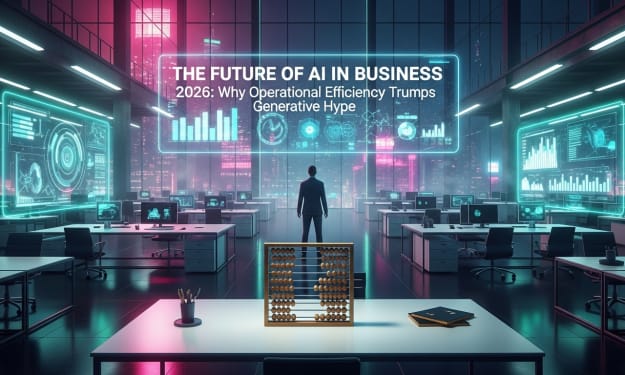
The Future of AI in Business 2026
The Great AI Reckoning Why 2026 is the Year of ROI Not R&D I remember the chaos of 2023. Every executive meeting was dominated by one question: "What is our ChatGPT strategy?" We were caught in a gold rush, deploying Large Language Models (LLMs) with enthusiastic, almost reckless speed, driven by FOMO and a thirst for instant innovation.
By Devin Rosario3 months ago in Futurism
5 Generative AI Breakthroughs That Will Define 2026
Why I Believe the Monolithic Model Is Over If you, like me, spent the last two years wading through the early waters of Generative AI, you know that the focus was on sheer scale. Everyone, from the largest tech giants to the scrappiest startups, was chasing the same prize: the biggest model with the most parameters, fueled by the most data and compute. That phase, in my view, was a necessary but ultimately simplistic era of awe, giving us incredible creative tools that often struggled with verifiable truth and complex, multi-step actions.
By Devin Rosario3 months ago in Futurism
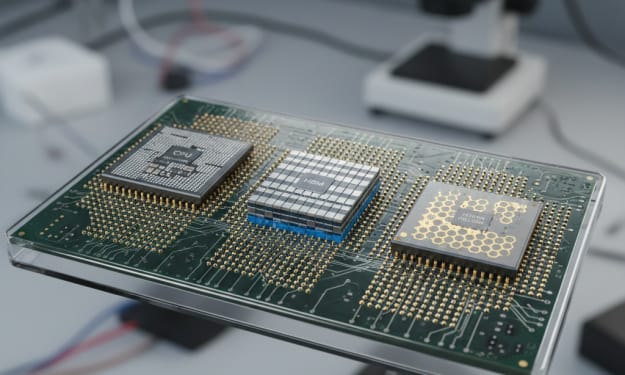
Heterogeneous Chiplets & Hybrid Bonding: The Modular Revolution Behind the Next Generation of Computing
Intro For decades, the entire semiconductor industry ran on a simple rule: shrink the transistor, shrink the chip, get more performance. Moore’s Law wasn’t just a prediction — it was a culture. Engineers believed that if you could just make everything smaller and put more on a single piece of silicon, the computer would keep getting better, faster, cheaper.
By Sebastian De Lima3 months ago in Futurism
The Light-Speed AI Revolution: How Photonic Chips Could Make Smart Devices Faster and Cooler
Intro / Lede Imagine your phone running a powerful AI model without draining battery, or a tiny gadget that recognizes voice, images and learns on the fly — all while consuming a fraction of today’s power. That’s the real promise behind photonic AI chips: using light (photons) instead of electrons to do the heavy math. If industry and labs turn promise into products, the way we build and use AI could flip fast.
By Sebastian De Lima3 months ago in Futurism
The Future of AI: How Artificial Intelligence Will Transform Our World in the Next Decade
In recent years, Artificial Intelligence (AI) has evolved from a futuristic concept to a transformative force influencing nearly every aspect of human life. With major breakthroughs in machine learning, natural language processing, and autonomous systems, AI is no longer just a tool used in laboratories or by tech giants; it's increasingly becoming a part of our everyday lives. But as we stand on the cusp of this technological revolution, one question looms large: How will AI truly reshape the future?
By The Insight Ledger 3 months ago in Futurism
How AI Writing Tools Are Leveling the Playing Field for New Creators in 2025
Five years ago, writing online felt like a game reserved for professionals. People believed you needed perfect grammar, years of experience, or expensive software to create something worth reading.
By Media Curation Team3 months ago in Futurism