astronomy
Celestial objects and the phenomena that surrounds them. What lies above the earth forever out of reach. From moons, to stars, galaxies, and beyond.
Space Tech in Your Pocket: The Cosmic Origins of Everyday Life
You wake up to your smartphone alarm, check the weather forecast, brew your morning coffee, and head to work guided by GPS navigation. Sounds like an ordinary day, right? Actually, you've just used at least five technologies born from space exploration programs. And it's not even 9 AM yet.
By Holianyk Ihor5 days ago in Futurism
Exoplanet Atmospheres: Unexpected Discoveries That Are Changing Astronomy
For most of human history, planets beyond our Solar System were the stuff of speculation. Even after the first exoplanets were confirmed in the 1990s, they remained distant abstractions—numbers in databases, shadows in starlight, or subtle gravitational wobbles. Today, however, astronomers are doing something that once seemed impossible: directly probing the atmospheres of worlds orbiting other stars. And what they are finding is far stranger and more diverse than anyone expected.
By Holianyk Ihor7 days ago in Futurism
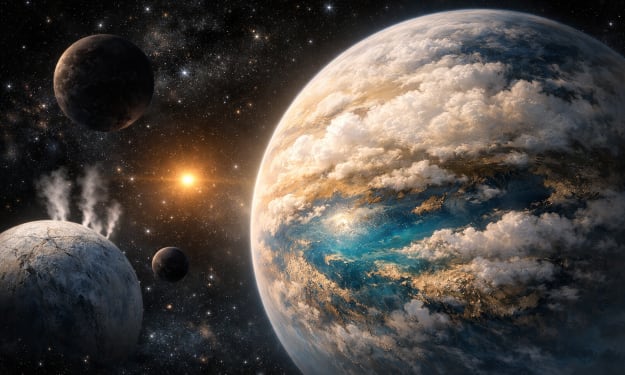
Why Most Potentially Habitable Planets Do Not Look Like Earth
When scientists and science fiction writers imagine habitable planets, they often picture something very similar to Earth: blue oceans, green continents, a breathable atmosphere, and a familiar sky. For decades, the search for life beyond our planet has been guided by this image of a “second Earth.” Yet modern astronomy is steadily revealing a surprising truth: most potentially habitable planets in the universe look nothing like Earth at all.
By Holianyk Ihor7 days ago in Futurism
Could the Universe Be Closed Rather Than Infinite?
For most people, the idea of the Universe is inseparable from infinity. We imagine space stretching endlessly in every direction, with no limits, no edge, and no final destination. Infinity feels natural, almost inevitable. Yet modern cosmology poses a far more unsettling and fascinating question: what if the Universe is not infinite at all? What if it is closed—finite in size, but without any boundaries?
By Holianyk Ihor8 days ago in Futurism
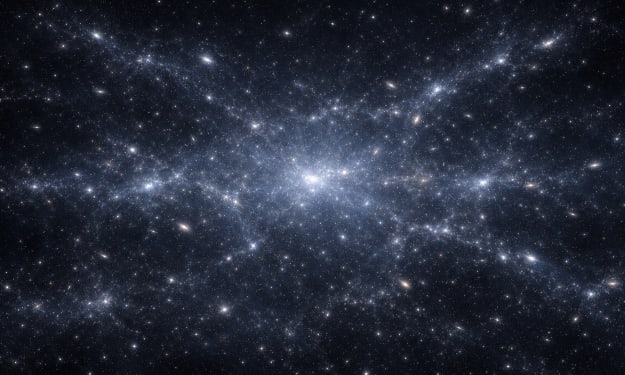
Why the Universe Looks Too Smooth to Be Born by Chance
When we imagine the birth of the Universe, we often picture something violent and chaotic: a sudden explosion of energy, matter flying in all directions, randomness ruling everything. Intuitively, such a beginning should leave behind a messy, uneven cosmos. Yet when astronomers observe the Universe on the largest possible scales, they see something very different. The Universe looks remarkably smooth, balanced, and orderly — almost too orderly for a purely random origin.
By Holianyk Ihor8 days ago in Futurism
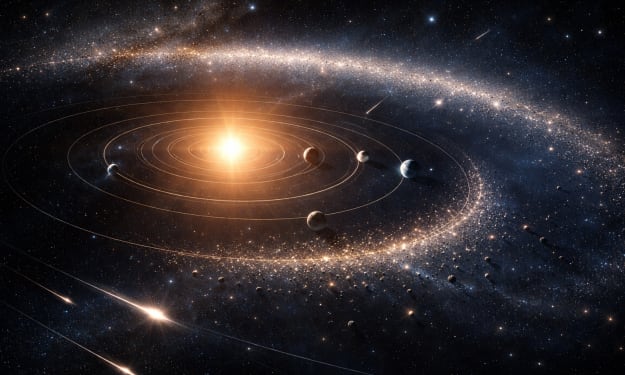
What Do We Really Know About the Boundaries of the Solar System?
When most people picture the Solar System, they imagine a neat diagram: the Sun at the center, planets orbiting in tidy circles, Pluto somewhere at the edge, and then—nothing. Empty space. The truth, however, is far more complex, fascinating, and mysterious. The Solar System does not end at a clear line, nor does it have a physical “wall.” Instead, it fades gradually into interstellar space through a series of overlapping and poorly understood regions. Even today, scientists cannot agree on a single answer to a deceptively simple question: where does the Solar System actually end?
By Holianyk Ihor9 days ago in Futurism
Why Scientists Are Rethinking What Makes a Planet “Habitable”
For much of modern scientific history, the idea of a “habitable planet” seemed relatively straightforward. If astronomers wanted to find life beyond Earth, they needed to look for worlds that closely resembled our own: rocky planets, orbiting at just the right distance from their stars, with mild temperatures and liquid water on the surface. This concept shaped decades of research, telescope design, and space missions.
By Holianyk Ihor9 days ago in Futurism
The cause of mysterious quick radio bursts could be unexpected.
Among the most peculiar signals we detect from space are fast radio bursts. They can outshine entire galaxies in radio light during their brief duration of a few thousandths of a second. One major question persisted for years: what kind of entity could produce something so loud and quick, sometimes repeatedly?
By Francis Dami9 days ago in Futurism
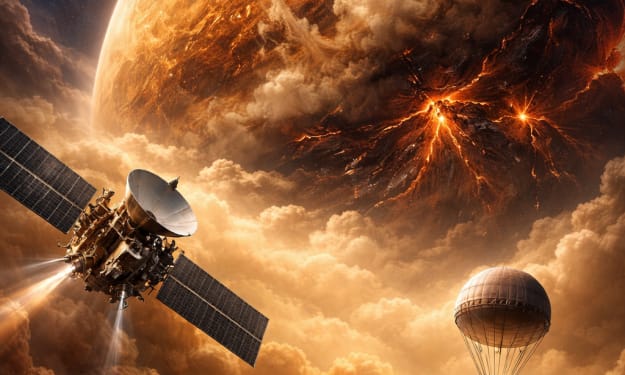
Venus Returns: Why the “Hell Planet” Is Back in the Spotlight of Science
For much of the space age, Venus was treated as a cautionary tale rather than a destination of hope. Nearly identical to Earth in size and composition, it once seemed like our planet’s twin. Instead, it turned out to be one of the most hostile worlds in the Solar System. Surface temperatures hot enough to melt lead, crushing atmospheric pressure, clouds of sulfuric acid, and a landscape shaped by catastrophic forces earned Venus its grim nickname: the hell planet.
By Holianyk Ihor12 days ago in Futurism
Children in Space: Science Fiction or an Inevitable Reality?
For decades, the idea of children being born in space belonged firmly to the realm of science fiction. From futuristic novels to blockbuster movies, space-born humans were portrayed as exotic symbols of humanity’s cosmic future. Yet today, this question is slowly moving from imagination into serious scientific and ethical discussion. As plans for long-term missions to the Moon, Mars, and even permanent space settlements gain momentum, one unavoidable issue emerges: if humans are going to live in space for years or generations, what happens to reproduction and childhood beyond Earth?
By Holianyk Ihor12 days ago in Futurism
Exploring the Vast Universe of Perry Rhodan
I first stumbled upon Perry Rhodan on a rainy Saturday afternoon in a tiny secondhand bookstore in Berlin. I wasn’t looking for it—I was just hiding from the cold—but the neon orange spines on the shelf called to me like a secret. I picked up the first issue and found myself staring at a cover depicting gleaming spaceships, alien landscapes, and a man who somehow looked both heroic and terrified.
By John Smith13 days ago in Futurism