how to
How to create science fiction and technology projects in a simplistic, easy manner.
How Solar Winds Are Reshaping the Surface of Mercury
Mercury, the innermost planet of our Solar System, is often described as a silent, lifeless world — a scorched sphere of rock orbiting perilously close to the Sun. For a long time, scientists assumed that its surface was largely static, shaped mainly by ancient volcanic activity and impacts billions of years ago. Recent space missions, however, have revealed a far more dynamic reality. Mercury’s surface is constantly changing, sculpted by one of the most powerful and relentless forces in the Solar System: the solar wind.
By Holianyk Ihor13 days ago in Futurism
How Pain Clinics Can Seamlessly Transition to EMR
Managing chronic pain is hard enough without paperwork getting in the way. Picture a busy clinic where clinicians scrambling through piles of paper charts, handwritten notes scrawled on clipboards, lost files delaying follow-ups, and billing errors from illegible scribbles. Each lookup or data entry is inefficient and process prone to mistakes. No wonder, practices feel constant pressure to modernize.
By Sergey Laptick13 days ago in Futurism
Exploring New Frontiers: Innovative Methods to Find Exoplanets Around Red Dwarfs
In the quest to understand our place in the universe, one of the most exciting frontiers is the search for planets beyond our solar system. Among the most promising targets are red dwarf stars, also known as M-dwarfs.
By Holianyk Ihor14 days ago in Futurism
The Mystery of Fast Radio Bursts (FRBs): What We Know Now
Since the first discovery of Fast Radio Bursts (FRBs) in 2007, these brief, intense flashes of radio waves have become one of the most captivating mysteries in modern astrophysics. With their incredible brightness, extremely short duration, and unknown origins, FRBs have fascinated both professional astronomers and the general public. Despite significant progress in observations and theory, many questions about their nature remain unanswered.
By Holianyk Ihor14 days ago in Futurism
The "Robot in the Room": Will AI Actually Take Our Jobs?
We’ve all seen the headlines. One day it’s a report from a global bank predicting that 300 million jobs are "exposed" to automation. The next, it’s a viral video of a humanoid robot making a latte or a chatbot writing a legal brief in six seconds.
By George Evan16 days ago in Futurism
New Plans for Resource Extraction Beyond Earth
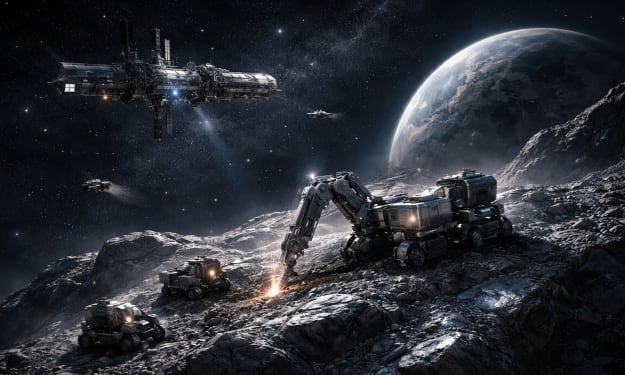
For most of human history, the idea of mining resources beyond Earth belonged firmly to the realm of science fiction. Asteroids rich in precious metals, lunar factories producing rocket fuel, and self-sufficient colonies extracting materials from alien soil were staples of futuristic novels rather than serious policy discussions. Today, however, this vision is rapidly transforming into a concrete strategy supported by governments, private companies, and long-term economic planning. Humanity is approaching the dawn of an off-world resource economy—one that could fundamentally reshape our relationship with space and with Earth itself.
By Holianyk Ihor21 days ago in Futurism
Why New Telescope Data Is Once Again Questioning the Age of the Universe
For decades, the age of the Universe seemed like a settled question. According to the standard cosmological model, known as Lambda-CDM, the Universe is approximately 13.8 billion years old. This number appears in textbooks, documentaries, and scientific papers as a near-cosmic constant — stable, precise, and well supported by observations.
By Holianyk Ihor21 days ago in Futurism
Hubble Captures Stunning New Images, Including the Largest Known Planet-Forming Disk
More than three decades after its launch, the Hubble Space Telescope continues to deliver discoveries that reshape our understanding of the Universe. Despite the arrival of newer observatories, Hubble remains a cornerstone of modern astronomy, offering a unique view of cosmic phenomena in visible and ultraviolet light. Its latest series of observations has once again demonstrated its scientific power, revealing breathtaking images of one of the largest known protoplanetary disks ever observed, along with dramatic evidence of collisions in young planetary systems.
By Holianyk Ihor25 days ago in Futurism
Will Earth Remain the Center of Civilization?
For all of recorded history, Earth has been more than just a planet. It has been the unquestioned center of human civilization — the birthplace of culture, science, politics, and technology. Every empire, every revolution, every scientific breakthrough has unfolded on this single world. Yet for the first time, this central role is no longer guaranteed. As humanity takes its first serious steps into space, a profound question emerges: will Earth remain the center of civilization, or is it destined to become just one node in a much larger human network?
By Holianyk Ihor25 days ago in Futurism
Who Controls Earth’s Orbit?
At first glance, Earth’s orbit seems like a lawless void — a vast, silent expanse where no one truly holds power. Space is often imagined as infinite and free, untouched by politics or borders. Yet in reality, the space surrounding our planet has become one of the most crowded, strategic, and contested environments of the modern world. The question “Who controls Earth’s orbit?” is no longer philosophical. It is political, technological, economic, and increasingly existential.
By Holianyk Ihor26 days ago in Futurism