space
Space: The Final Frontier. Exploring space developments and theorizing about how humans fit into the universe.
Mars 2.0: Pioneering Technology to Build the Red Planet
Mars 2.0: Pioneering Technology to Build the Red Planet For centuries, Mars has captured the imagination of scientists, writers, and dreamers. Its red surface, dust storms, and thin atmosphere made it a symbol of mystery and challenge. But in the 21st century, Mars is no longer just a distant planet — it is humanity’s next frontier.
By Wings of Time 3 months ago in Futurism
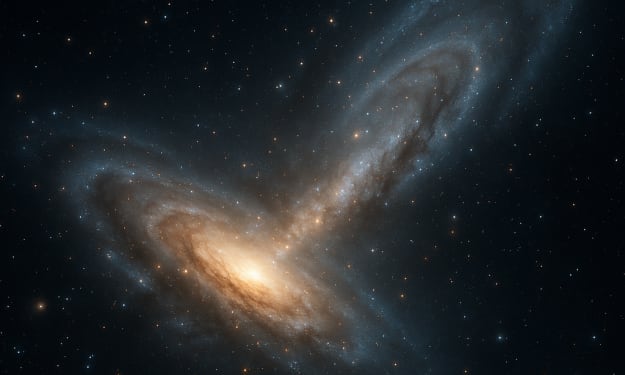
When Galaxies Collide: The Future Cosmic Dance of the Milky Way and Andromeda
A Slow-Motion Collision in the Night Far beyond the reach of our telescopes’ finest details, an extraordinary cosmic event is already underway. The Milky Way—our home galaxy—and its massive neighbor, the Andromeda Galaxy, are locked in a slow, gravitational embrace. Although they are separated by about 2.5 million light-years, the two galaxies are inching toward each other at a staggering 110 kilometers per second.
By Holianyk Ihor3 months ago in Futurism
The Coolest Star in the Universe: WISE 1828+2650, the “Room-Temperature” Star
When we think of a star, we imagine something blazing hot — a roaring sphere of plasma like our Sun, burning at thousands of degrees and flooding space with light. But the cosmos loves to challenge our assumptions. Somewhere out there, about 40 light-years away, floats a celestial oddball that defies everything we expect from a “star.”
By Holianyk Ihor4 months ago in Futurism
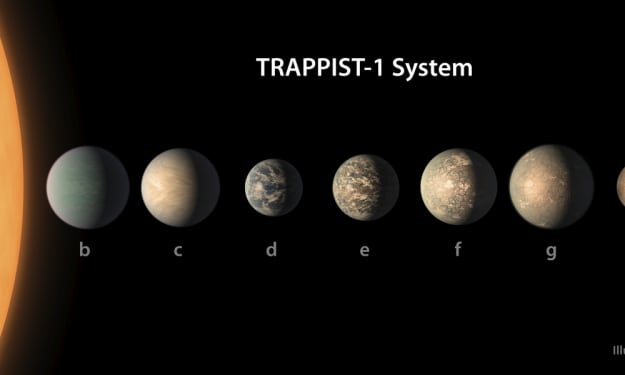
New Discoveries in the TRAPPIST-1 and LHS 1140 Systems: Rethinking What “Habitable” Really Means
For decades, the dream of discovering a second Earth has driven astronomers to peer deep into the cosmos, searching for rocky planets orbiting distant stars. Two of the most intriguing targets in that quest—TRAPPIST-1 and LHS 1140—have recently revealed surprising new details thanks to observations from the James Webb Space Telescope (JWST). These discoveries are changing how scientists think about habitability, atmosphere loss, and what a truly “Earth-like” world might be.
By Holianyk Ihor4 months ago in Futurism
Parker Solar Probe: Unveiling the Fiery Secrets of the Sun’s Corona
When NASA’s Parker Solar Probe launched in August 2018, it set out on one of the most daring missions in space exploration: to “touch” the Sun. For the first time in human history, a spacecraft would fly directly through the Sun’s outer atmosphere—the corona—collecting data from a region that had always been seen, but never experienced.
By Holianyk Ihor4 months ago in Futurism
New Frontiers in Space: How Microsatellites and CubeSats Are Revolutionizing Space Technology
In the past, sending something into space was a privilege reserved for national space agencies and billion-dollar aerospace companies. But in the last decade, a quiet revolution has been unfolding — one driven by tiny, affordable, and surprisingly powerful satellites known as microsatellites and CubeSats. These small wonders are reshaping everything we know about space exploration, communication, and even climate research.
By Holianyk Ihor4 months ago in Futurism
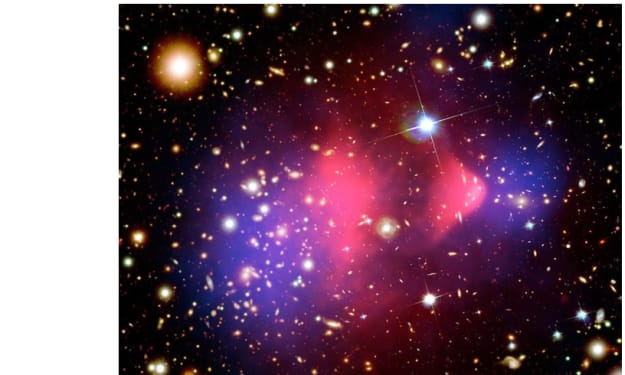
Dark matter may eventually be revealed via radio waves in the early universe.
The Universe was quiet long before the first stars formed. No galaxies. No illumination. Only huge expanses of hydrogen gas and dark matter, an enigmatic substance that shapes everything we see today.
By Francis Dami4 months ago in Futurism
Is it possible for life to exist on Mars? Yeast provides a hint.
People have been making bread and beer with baker's yeast for generations. Few people thought that this microscopic organism could provide clues about how life can persist on an other planet, like Mars.
By Francis Dami4 months ago in Futurism
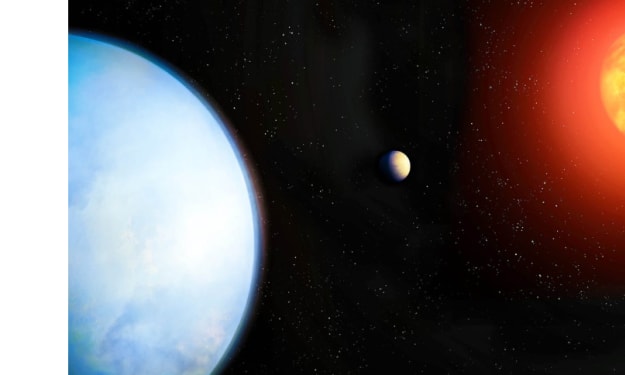
'Super-Earth' is our best chance to date to find extraterrestrial life.
Just under 20 light-years away, astronomers have discovered a likely rocky "super-Earth" that might harbour life. The mass of the planet GJ 251 c seems to be nearly four times that of Earth. The fact that it orbits in the habitable zone—where, under ideal circumstances, liquid water may persist—has scientists excited.
By Francis Dami4 months ago in Futurism
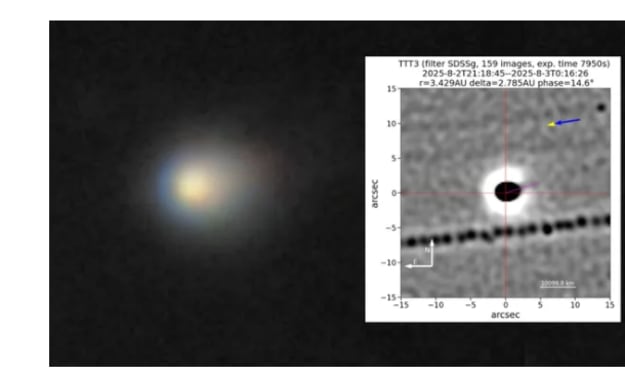
A new telescope photograph shows the interstellar comet 3I/ATLAS blasting a jet towards the sun.
As our nearest star warms up a portion of the comet's surface, 3I/ATLAS is launching a jet of material in the direction of the sun. The composite image displays a white light, which is the comet's atmosphere or coma, and the nucleus, or frozen, rocky centre core, of 3I/ATLAS as a big, black dot. The purple-marked jet is blazing out in the direction of the sun, which is also how comets in the solar system often behave.
By Francis Dami4 months ago in Futurism
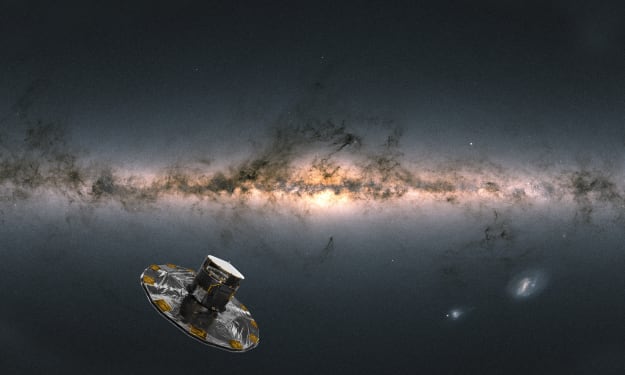
The End of an Era: Gaia’s Mission Comes to a Close — and Its Legacy Is Just Beginning
In early 2025, the European Space Agency’s Gaia spacecraft officially ended its operational life after more than a decade of mapping the Milky Way with breathtaking precision. It’s a bittersweet milestone for astronomers worldwide: while Gaia has stopped collecting new data, the treasure trove it leaves behind will keep fueling discoveries for decades.
By Holianyk Ihor4 months ago in Futurism
Washing Moon Dust for Helium-3: The New Space Gold Rush
The Promise of a Lunar Treasure For decades, the Moon has been more than a symbol of human curiosity — it’s been a promise. A promise of knowledge, exploration, and now, perhaps, limitless clean energy. Among all the minerals and exotic materials believed to lie within its dusty surface, one element stands out as a true cosmic prize: helium-3.
By Holianyk Ihor4 months ago in Futurism