vintage
Vintage articles and footage from the science fiction archives.
The Science Fiction of Music
My first novel, Big in Japan, is about a neurotic American prog-rocker coming of age in Japan. My second, Jellyfish Dreams, is about a biologist’s quest to reanimate his dead fiancée at the instigation of a black hole beneath his sofa. Readers who’ve read both books usually remark on how different they are, but I don’t see it that way. For one thing: crazy artist, mad scientist—same difference. For another, even if you agree with (a quote I’ve seen attributed to) sf comics genius Warren Ellis that “Prog rock was sick and wrong then and it is sick and wrong now,” one can’t deny that prog drinks as liberally from the sf well as it does from the epic and fantasy ones. And so, a primer on some of history’s more salient prog-sf conjunctions:
By M. Thomas Gammarino9 years ago in Futurism
Buried Screwball Facts About Nikola Tesla
Travel anywhere outside the United States and the name of Nikola Tesla is known. Ask the average person on an American sidewalk? They’re apt to recall the 80’s rock band. Or they’ll nod and mumble about Elon Musk’s motor company.
By Matt Cates9 years ago in Futurism
Isaac Asimov's Autobiography: In Memory Yet Green
I ran into my pal, Matthew B. Tepper, a fellow Isaac Asimov enthusiast at the L.A. Science Fiction and Fantasy Society. To date, he owns 465 of the 515 books Asimov wrote. I asked him if he had any suggestions of what I ought to read that most people hadn’t from his oeuvre. He brought me into LASFS’ extraordinary library. Therein he pulled out the first volume of In Memories Yet Green, Isaac Asimov’s autobiography and said “read this.”
By Joshua Sky9 years ago in Futurism
Sci-Fi's Obsession with Ancient Greece and Rome
Sometimes science fiction returns to the past for places, people, and themes to enrich its mind-journeys into the future. Such is the case with these sci-fi movies, TV episodes, and works of fiction, each one drawing from the ancient worlds of Greece or Rome to dress its story. Brit Marling, a screenplay co-writer of Another Earth, says that this isn’t really surprising. “We’re retelling the same dramas from Ancient Greece,” Marling said. “These stories are so fundamentally old, the mythology that they come from, the hero’s journey — the way a narrative works. Science allows you to take the same story and see it from a new perspective because the science is always new and fresh.” Science fiction’s interest in the ancient world goes beyond mere allusion, as in the middle name of Captain James Tiberius Kirk (Tiberius, in case you’re wondering, was a somber, reclusive Roman ruler who nevertheless left the empire in a better state than he found it). If you’re deeply interested in how the speculative worlds of the future and the worlds of ancient Rome and Greece intersect, you may be interested in a serious paper by academic Tony Keen, “The 'T' stands for Tiberius: models and methodologies of classical reception in science fiction.” If that sounds a little heavy, enjoy the following summary of a few times when togas, laurel wreaths, aliens, and spaceships partied it up in one crazy combination.
By Sarah Quinn9 years ago in Futurism
Space
In a recent Omni article, "New Words Were Needed," I looked at some of the commonalities between modernism and science fiction. After inventorying some of the ways science fiction transposes modernist formal concerns to the level of story, I wrote, "And those are just some of the techniques of modernism; I won't even mention postmodernism."
By M. Thomas Gammarino9 years ago in Futurism
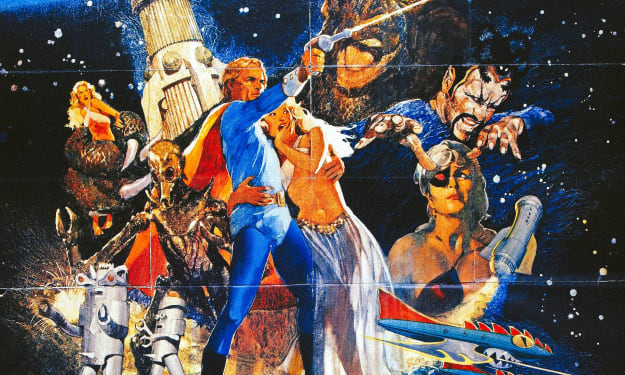
Flesh Gordon
Since aliens from outer space are constitutionally way ahead of us puny Earthlings in everything from interstellar technology to galactic government, it was merely inevitable that they should have the edge on us in the dubious field of pornography. And it was equally inevitable that America's favorite space-age hero (or a near facsimile) should go getting himself involved in battling this erotic menace from distant worlds. Such cosmic combat is the main theme in a sci-fi spoof Flesh Gordon, a Graffitti production, directed by Mike Light-Veteran and produced by Bill Osco and Howard Ziehm, who apart from producing the hardcore entertainments of Mr Light were also involved in Hollywood Blue. With the million dollars they made from these three porn movies, Messrs. Osco, Ziehm and Light decided to risk all on an X-rated space movie, the first of its kind in the world (or any other world), and the most outrageous interpretation of the science-fiction ethos since Barbarella, one of the best sci-fi cult classics of all time. Playing the principal role of Flesh Gordon is 24-year old Jason Williams, with Suzanne Fields, a 35-23-36 green-eyed blonde, as Dale Ardor, his female lead.
By Eddie Wong9 years ago in Futurism
Classic 1950s Sci-Fi Movies
Classic 1950s sci-fi movies might not have the bells and whistles of modern CGI, but what they do have is a whole lot more charm and a great deal of style! Whether you’re settling in for a late night movie marathon or trying to find something that’s just right for a lazy Sunday afternoon, whether it’s a suspenseful horror flick or an inspiring tale of space exploration, take your pick from this round up and treat yourself to one of the original greats of the genre.
By Lindsie Polhemus9 years ago in Futurism
The Sci-Fi Museum Lover's Bucket List
If you’re a true fan of science fiction, whether campy or classic, space opera or speculative fiction, Star Trek or Jules Verne, you probably can’t get enough of the worlds your favorite characters inhabit, the clothes they wear, and the technology they wield. Lucky you, because some of the most exciting artifacts and memorabilia are exhibited in carefully curated museums around the world, and the momentum is building for even more. Check out this bucket list of already-existing sci-fi museums and exhibits, then get ready for two world-class museums coming to Hollywood, California and Washington D.C. in the years to come.
By Sarah Quinn9 years ago in Futurism
Most Sadistic Cults of the 20th Century
"Don't drink the Kool-Aid" doesn't sound like such an important warning, but if the People's Temple followers in Jonestown would've been given this advice, over 900 lives would have been saved. Until September 11th, the largest loss of American civilian life occurred when cult members of the People's Temple ingested fruit punch that was laced with cyanide in a mass suicide. Cults are both fascinating and terrifying. Their mystery draws the attention of the public, but the often brutal and radical ways of cults instill fear. Some of the deadliest cults since the 1950's may not be the most well known, but their attacks were brutal, and their unconventional views attracted individuals to support their dangerous causes. As a result, when the 10:00 news asks, "Do you know where your children are?" you better hope they're not joining a cult with a 16-year-old who claims to be a 500-year-old vampire. Individuals of all ages join cults for many reasons; whether it is for friendship or identity, or as a result of pressure, people are constantly joining ranks among the masses to be part of a movement that they believe in. Since the 1930's, cults have been a primary subject in sociological study. Cults are made up of people from all walks of life, and are formed all over the world. The reasons why vary—from the belief that they themselves are vampires, to the idea that children born after 1981 must be terminated because they are evil.
By George Gott9 years ago in Futurism