
The 10,000-Year Memory: Why Microsoft’s New Glass Storage Changes Everything
We are currently witnessing an unprecedented paradox: a civilization that produces more data than any before it, yet relies on the most ephemeral storage media in history.

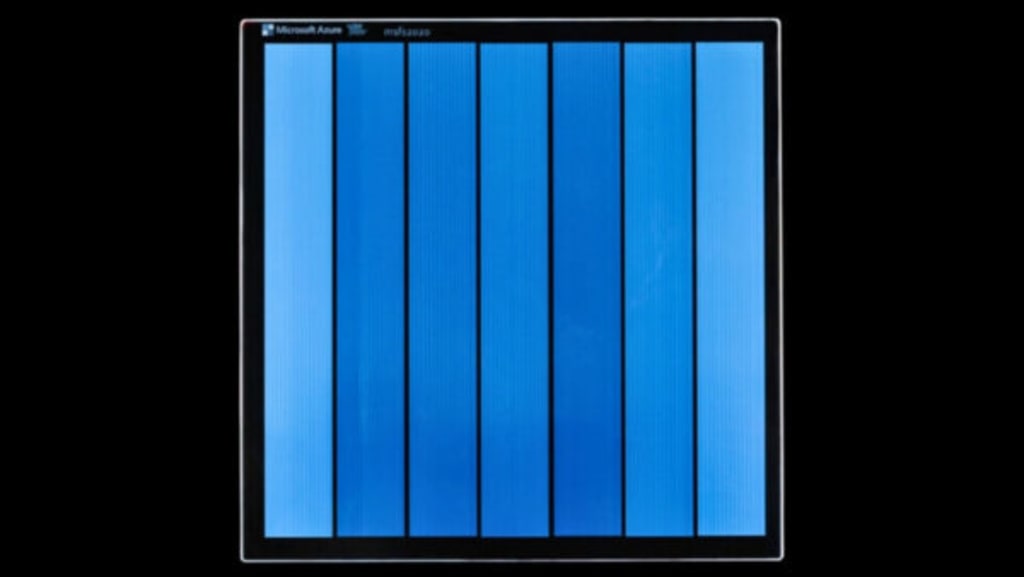
We are currently witnessing an unprecedented paradox: a civilization that produces more data than any before it, yet relies on the most ephemeral storage media in history. Our collective wisdom is currently etched onto magnetic tapes and spinning disks with lifespans measured in mere years, threatening a "digital dark age" where our history simply evaporates. We are essentially building our digital cathedral on shifting sands, constantly fighting the relentless tide of digital entropy.
Microsoft Research’s "Project Silica" offers a definitive break from this cycle of obsolescence. By utilizing a palm-sized square of ordinary glass, researchers have pioneered a method to store vast quantities of information with geological-scale permanence. This isn't just an incremental upgrade to the hard drive; it is a fundamental reimagining of how humanity might preserve its legacy across the millennia.
Beyond the Epoch: Data Stability on a Geological Scale
The most profound achievement of Project Silica is its conquest of time. Through rigorous "accelerated ageing experiments," researchers have demonstrated that data written into this medium remains stable and readable for over 10,000 years. This lifespan shifts our perspective of data from "temporary state" to "permanent record," moving away from the fragile plastics and magnetic films that have defined the last century.
This breakthrough builds on decades of optical physics, specifically the exploration of fused quartz glass. By transitioning to a material that is essentially as stable as a gemstone, we move past the era of periodic "data migration"—the costly and risky process of moving files to new hardware every decade. We are looking at a future where a library can remain silent, cold, and entirely stable without the need for constant maintenance.
"Tests suggest the data will be readable for more than 10,000 years... This vastly exceeds the lifetime of conventional archival storage media such as magnetic tape or hard drives."
The Siliceous Vault: Two Million Books in Your Palm
Project Silica achieves a staggering spatial efficiency that borders on the impossible. A single, thin square of glass—no larger than a drink coaster—can house the equivalent of two million books. This density is achieved by manipulating "voxels," tiny three-dimensional volumes less than a millionth of a meter across, allowing for a storage density of 1.59 gigabits per cubic millimeter.
The implications for our global infrastructure are transformative. Our current data centers are massive, energy-hungry monoliths that require multi-billion dollar cooling systems to prevent hardware failure. A glass-based archive, by contrast, requires zero energy to maintain once the data is written, potentially replacing sprawling server farms with compact, energy-neutral glass libraries that could fit in a standard room.
Sculpting Reality in Quadrillionths of a Second
To write data into the glass without triggering a catastrophic fracture, the system employs "ultrashort" femtosecond laser pulses. A femtosecond is one-quadrillionth of a second (10⁻¹⁵ s). To visualize this scale, consider that comparing ten femtoseconds to a single minute is like comparing one minute to the entire age of the universe.
This extreme speed is the secret to the technology’s success. The pulse is so brief that it alters the molecular structure of the glass via an intense electric field before heat has the chance to propagate and shatter the surrounding material. This process utilizes the same fundamental physics that earned the 2023 Nobel Prize in Physics for pioneers like Ferenc Krausz, signaling a major transition where theoretical "attosecond" science is finally being harnessed for industrial-grade applications.
From Cinematic MacGuffins to 5D Memory Crystals
The concept of a "5D memory crystal" has recently made the leap from the laboratory to the silver screen. In Mission Impossible: The Final Reckoning, a similar glass device is depicted as a secure vault for a sinister, god-like AI. It is a rare moment in science communication where the "bleeding-edge" reality of a lab has caught up to the most imaginative tropes of Hollywood.
However, the real-world application is far more grounded and arguably more significant. Companies like SPhotonix are already working to commercialize this "5D glass nanostructuring" developed at the University of Southampton. This isn't just a movie prop; it is a nascent industry aimed at ensuring that our most vital cultural and scientific records survive the rise and fall of the very systems that created them.
A Total Architecture for Eternal Retrieval
Project Silica’s true value lies in the fact that it is no longer just a laboratory curiosity; it is a comprehensive, end-to-end data platform. The researchers have demonstrated a full lifecycle system—from encoding and writing with "off the shelf" industrial lasers to reading the data via microscopes and applying sophisticated error correction. This maturity suggests the technology is ready for integration into our existing archival workflows.
The system balances two distinct storage strategies to meet different needs. The first uses "micro-explosions" to create void-like features for maximum density, while the second alters the refractive index for higher writing speeds—reaching approximately 65.9 megabits per second. This flexibility allows the system to be tailored for different archival priorities, whether the goal is absolute capacity or the rapid ingestion of vast historical datasets.
A Final Thought on Human Legacy
We are standing at the threshold of a new era in human record-keeping. As ultrafast photonics matures and the complexity of high-speed lasers continues to decrease, the cost of permanence will fall. We are moving from a world of "temporary digital storage," where we must choose what to save every few years, to a world of "permanent archival memory."
This shift invites a profound philosophical reflection. In an age where we can finally preserve everything, the burden shifts from the how to the what. If our digital footprints are destined to outlast the very buildings we inhabit, what data is truly worth preserving for the next 10,000 years? We are finally building a mirror that will reflect our image to the distant future; the question remains what that reflection will show.
About the Creator
Mohammad Hamid
Big Dream Work Hard and Achieve 💪
Keep reading
More stories from Mohammad Hamid and writers in Futurism and other communities.
Apple’s 2026 Gamble: Why the Foldable iPhone is Arriving Sooner—and Riskier—Than Expected
For years, the prospect of a foldable iPhone has been the industry’s most persistent "ghost in the machine"—a device perpetually two years away, floating in a limbo of patent filings and supply chain rumors. Market observers long assumed Apple would maintain its characteristic "wait-and-perfect" stance, delaying entry until folding displays reached a level of durability and seamlessness that mirrors a static glass sheet. However, recent data regarding manufacturing schedules suggests an aggressive shift in strategy, indicating that Apple has moved past the stage of cautious experimentation.
By Mohammad Hamida day ago in Futurism
Web 3.0 Blockchain Market Outlook: Decentralized Internet Evolution and Growth Opportunities
According to IMARC Group's latest research publication, The global web 3.0 blockchain market size was valued at USD 5.3 Billion in 2025. Looking forward, IMARC Group estimates the market to reach USD 107.8 Billion by 2034, exhibiting a CAGR of 39.77% during 2026-2034.
By Michael Richard3 days ago in Futurism
Australia Cyber Insurance Market: Risk Exposure, Digital Adoption & Regulatory Frameworks
According to IMARC Group, the Australia cyber insurance market reached USD 467.1 Million in 2025 and is projected to expand to USD 1,994.3 Million by 2034, exhibiting a strong compound annual growth rate (CAGR) of 17.50% during 2026–2034. This rapid growth reflects escalating cyber risk exposure across businesses and institutions in Australia. As digital transformation accelerates—driven by cloud computing, mobile workforces and data-driven operations—organizations face increasing vulnerability to ransomware, phishing attacks and data breaches. Cyber insurance is emerging as a critical financial risk management tool, providing coverage for business interruption, regulatory fines, forensic investigations and reputational damage.
By Kevin Cooper6 days ago in Futurism
The Cairn Beside the Lake
And so it came to pass that King Ertharion, Tenth King of Lombaia, stood beside the still lake below unrelenting and unassailable cliffs with the remainder of his harried host. In what was the tenth year of his reign and his forty-fourth upon this great green earth, Menigo the Betrayer, cousin of King Ertharion, pressed home his false claim.
By Matthew J. Fromm3 days ago in Fiction




Comments
There are no comments for this story
Be the first to respond and start the conversation.