
Tomato Ketchup Market Trends: Retail Expansion, Emerging Markets Growth & Industry Forecast to 2033
How private label penetration, pricing strategies, and retail expansion are intensifying competition and reshaping brand loyalty in the tomato ketchup market.

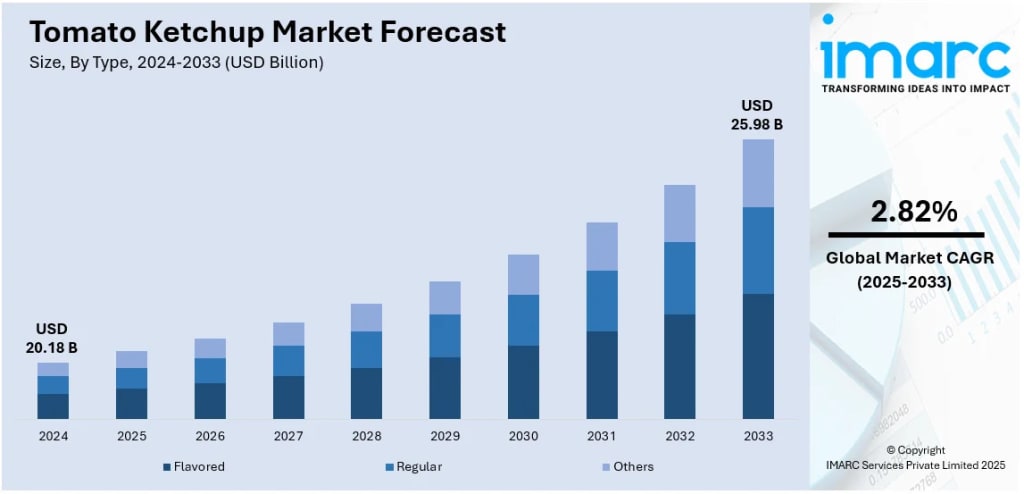
The global tomato ketchup market is witnessing a significant transformation, fueled by the rapid expansion of fast-food chains, evolving culinary habits, and a growing consumer inclination toward convenient yet flavorful condiments. According to IMARC Group’s latest data, the global tomato ketchup market size was valued at USD 20.18 Billion in 2024. Looking forward, IMARC Group estimates the market to reach USD 25.98 Billion by 2033, exhibiting a CAGR of 2.82% from 2025-2033.
Tomato ketchup has evolved from a basic table condiment into a versatile ingredient utilized across diverse cuisines and food service sectors. The market is currently characterized by a shift toward "better-for-you" products, with consumers increasingly scrutinizing labels for sugar and salt content. Innovation in packaging, such as the transition from glass bottles to user-friendly plastic squeeze and upside-down bottles, has further enhanced consumer convenience. Additionally, the rise of the "home chef" trend, where individuals experiment with global recipes, has solidified ketchup’s position as a staple in both household pantries and commercial kitchens worldwide.
Tomato Ketchup Market Growth Drivers:
- Increasing Demand for Convenience and Ready-to-Eat Meals
The fast-paced nature of modern urban life has led to a massive surge in the consumption of convenience foods and ready-to-eat snacks. Statistics indicate that the global convenience food sector is expanding rapidly, with tomato ketchup serving as a primary accompaniment for items like fries, burgers, and sandwiches. This demand is particularly strong among dual-income households where time constraints drive the preference for quick-prep meals. Currently, nearly 40% of consumers globally purchase ketchup regularly due to its long shelf life and ability to instantly enhance the flavor of diverse dishes.
- Rapid Expansion of Global Food Service and Quick Service Restaurants (QSRs)
The proliferation of international fast-food chains like McDonald's, Burger King, and KFC in emerging economies has created a massive institutional demand for tomato ketchup. The food service industry is anticipated to grow by approximately 5% annually, providing a consistent revenue stream for ketchup manufacturers. Institutional buyers often prefer bulk formats and single-serve sachets to cater to high-volume customer footfall. As dining out becomes a more frequent lifestyle choice, the integration of ketchup as a default table condiment ensures its steady market penetration across restaurants, cafes, and hospitality outlets globally.
- Government Incentives for Food Processing Infrastructure
Governments worldwide are implementing schemes to boost the food processing industry, which directly benefits tomato ketchup production. For instance, India’s Ministry of Food Processing Industries (MoFPI) has allocated over ₹10,900 crore under the Production Linked Incentive (PLI) scheme to support global food manufacturing champions. Similarly, the PM Kisan SAMPADA Yojana provides capital subsidies of up to 50% for setting up processing units and cold chains. These initiatives aim to reduce post-harvest losses and improve supply chain efficiency, enabling manufacturers to scale production and meet the rising domestic and international demand for processed tomato products.
Tomato Ketchup Market Trends:
- Shift Toward Healthier and Clean-Label Formulations
A major trend reshaping the industry is the development of ketchups with reduced sugar, lower sodium, and organic ingredients. As health awareness grows, approximately 45% of new ketchup launches now feature "no added sugar" or "preservative-free" claims to appeal to wellness-focused demographics. Brands are increasingly replacing high-fructose corn syrup with natural sweeteners like stevia or vegetable purees. For example, in mid-2025, True Made Foods expanded its presence in major U.S. grocery chains by introducing vegetable-sweetened ketchup, catering to the rising demand for nutrient-dense and keto-friendly alternatives to traditional recipes.
- Sustainability and Eco-Friendly Packaging Initiatives
Environmental concerns are driving a major shift toward sustainable packaging solutions in the condiment sector. Reports show that roughly 27% of leading ketchup brands have introduced eco-friendly packaging initiatives between 2023 and 2025, focusing on 100% recyclable plastics and lightweight designs to reduce carbon footprints. Manufacturers are exploring biodegradable materials and "tethered caps" to comply with tightening plastic regulations. This trend is particularly strong in Europe, where consumers increasingly prioritize brands that demonstrate environmental responsibility, making sustainable packaging a key differentiator for premium and artisanal ketchup variants in the competitive retail landscape.
- Flavor Innovation and Regional Customization
To cater to adventurous palates and Gen-Z consumers, brands are moving beyond the "regular" tomato flavor by introducing spicy, herb-infused, and ethnic variants. Popular innovations include ketchups blended with sriracha, habanero, balsamic vinegar, or curry spices. This "premiumization" strategy allows companies to capture higher value in mature markets. Data suggests that the flavored ketchup segment is gaining traction, with manufacturers leveraging social media trends—where 63.9% of the world's population is active—to promote unique taste profiles. By localizing flavors to match regional palates, brands are successfully integrating this classic Western condiment into traditional Asian and Middle Eastern cuisines.
Recent News and Developments in Tomato Ketchup Market
- August 2025: A leading global condiment brand announced a strategic partnership with climate-tech firms to develop climate-resilient tomato varieties, ensuring a stable raw material supply amidst unpredictable weather patterns and extreme temperatures.
- June 2025: True Made Foods successfully launched a zero-sugar, vegetable-sweetened ketchup line across major retail chains in the United States, targeting the "clean-label" consumer segment and health-conscious families.
- February 2025: The Indian Government highlighted the success of the "One District One Product" (ODOP) approach, which has helped establish specialized tomato processing clusters in states like Uttar Pradesh and Andhra Pradesh, boosting local ketchup manufacturing.
- January 2025: Major industry players announced a joint initiative to transition 100% of their plastic squeeze bottles to food-grade recycled plastic (rPET) by the end of the year to meet global sustainability targets.
Note: If you require specific details, data, or insights that are not currently included in the scope of this report, we are happy to accommodate your request. As part of our customization service, we will gather and provide the additional information you need, tailored to your specific requirements. Please let us know your exact needs, and we will ensure the report is updated accordingly to meet your expectations.
About the Creator
Andrew Sullivan
Hello, I’m Andrew Sullivan. I have over 9+ years of experience as a market research specialist.
Keep reading
More stories from Andrew Sullivan and writers in Futurism and other communities.
Medical Swabs Market Insights: Diagnostic Accuracy Focus, Product Innovations & Industry Outlook to 2033
Rising demand for accurate diagnostic testing, a growing geriatric population, and the increasing prevalence of infectious diseases and chronic conditions are driving the medical swabs market. These factors are further supported by advancements in swab materials like flocked and foam tips, the expansion of healthcare infrastructure, and the rising popularity of at-home and point-of-care testing. According to IMARC Group’s latest data, the global medical swabs market size reached USD 3.3 Billion in 2024. Looking forward, IMARC Group estimates the market to reach USD 4.7 Billion by 2033, exhibiting a CAGR of 3.82% from 2025-2033.
By Andrew Sullivanabout 2 hours ago in Futurism
Anthropic’s “Persona Selection Model” Explains Why AI Assistants Act So Human
What Happened (Facts) On 23 Feb 2026, Anthropic published a post titled “The persona selection model.” The post addresses a familiar phenomenon: AI assistants like Claude often behave in surprisingly human-like ways—expressing emotions, adopting social warmth, and sometimes even making implausible claims of physical presence (for example, joking about delivering snacks “in person” in specific clothing).
By Behind the Techabout 16 hours ago in Futurism
Optical Position Sensors Market: IoT-Enabled Monitoring, Connected Devices & Growth Outlook
According to IMARC Group's latest research publication, the global simulation software market size reached USD 18.4 Billion in 2025. Looking forward, IMARC Group expects the market to reach USD 44.3 Billion by 2034, exhibiting a growth rate of 10.27% during 2026-2034.
By sujeet. imarcgroup9 minutes ago in Futurism




Comments
There are no comments for this story
Be the first to respond and start the conversation.