
An Important Distinction
Because I have too much time on my hands and haven’t stretched my philosophy brain in a while :)

So, you want to experiment with a little bit of existentialism?
You've seen the videos and heard the discussions, if discussions they can be called, and now you think you're ready to begin. Well, I'm sorry to gatekeep, but there are some important things you need to know. Nothing mental, just a few safety guidelines to ensure that you, and those around you, are protected from the risks of inexpert existentialistic navel gazing.
That dread is a wonderful thing! Don't get me wrong. But not everyone can handle it the same, and all gatherings should have a designated sane person to provide some much needed guidance. Or a sharp reminder that, "it's not that deep, bro." Even when it is that deep, which is always.
Now, what is existentialism you might ask? And that question would be perfectly reasonable. It's the kind of thing one often hears about but rarely has explained.
In brief, existentialism is the philosophical study of existence. Famously including the phrase "cogito ergo sum" as originally pontificated by Rene Descartes (though this is closer to epistemology if we’re being technical) and expanded in many respects by German philosopher Friedrich Nietzsche. Our modern conception of it was largely influenced by 20th century French philosophers such as Albert Camus (The Stranger and the Myth of Sysiphus), Jean-Paul Sartre (Existentialism is a Humanism), Franz Fanon (the Wretched of the Earth), and Simone De Beauvoir (The Ethics of Ambiguity).
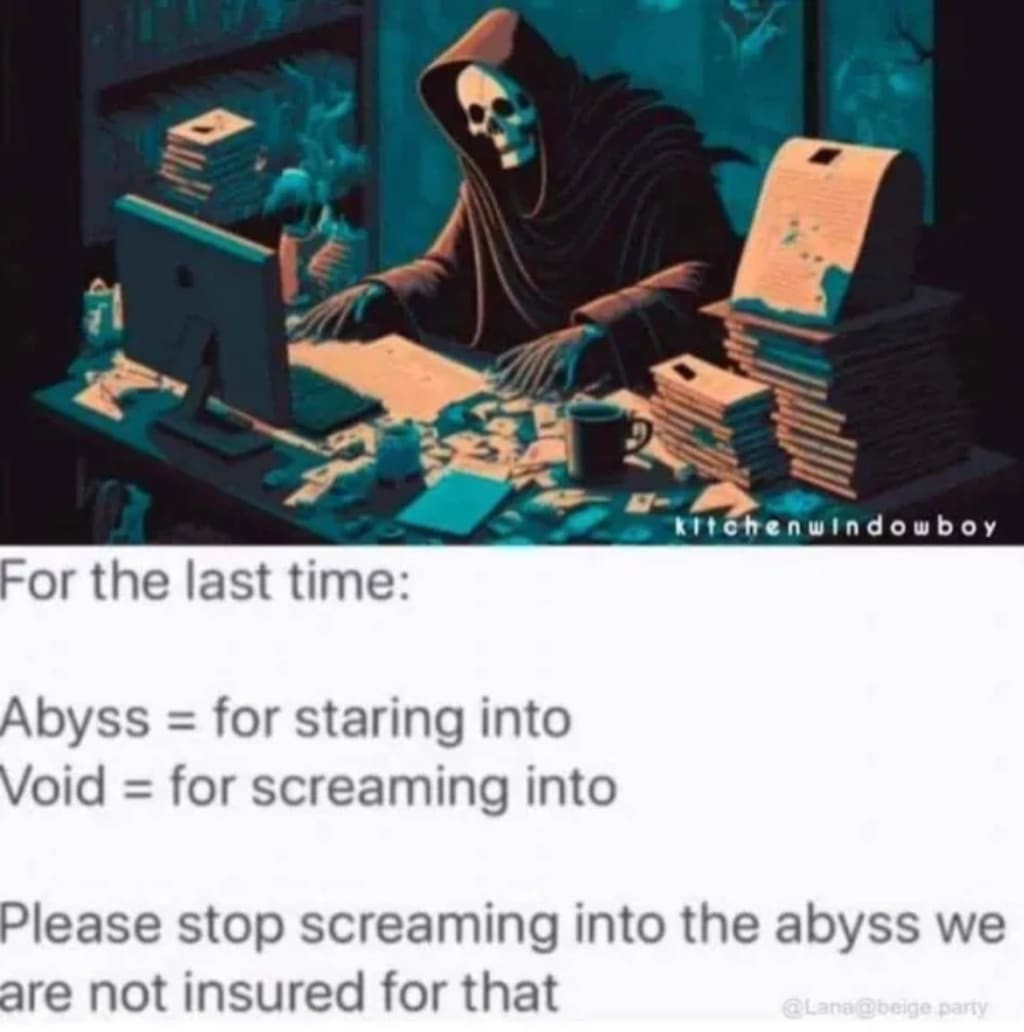
Sadly, I must ask for your attention to remain on me. Yes, the word "philosophical" is going to make some people roll their eyes - considering that it is often called the art of saying as little as possible in as many words as possible - but it is important. Existential dread, and the glorious voids and abysses mentioned in the cover image, are closely related to the academic study of existentialism. But luckily for the novel existentialist, study is not required.
Even more luckily for lapsed philosophers like me, one does not need to read books written by famous dead people to engage in existential examination. Nor yet in the crushing awareness of one's own existence and the absurdity of said.
Now, then, on to the meat of things.
As referenced in the meme above, there are two distinct places central to the practice of existentialism and thus the responsible enjoyment of existential dread. These places must maintain their distinctions for insurance reasons, obviously, but also for the sake of the budding philosopher's mind and health. It is reasonable to assume that the two are inter-changeable, however, that assumption has led to the unfortunate end of many a navel-gazing expedition.
Not to say that all persons involved perished. Far from it. However, one might consider them dead if they, as a result of misunderstood location, cease to examine their life. As footwear's greatest thinker Socrates said, "the unexamined life is not worth living."
But what is the void, what is the abyss, and why must they not be confused? After all, the two are frequently used interchangeably and for the most part, no one is hurt as a result. Right? Yes and no. Simply because something CAN be used interchangeably does not mean that one SHOULD do so. Leaving aside the squawking of logicians who would credibly claim I am wrong in this instance.
For the sake of maintaining consistency with the cover image of this article, I shall begin by endeavouring to explain the abyss. You see, it is for staring into, not screaming into. And there is a simple explanation as to why this distinction must be maintained - that reason being insurance.
You see, the abyss is not empty. For if you stare long enough into it, it will stare back into you. There is something therein contained, but whether that something is the great Cthulhu or your own depraved nature is yet to be determined. By screaming into the abyss, one draws the attention of the creature, the ID, the something that hides in the dark.
That writhing, churning mass of something waits there, and if given the breath of that scream there is every chance that it will crawl or slither or walk out. And thus become the problem of all those outside the abyss. I’m sure you can see why that would be a challenge vis a vis insurance. If every half-trained existentialist draws something from the abyss, can you imagine the mess we would be in?
Thinking in terms of conservation, we have no idea how much something Is even left down there. Considering how common the confusion between void and abyss is, we must ensure that our efforts to better understand our existence - or at least, to deal with our own awareness of said existence - continue as sustainably as possible.
For the good of all humankind.
And now we come to my personal favourite place for concerts. Allow me to explain the beautiful, lonely, isolated horror of the void. And, more importantly, why it is not for gazing but rather for screaming. The reason is very simple, and, gratifyingly, with serve to explain both.
The void is empty. It is nothing. It is everything. The void is the space between reality and fiction, where sound does not exist. Unlike where one might scream into the abyss, and thereby awaken something, one can scream into the void and receive nothing.
According to the marketing for Ridley Scott’s Alien, and basic astrophysics, in space, no one can hear you scream. The void is an eternal and infinite emptiness into which all things vanish without a trace. If one were to scream into it, the sound then ceases to exist. That is its role in existentialism, it is the awareness of nothing.
From the Christian (Catholic?) refrain “mortal thou art dust. And unto dust thou shall return,“ we gain a base-level understanding of the void. Assuming, of course, that the aspiring existentialist abstracts their thinking to suit it. The void is that from which we spring, and into which we fall - in the meantime, it is the place where our screams go to be unheard.
Often times in frustration, we might say that we are screaming into the void when we are not heard. Or else, when we are ignored. And however true that might be, it is incomplete when attempting to understand our existence In relation to the void.
There is no thing that gazes back at us from the void, no thing that can rise from it to meet or consume us. In screaming into it, we release the tension from what some choose to call our souls, knowing that we can never be answered. It takes in and consumes all that we cast into it, and whatever we throw will never encounter another thing through the whole of time, if time can be said to exist therein.
Sadly, that is likewise why our insurance does not cover gazing into the void. You see, in order to gaze, we must have something to rest our eyes upon, and the void is nothing. It is empty space, however, that is not a complete description. Empty is a word that requires some variant of “full” to exist in contrast to, and the void is just that. Void, vacuum, that thing which nature abhors - it both exists and does not exist.
Those who gaze into the void, the place that is not a place, the thing that is not a thing, often find themselves seeing something but unlike the abyss, that something is purely imagined and does not exist. It has never and will never exist. Because he void does not really exist. It is the nothingness without comparison to the “somethingness” that makes up reality.
And if one is not careful, then one might slip into it and be lost. That is why we do not gaze into the void, except in special circumstances and only when properly trained as existentialists. Unlicensed gazing has a bad habit of consuming the one doing the gazing.
By directing one’s attention to the void, by meditating on it as one might to the abyss, one runs the very serious risk of falling into that nothing. Not to say that one might wholly disappear, in a physical sense, though that has been suspected to happen on occasion; rather, one might fall victim to true nihilism.
Nihilism has a bad reputation. Most persons think of it as the depressing, studied belief in nothing - not to be confused with believing nothing you must understand, but rather the belief in nothing. That nothing is, nothing was, nothing matters, nothing will ever be.
Positive nihilism can most efficiently be described as “nothing matters :)” and that smiley face is important. Negative nihilism can likewise be described as “nothing matters :(“ and that frowney face is important. The former allows for importance to be defined wholly by the thinker engaging with the thought - for their own life to be wholly defined by their own reason. While the latter does not allow for any significance or importance, and could lead to… untimely ends.
True nihilism, the belief of the void, on the other hand can have no positives. It is like the void itself, and most often is the reason why we lose so many aspiring existentialists to it. Thus raising our insurance rates To unsustainable levels and giving all of us who think too much a bad name.
The abyss will answer if screamed into, it will rise up and take action against those who treat it wrongly. The something contained therein is dangerous if awakened. The void will never answer, can never answer, does not even exist as we understand existence to work - it is theoretical and to be approached only with greatest caution. The unwary existentialist might, in their untrained folly, imagine something, anything to answer from the void. And in so doing, become lost to it themselves, where only the sound was meant to go.
And now I hope you understand why the abyss is for gazing into but never screaming, and the void is for screaming into but never gazing.
Good luck to all aspiring existentialists out there! And when next you engage with the void, tell it Alex sent you. It won’t matter and no one will notice, how fun is that? :)
About the Creator
Alexander McEvoy
Writing has been a hobby of mine for years, so I'm just thrilled to be here! As for me, I love writing, dogs, and travel (only 1 continent left! Australia-.-)
"The man of many series" - Donna Fox
I hope you enjoy my madness
AI is not real art!
Keep reading
More stories from Alexander McEvoy and writers in FYI and other communities.
A Failed Artist, A Disillusioned Poet, An Underpaid Game Show Host
I took my son and niece to Gori, a small town in Georgia where Joseph Stalin was born. They talked me into visiting the Stalin's Museum, the largest in the post-Soviet space. I had resisted going there because I just can't stand the monster and know enough about him, or so I thought.
By Lana V Lynxabout a month ago in FYI



Comments (3)
I shall remember to stare into the abyss and screen at the void to avoid attracting the attention of things we don’t want attracted
Excellent article Alexander - I studied some ethics during my college days and my personal philosophy is one of optimistic nihilism - nothing matters so we can assign meaning to whatever we choose! What d'ya think?
Perhaps the thing in the abyss is just waiting to be stared at with love and affection. That any chthonic creature are just really big puppies waiting to be adopted. Either way, loved this and thanks for the lesson!