Latest Stories
Most recently published stories in FYI.
Clubbers Return To Liverpool Music Scene To Test Effect Of Removing Restrictions
As part of UK Prime Minister Boris Johnson's road map to releasing the Covid 19 lockdown, a number of events were arranged in Liverpool over the weekend to analyse the impact of holding mass events with no restrictions now that most people in the UK have had at least one dose of a Covid 19 vaccine. The events that had been arranged included a number of large music events across the city of Liverpool which people could attend with out the need for social distancincing or wearing face coverings.
By Ashish Prabhu5 years ago in FYI
MYTHICAL SERPENTS(DRAGON) THROUGH HISTORY
The Dragon has had a significant impact in legends and religions since pre-noteworthy occasions. The historical backdrop of mythical beasts returns in any event 6,000 years, and there are winged serpent stories and legends from each landmass with the exception of Antarctica. In pretty much every culture, and all from the beginning of time, there are accounts of these legendary and mysterious animals called winged serpents. Various individuals have different hypotheses of why such countless societies grew a durable faith in mythical serpents; be that as it may, none can really be demonstrated.
By SAMRAT(CYBER-FACTY)5 years ago in FYI
Explore Your Subconscious with the Ganzfeld Effect: A Tutorial
Perfectly normal hallucinations Psychosis is thought to be a continuum, encompassing benign levels of perceptual aberrations, magical thinking and a tendency to see hidden meaning in innocuous stimuli (the face of Jesus in your toast), and, at the extreme end, the ravages of full-blown psychosis as experienced in schizophrenia (Lenzenweger, 2018).
By Angela Volkov5 years ago in FYI
All My Favourite Poisons
As a child, I wanted to be a chemist. These days, the sole vestige of my interest in chemistry is my slightly disquieting obsession with poison. A friend visiting my apartment for the first time declined my offer of a glass of water stating, ‘You have four books on poisons’. Wrong. I have five books on poisons.
By Angela Volkov5 years ago in FYI
Culturally Appropriate: Steal These Traditions to Improve Your Life
Christmas in Japan: when is appropriation merely appreciation? The world knows no greater evil than a White girl in a cheongsam-inspired prom dress or a non-Dutch person in Dutch braids (also known as Boxer braids and often worn by people who aren’t pugilists). I, too, have been the victim of cultural appropriation while in Japan during the holiday season, forced to endure “Christmas” sponge cakes smothered with strawberries, fried chicken vendors on every street corner, and what appeared to be the conflation of the good Colonel with Jolly Old Saint Nick. (Japanese people eat KFC to celebrate Christmas — go figure!)
By Angela Volkov5 years ago in FYI
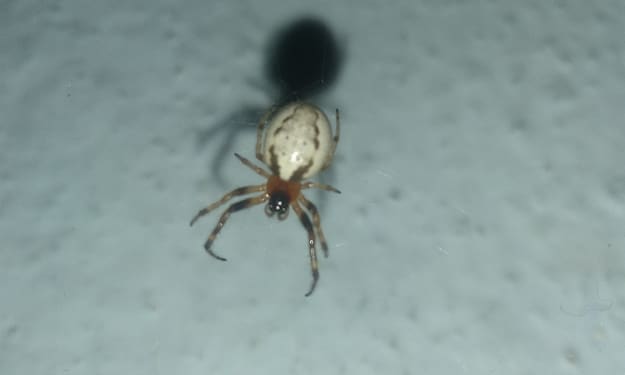
Spider insects
Start writing... Spiders are among the most prevalent household pests, crawling their way into two out of three American homes. At the same time, the most common creature-based phobia in the world is arachnophobia, the fear of Spiders. So, when most homeowners spot one, they tend to employ the nearest form of DIY pest control –a vacuum or shoe.But a few fearless folks adopt a live-and-let-live motto, hoping to enjoy some of the good that Spiders do. If seeing one dangling in a web or scurrying across the floor doesn't make you shudder, you might want to share your home with a few.One word of caution: It's always best to avoid touching a Spider. While they never actively seek human contact, they will bite if they feel threatened or endangered. Their venom causes reactions that differ from species to species and person to person. Symptoms of a bite may include a stinging sensation, red mark, localized swelling or an injury requiring hospitalization. Consult your doctor if you have a concern.Before you squish the next Spider you see, consider how this eight-legged wonder might improve your life.They eat pests.Spiders feed on common indoor pests, such as Roaches, Earwigs, Mosquitoes, Flies and Clothes Moths. If left alone, they will consume most of the insects in your home, providing effective home pest control.They kill their own kind.When Spiders come into contact with one another, a gladiator-like competition frequently unfolds –and the winner eats the loser. If your basement hosts common Long-Legged Cellar Spiders, this is why the population occasionally shifts from numerous smaller individuals to fewer, larger ones. That Long-Legged Cellar Spider, by the way, is known to kill Black Widows, making it a powerful ally.They help curtail disease spread.Spiders feast on many household pests that can transmit disease to humans –Mosquitoes, Fleas, Flies, Cockroaches and a host of other disease-carrying critters.Seasonal Appearances.General Features.Spiders range in body length from 0.5 to about 90 mm (0.02–3.5 inches). The largest spiders are the hairy mygalomorphs, commonly referred to as tarantulas, which are found in warm climates and are most abundant in the Americas. Some of the largest mygalomorphs include the goliath bird-eating spider (Theraphosa leblondi or T. blondi), found in parts of the Amazon, and the pinkfoot goliath (T. apophysis), limited to southern Venezuela. The smallest spiders belong to several families found in the tropics, and information about them first became known in the 1980s.Female spiders generally are much larger than males, a phenomenon known in animals as sexual size dimorphism. Many female orb weavers, such as those in the families Tetragnathidae and Araneidae, show extreme size dimorphism, being at least twice the size of males of the same species. The extreme difference in body size appears to have arisen through selection processes favouring fecundity in females and “bridging” locomotion in males. Bridging is a technique used by spiders for orb web construction; the spider produces a silk thread that is carried by the wind and becomes attached to an object, forming a bridge. Small, light males can build and traverse silk bridges more rapidly than larger, heavier males can. Scientists suspect that this gives small males more mating opportunities, thereby favouring selection for their small size.Distribution..Spiders are found on all continents (except Antarctica, although spider fragments have been reported there) and at elevations as high as 5,000 metres (16,400 feet) in the Himalayas. Many more species occur in the tropics than in temperate regions. Though most spiders are terrestrial, one Eurasian species is aquatic and lives in slow-moving fresh water. There are a few species that live along shores or on the surface of fresh or salt water.Small spiders and the young of many larger species secrete long silk strands that catch the wind and can carry the spiders great distances. This behaviour, called ballooning, occurs in many families and expedites distribution. Some species are distributed in this way around the globe within the bounds of the northern jet stream. Ballooning spiders drift through the air at heights that range from 3 metres (10 feet) or less to more than 800 metres (2,600 feet).Importance.
By Zarinabanu Zarinabanu5 years ago in FYI
What Is The Role Of The Kidney In Blood Pressure Regulation?
The kidney plays a role in hypertension. A researcher published to date about 200 years ago is known that abnormalities in the production of urine by the kidney alter the blood in a way that increases vascular resistance, leading to high blood pressure. And the enlarged heart is mass. Several years later, Harry Goldblatt induced fatal hypertension in dogs by rupturing one of the renal arteries.
By Mustafa Rangoonwala5 years ago in FYI
Jean-Henri Riesener, cabinet-maker to French kings
Jean-Henri Riesener was one of the finest cabinet-makers of his age, which, unfortunately for him, coincided with the French Revolution. The opulence that he played a major role in creating was fine for the court of King Louis XVI and Marie Antoinette, but when his aristocratic customers lost their heads, or at least their fortunes, his own fortune went downhill with theirs and he eventually died in poverty.
By John Welford5 years ago in FYI