
Mexico Is At War
After El Mencho’s death, Mexico erupts in cartel violence

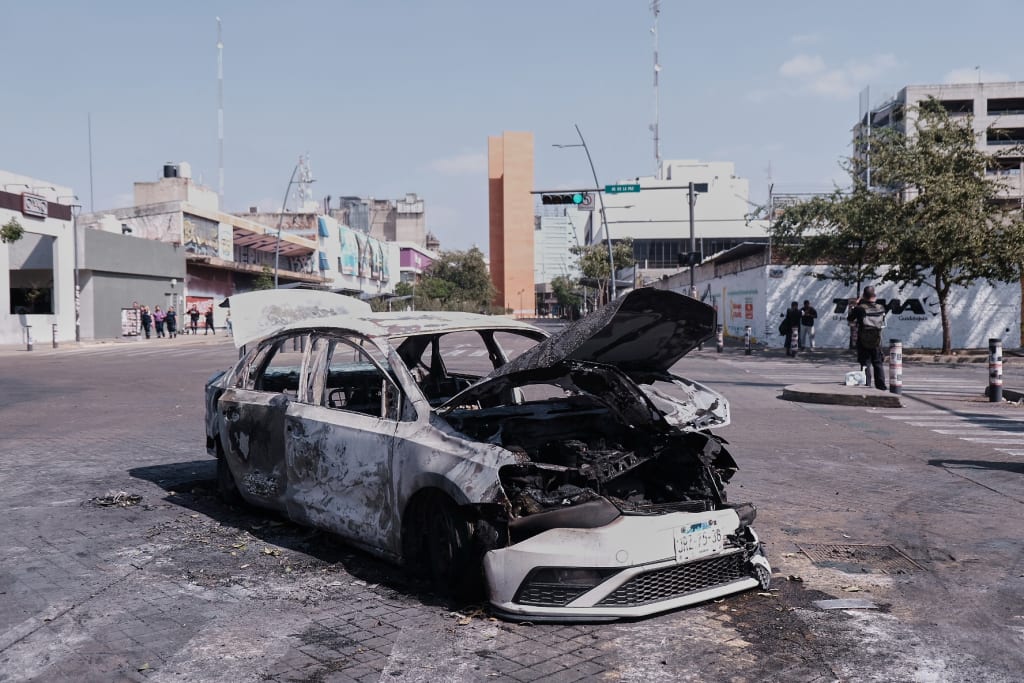
“Terrifying.” “Surreal.” “Scary.”
Those were the words an American tourist used to describe what unfolded in Puerto Vallarta, the resort city so many travelers associate with beaches, nightlife, and cruise ships—not burning vehicles and military convoys.
But on Sunday, paradise looked like a war zone.
Videos circulating on national outlets showed gas stations engulfed in flames, helicopters circling overhead, and armed government forces riding in the backs of pickup trucks. Another clip appeared to show gunmen firing from a moving vehicle as they sped toward a confrontation. Streets that had been crowded with tourists just hours earlier were suddenly empty—smoke rising where vacation photos had been taken that morning.
And this wasn’t isolated.
According to reporting from outlets like The New York Times, much of the violence also erupted in Guadalajara, the capital of Jalisco, more than 300 kilometers away. Attacks were reported in more than ten other states. In total, Mexican authorities later confirmed over 250 roadblocks across 20 states. That’s not unrest. That’s paralysis.
So what triggered this nationwide meltdown?
The death of one man: Nemesio Oseguera Cervantes, better known as “El Mencho,” founder and leader of the Jalisco New Generation Cartel (CJNG).
For years, El Mencho was considered Mexico’s most powerful cartel boss, especially after the arrest of Joaquín Guzmán in 2016. He was elusive, strategic, and brutal—one of the last narco figures to command both fear and myth in equal measure.
His death came during a February 22, 2026 operation in Tapalpa, Jalisco. Mexican special forces reportedly launched a coordinated raid, facing heavy gunfire before killing four cartel members and injuring Oseguera, who later died while being transported to Mexico City. Authorities seized armored vehicles, rocket launchers, and high-powered weapons. U.S. intelligence reportedly assisted in the operation.
On paper, it was a massive win in the war on drugs.
In reality, it ignited an inferno.
Armed cartel members seized highways, torched buses, blocked airports, and forced civilians out of vehicles at gunpoint. In Guadalajara, panic swept through the international airport as travelers hid behind counters. In multiple municipalities, coordinated arson attacks targeted banks and businesses. National Guard members were killed. Officials were assassinated. Prison riots broke out.
The message was unmistakable: even without its leader, CJNG could still bring Mexico to its knees.
And here’s what makes that threat credible—CJNG isn’t just violent. It’s structured.
Unlike traditional cartels, the organization reportedly operates with a franchise-style model. Local criminal groups pay tribute for the right to use the CJNG brand. Regional commanders manage daily operations, but strategic control flows from the top. It’s decentralized enough to survive disruption, yet centralized enough to coordinate national retaliation.
That model helps explain how the death of one man triggered coordinated chaos across dozens of states.
But what happens next?
Historically, kingpin removals don’t end drug trafficking. The fentanyl supply chain doesn’t depend on a single individual. Cartels import precursor chemicals, operate clandestine labs, and move product through hundreds of routes. Remove one leader, and either a successor consolidates power—or the organization fractures, often leading to even more violence.
CJNG now faces both possibilities.
With Oseguera’s brothers imprisoned and his son serving a life sentence, there’s no obvious heir. That could mean internal power struggles. It could mean splinter factions. Or it could mean a new leader emerges quickly to maintain cohesion.
Rival groups—especially the Sinaloa cartel—will be watching closely.
Meanwhile, the broader implications are enormous. Guadalajara is scheduled to host matches for the 2026 FIFA World Cup. Jalisco officials expected over a million visitors. Instead, airlines canceled flights. Tourists sheltered in place. Travel advisories spread across multiple countries.
Economically, the stakes are massive. Politically, the pressure is just as intense.
Was this a decisive blow against one of the world’s most powerful traffickers? Absolutely.
Did it weaken the drug trade? That’s far less certain.
What is certain is this: Mexico’s cartel war didn’t end with El Mencho’s death. If anything, a new chapter just began.
About the Creator
Lawrence Lease
Alaska born and bred, Washington DC is my home. I'm also a freelance writer. Love politics and history.
Keep reading
More stories from Lawrence Lease and writers in FYI and other communities.
What Your Airplane Seat Says About You
Picking your seat on a plane isn’t just logistics—it’s psychology. People refresh seat maps like stock tickers, check SeatGuru obsessively, and even pay extra just to lock in a specific spot. Why? Because air travel strips away most of your control. Your schedule, your space, your comfort—it’s all dictated by the airline. Your seat becomes the one decision that’s truly yours.
By Lawrence Lease8 days ago in FYI
Boundless
A geographical map could take you there. To the places I've been, to the sights I've seen, to the landscapes I've climbed. But no compass could point you in the direction of my memories. To the experiences I've lived, to the happiness I've felt, to the wonder I've held so close to my heart.
By Alyssa Musso2 days ago in Writers



Comments
There are no comments for this story
Be the first to respond and start the conversation.