
“Travel Ban” in NYC
What No One Tells You About Being an Essential Worker on the Road

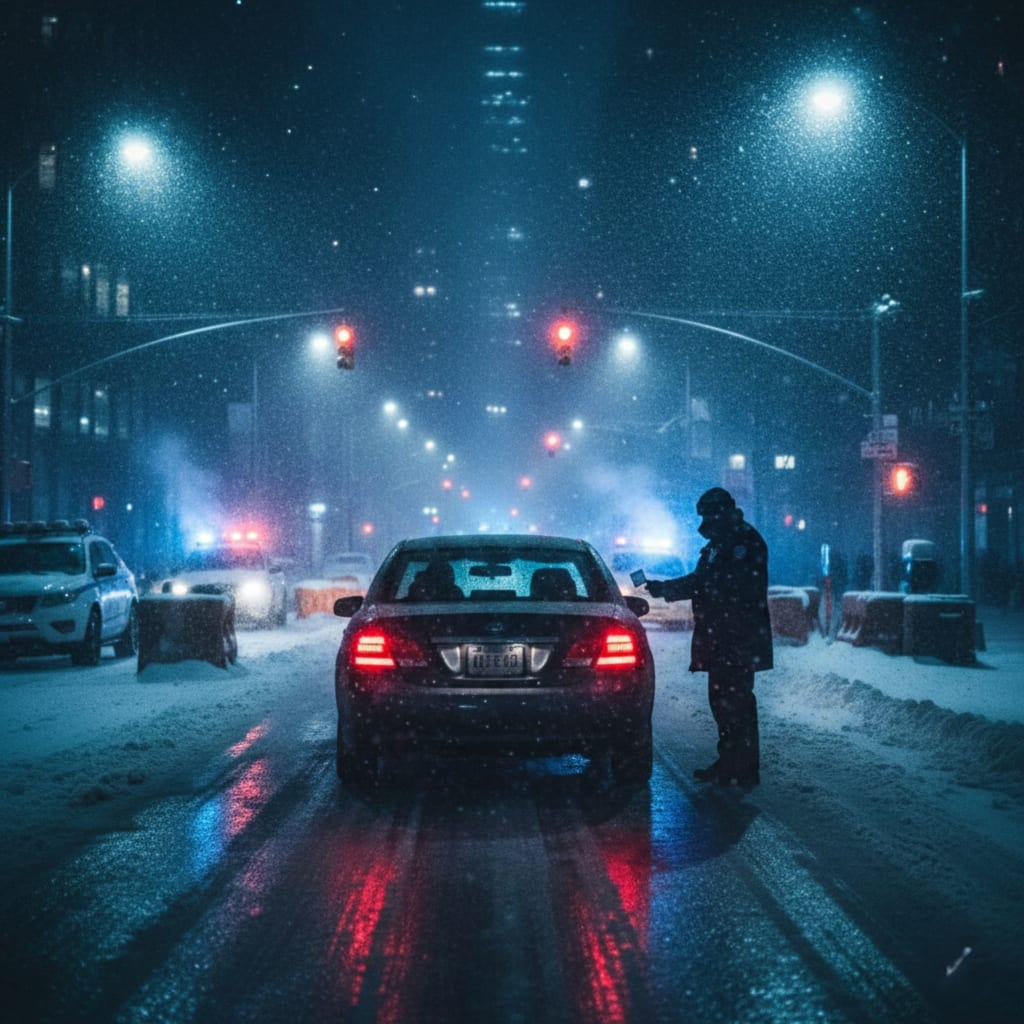
Who’s actually allowed to drive, what proof you really need, and what it feels like when your job depends on a cop’s decision at 2 a.m.
The first time a squad car slid in behind me on an empty Brooklyn avenue during a travel ban, my hands started sweating before the lights even flashed.
The streets were dead quiet under a hard, sideways snow. A storm big enough for a mayoral press conference, big enough for those all-caps alerts: “NYC TRAVEL BAN IN EFFECT. NON-ESSENTIAL VEHICLES PROHIBITED.”
And there I was, hazard lights blinking, a trunk full of equipment, technically “allowed” to be there… but still very aware that all it would take was one officer who didn’t agree.
I remember thinking: I know I’m essential. But do they? And how do I prove it in thirty seconds on the side of the road?
That’s the part nobody explains when the news headlines scream “TRAVEL BAN” and the city goes half-dark.
The rules sound simple—“essential workers are exempt”—until you’re the one behind the wheel, trying to figure out whether your laminated ID and a half-charged phone count as a legal argument.
This is for you if you’ve ever had to make that drive. Or if you might, and you don’t want to be guessing when it matters.
What “NYC Travel Ban” Actually Means When You’re Behind the Wheel
NYC throws around a bunch of different phrases whenever the weather or an emergency hits: travel advisory, hazardous travel, travel restrictions, travel ban.
They don’t all mean the same thing.
A travel advisory is basically the city saying, “Stay home if you can, the roads are trash.” Annoying, but not enforced.
A travel ban is very different.
A real travel ban is when the city or state says that non-essential vehicles are prohibited from being on the road, often under emergency authority. Police can pull you over specifically because you’re out driving when you’re not supposed to be.
You’ll usually see it when:
There’s a major snowstorm or blizzard making roads dangerous
There’s a flooding event or hurricane-related emergency
There’s some serious infrastructure failure or public safety crisis
The tricky part? The alerts are often short, vague, and plastered everywhere—subways, phones, Twitter, the bottom of every newscast—without a neat little sentence that says:
“You may drive if you are an essential worker AND you have proof of X, Y, and Z.”
So people either overreact and stay home when they’re actually required to show up… or they underreact and drive around like nothing is happening.
Both come with consequences.
Who Really Counts as an “Essential Worker” During a Travel Ban?
If you read the official emergency orders, the list of “essential workers” looks clinical and almost sterile. But when you translate it into real lives, it’s messy, and it hits a lot more people than just doctors.
In NYC, during severe weather or emergency travel bans, these are usually the categories that are allowed to travel:
Healthcare workers
Doctors, nurses, respiratory therapists, techs, EMTs, home health aides, nursing home staff, dialysis staff, mental health providers.
If your absence can directly risk someone’s health, you’re usually considered essential.
Emergency responders & public safety
Police, firefighters, EMTs, paramedics, OEM workers, corrections officers, certain security staff working at critical facilities.
Public transit and transportation workers
MTA employees, bus drivers, subway workers, track maintenance, people who keep the bridges and tunnels functioning, airport staff needed for critical operations.
Utilities & critical infrastructure
Electric, gas, water, telecom workers, and contractors supporting them.
The people climbing poles in ice storms or wading into basements so the rest of us still have power and internet.
Certain government and city operations
Sanitation workers, snow plow drivers, highway and DOT crews, some city employees needed for emergency response and shelter operations.
Food and pharmacy supply chain
Depending on the order, this can include grocery distribution, certain delivery drivers, warehouse workers, and pharmacy staff, especially if they’re supporting access to medication and food.
Shelter, social services, and care facilities
Staff at shelters, group homes, domestic violence shelters, and places where people literally cannot be left alone.
Not every job in those spaces is automatically covered, and the language changes from one emergency order to another.
But the general idea is this:
If your work is required to keep people alive, safe, or housed, you’re likely considered essential.
The problem is that you don’t carry a legal brief with you in the car. You carry an ID badge, a shift time, and a boss who expects you to show up no matter what the sky is doing.
The Moment It Stops Being Theory and Becomes a Flashing Light in Your Rearview
Back to that snowstorm.
It was the kind where snow piles on the windshield faster than the wipers can clear it, and the wind makes every walk across the street feel like a dare. I was driving between sites for work—work that was officially labeled “essential” by the state, for once written down in a memo.
The problem is, the cop who pulled me over hadn’t read my memo.
He rolled down his window just enough to shout through the storm, “You know there’s a travel ban, right?”
I said yes.
He paused. “So why are you driving?”
That’s the moment your brain splits.
One half wants to say, My supervisor said I had to come in. I’m on payroll. They’ll write me up if I don’t. Is that a good enough reason for you?
The other half knows you have about ten seconds to calmly prove that your presence on the road won’t get you a ticket or turned around.
I handed over my work ID, my license, and a printed letter my organization had emailed to “all field staff.” The letter said, in formal language, that we were critical workers required to travel even during state and city travel restrictions.
He looked at it. He looked at me. Then he waved me on.
That wave felt like permission, but it also felt like a coin flip.
Because here’s the uncomfortable truth: being “essential” doesn’t magically protect you from confusion, hassle, or even penalties.
It just means you have a shot at explaining yourself.
What Proof You Actually Need When You’re Out During a Travel Ban
Over time, after a few storms and a lot of nervous conversations, I started treating travel bans the way my more seasoned coworkers did: like something you prepare for in advance.
If you’re an essential worker in NYC and you know you may have to drive during a travel ban, this is the kind of proof that actually helps when you get stopped.
1. A clear work ID that shows:
Your name
Your employer
Your photo
Ideally, your role or department
It doesn’t have to scream “ESSENTIAL WORKER” in neon, but it should look official and be easy to read in dim light.
2. A letter from your employer specifically mentioning emergencies or bans
This can be digital or printed, but printed is better when the Wi‑Fi is down and your phone is dying.
The strongest versions usually include:
Your name and role
Your employer’s full name and contact info
A statement that you are required to travel to perform essential services
Language referencing “state or city travel restrictions” or “declared emergencies”
A signature from a real person with a title (HR, Director, etc.)
If your workplace doesn’t provide one, ask. Push a little. You’d be surprised how many supervisors have a template sitting in their drafts that no one ever requests.
3. Your work schedule or proof of a shift
A screenshot of your schedule. An email saying “See you at 11 p.m.,” a work app with your shift time, or even a text from your manager confirming you’re on duty.
Not all officers will care, but when they do, it helps to show you’re not just improvising.
4. Any official designation your field has been given
Sometimes the state or city issues guidance that certain sectors are essential—healthcare, utilities, etc. You can screenshot that or keep a link saved.
It’s not a magic shield, but paired with your ID and letter, it tells a coherent story.
5. Common sense in how you present yourself
You do not need to show up in scrubs, a hard hat, or a high-vis vest just to prove you belong on the road.
But being calm, clear, and not defensive goes a long way. You’re not arguing a case in court. You’re just helping an officer answer the question, “Is this person supposed to be out here?”
The Emotional Fine Print Nobody Puts in the Emergency Order
There’s the legal side of all this, and then there’s the human side.
The human side is the part where:
You’re white-knuckling the steering wheel because the road is a sheet of ice, but your job doesn’t come with a “weather closure.”
Your phone keeps buzzing with emergency alerts while your supervisor texts, “Still planning on you coming in, right?”
You’re silently doing the math of, Is this ticket worse than getting written up or fired?
Being labeled “essential” sounds flattering in press conferences. On the ground, it can feel like being drafted.
I’ve known nurses who slept in the hospital on blow-up mattresses because the snow outside made commuting impossible and their patients didn’t vanish just because transportation shut down.
I’ve known home health aides who risked icy sidewalks and unsafe neighborhoods because their client couldn’t get out of bed alone, travel ban or not.
I’ve known utility crews who drove toward downed power lines while everyone else drove away.
Most of them didn’t call themselves heroes. They called themselves exhausted.
When the city uses phrases like “essential workers are exempt from the travel ban,” it sounds almost generous, like a perk.
But what it really means is:
You’re expected to be there even when everyone else is being told to stay home.
That’s a heavy thing to carry in your body while the snow is piling up on your windshield.
The Quiet Negotiation Between Safety, Duty, and Reality
Every travel ban forces a silent negotiation for essential workers.
If you go in:
You’re risking dangerous roads, getting stranded, getting into an accident, or getting stopped and stressed out by police who may or may not agree with your “essential” status.
If you stay home:
You’re risking patients being understaffed, residents missing medication, power outages taking longer to fix, shelters running short on staff—and your employer deciding you’re not reliable when it counts.
Most of us don’t get to sit with that in a calm way. We feel it as guilt, or resentment, or numb resignation.
We don’t talk about it much in policy language, but we feel it at 3 a.m. when we’re scraping ice off the windshield and the notification on our phones reads in all caps, like we’re doing something wrong simply by getting in the car.
So here’s the question I slowly learned to ask myself before each storm:
“What would it look like to take my safety seriously and honor the responsibility I’ve chosen?”
That question doesn’t erase the tension. But it made me more proactive.
I started:
Asking my employer in advance: “If there’s a travel ban, are we still expected to come in? Can we get documentation?”
Talking with coworkers about carpooling during storms or identifying safe rest spots along the route.
Knowing alternate routes that avoid flood-prone underpasses or notorious icy hills.
Giving myself permission to say, “The conditions are beyond what I can safely handle,” and documenting that.
The law talks about exemptions and essential functions.
We live the reality of risk management and hard choices.
What You Can Do Now, Before the Next Alert Blows Up Your Phone
If you’re in NYC and your job might put you on the road during a travel ban, the time to figure this out is before the mayor stands in front of a podium with a snow chart.
You can:
Clarify your status now
Ask your manager or HR: “Are we considered essential during city or state travel bans? What’s the official policy?”
Get your proof in order
Request a formal letter. Keep a printed copy in your glove compartment and a digital copy on your phone. Make sure your ID is up to date and not cracked or illegible.
Know the types of emergencies that trigger bans
Heavy snow, ice storms, hurricanes, serious flooding. If the forecast is hinting at those, start your prep.
Plan your routes and backup plans
Think about which bridges, tunnels, or highways tend to close first. Identify safer routes, even if they’re slower.
Decide your line in the sand
You don’t owe your life to a company that sees you as disposable. There’s a point where you get to say, quietly to yourself, No job is worth driving into a situation that feels genuinely life-threatening.
You can still be committed, still be compassionate, and still be a backbone of this city—without pretending you’re invincible.
The Takeaway You Won’t See in the Emergency Alert
Travel bans in NYC are loud: alarms on your phone, news anchors breathless on TV, mayors and governors at podiums.
But the real story is quiet.
It’s the nurse threading her way through snowdrifts at dawn.
The MTA worker heading into a subway system that looks like a ghost town.
The home health aide on the bus wondering if the route will even make it to the last stop.
The utility worker tossing chains into the back of a truck while their kids sleep at home, unaware.
Being “exempt” doesn’t make you a rule-breaker or a superhero.
It makes you someone entrusted with moving through a city that’s temporarily told most people to stop.
If that’s you, you deserve clarity—not just a vague line in a press release.
You deserve to know:
Whether you’re truly considered essential
What you’re allowed to do on the road
What proof you need when someone in uniform asks, “Why are you out here?”
And maybe, underneath all of that, you deserve something else we rarely say out loud:
You deserve a city that remembers, long after the snow melts and the alerts stop buzzing, that its “essential workers” are flesh-and-blood people, not just categories in an executive order.
Because the next time the sky turns strange and the banner scrolls across the screen—TRAVEL BAN IN EFFECT—the city will quiet down.
The sirens will echo a little louder across emptier streets.
And somewhere in that quiet, there will be you, key in the ignition, proof on the passenger seat, deciding once again how much of yourself you’re willing to put on the road.
About the Creator
abualyaanart
I write thoughtful, experience-driven stories about technology, digital life, and how modern tools quietly shape the way we think, work, and live.
I believe good technology should support life
Abualyaanart
Keep reading
More stories from abualyaanart and writers in FYI and other communities.
Daylight Saving Time Turns 60 and Arrives Earlier This Year
It's time to Spring Forward Daylight Saving Time is when we Spring Forward and turn clocks up one hour. It was once the last Sunday in March, but it has been coming earlier. This year, we lose an hour of sleep on March 8, and 2026 marks the 60th anniversary of this annual change that gives more daylight in the evenings.
By Cheryl E Prestonabout 14 hours ago in FYI
Winterthorne
Winterthorne stood alone at the edge of the park. The beautiful snow that had surrounded him was all trampled now, from the feet of all of the children who had built him. He missed the sparkly clean snow blanket, but he was happy that so many children had come out to make him.
By Laura DePace3 days ago in Fiction




Comments
There are no comments for this story
Be the first to respond and start the conversation.