literature
Geek literature from the New York Times or the recesses of online. Our favorite stories showcase geeks.
'Harry Potter and the Cursed Child:' Book Review
It’s been nineteen years since the Battle of Hogwarts. Harry Potter is Head of Magical Law Enforcement, husband to Ginny Weasley, and father to three children: Lily, James, and Albus. Life should be easy for the Chosen One, but that doesn’t seem to be the case. The Ministry is up to their eyeballs in paperwork, nasty rumors are flying around about a specific magical object, and middle child Albus starts to realize being the child of Harry Potter isn’t all fun and games. This is especially as Albus is sorted into Slytherin and befriends Scorpius, son of Draco Malfoy.
By Selena Lundy8 years ago in Geeks
'Marked (House of Night #1):' Book Review
In a world where vampyres and humans co-exist, high school student Zoey is struggling with home life and boy problems. The only way that could get worse is if she gets Marked as a vampyre fledgling, which, to her dismay, she does. Caught between terror at becoming something her friends and family are scared of and excitement at becoming her own person, Zoey enters into the House of Night, an insinuation that schools fledglings.
By Selena Lundy8 years ago in Geeks
Book Review: 'To Die in Vienna'
Who doesn't love a good spy thriller? Looking at the cover of To Die in Vienna, you cannot mistake it for being anything but. Set in the capital city of Austria, Wignall's latest book follows Freddie Makin, a surveillance operative whose life is saved by a migraine.
By Monita Roy Mohan8 years ago in Geeks
Book Review: '84K' by Claire North
The near future of 84K is a world driven by money—it can make you and break you. Every possible service imaginable (police, hospitals, etc) can be accessed only by money. You need a subscription for everything. Not only that, if you have committed a crime, all you need to pay is an indemnity. No need for prison in the economy-driven dystopia.
By Monita Roy Mohan8 years ago in Geeks
Macbeth: Symbolism
Macbeth, written by William Shakespeare, a short tragedy about a man, Macbeth, encountering three witches and hearing his future that he would become Thane of Cawdor and King. His ambition leads him to commit heinous acts of killing the king and other characters as well. In the end, Macbeth begins to hallucinate along with his wife, Lady Macbeth and is eventually killed by Macduff. In Macbeth, Shakespeare uses visions and hallucinations to express the inner struggle that the characters are feeling for the crimes they've committed and were going to commit.
By Mikyah Henderson8 years ago in Geeks
Why It's Okay to Judge a Book by Its Cover
We've all grown up being told not to judge a book by its cover. This, of course, is meant to be taken both literally and metaphorically. Don't judge a book by its cover, because even if it has an ugly cover, it might be the best book you've ever read. Don't judge a person by how they look, but rather by their personality.
By Alyssa Conroy8 years ago in Geeks
5 Books That Will Make You Cry
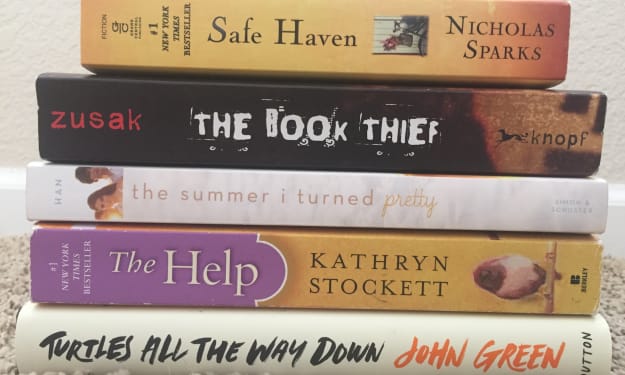
I love when a book makes me cry. There's something about having so much empathy for a character that you become physically emotional that's really special. It's cleansing and it's utterly human. When a book makes me cry, I know it's good because I've connected with the characters enough and been emotionally moved enough that I have a physical reaction. So, here are five books that made me cry, and that'll make you cry too.
By Alyssa Conroy8 years ago in Geeks
She Definitely Doesn’t Need You Anymore
Most people know that conflict is a heavily defining part of life; this is one thing that goes without saying. From arguing with a parent over curfew to disagreeing with the way a coworker accomplishes tasks or having to continually remind your housemate to take care of chores, everyone has encountered conflict. While conflict in itself isn’t bad, the way people handle it determines whether the effect is positive or negative. Much like in real life, in literature, conflict is essential. It is the base on which all other aspects of the story branch from, and without conflict there would be no plot line, which would result in having nothing interesting to read. In Kate Chopin’s “Story of an Hour”, there are multiple important conflicts, and while none of them are in established usage for that era, they all make the story a story.
By Emma Williams8 years ago in Geeks
The Gatsby Complex
The Great Gatsby by F. Scott Fitzgerald encompasses a variety of themes including the glorification of wealth, romanticization of unrequited love, and the pursuit of the American dream—to name a few among many. However, one theme that is often overshadowed by the ones listed above is the theme of idolizing something that simply doesn't live up to one's perceived expectations of it. For instance, Jay Gatsby internalized the notion that Daisy Buchanan, the girl he dreamt his whole life of being with, was nothing short of idealized perfection. However, for anyone that has read the book, this simply doesn't hold true—Gatsby idolized Daisy and wound up with a relationship that didn't live up to his expectations. This isn't something that only occurred in the roaring 20s, a period of wealth, abundance, and jazz, but is a recurring aspect that follows us even to this day and age.
By Ankita Upadhyay8 years ago in Geeks