
The Hidden Reality of Mobile App Development in Seattle
Why the "Amazon Tax" and the "Seattle Freeze" are reshaping the local tech scene - and how I learned to survive the transition.

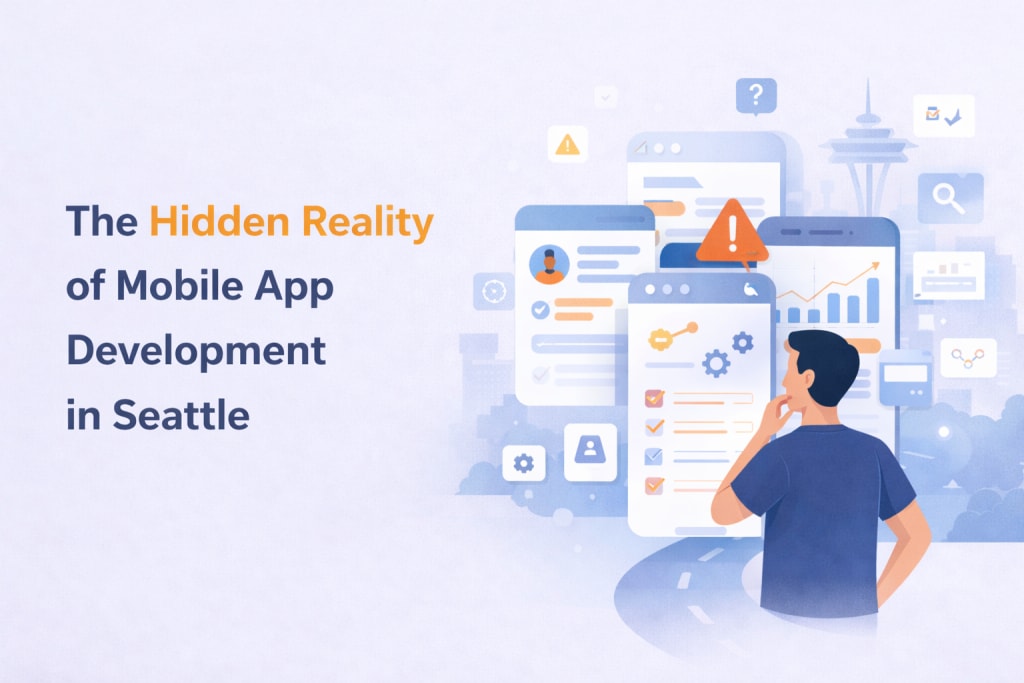
I still remember my first month trying to break into the Seattle tech scene. I walked into a networking event in South Lake Union, armed with a flashy pitch deck and the kind of "hustle culture" energy that works wonders in Miami or Los Angeles.
I left with zero leads and a cold realization: Seattle is different.
Often lazily labeled "Silicon Valley North," the Emerald City has a business DNA that is entirely its own. It is a market defined not by how fast you can sell, but by how well you can build. For anyone looking to enter the mobile app development Seattle space—whether as a founder, a developer, or a client—understanding this hidden reality is the difference between bankruptcy and a buyout.
Here are the five brutal but valuable lessons I’ve learned navigating one of the most sophisticated tech ecosystems on earth.
1. The "Amazon Tax" on Talent is Real
In most cities, if you want to hire a mobile developer, you are competing with other local agencies. In Seattle, you are competing with Amazon, Microsoft, and Google.
This creates what I call the "Amazon Tax." You cannot simply offer a competitive market rate; you have to offer a reason for top-tier talent to walk away from restricted stock units (RSUs) and golden handcuffs.
The stats back this up. In 2025, the average base salary for a mobile developer in Seattle hovered between $140,000 and $165,000, with specialized AI-integrated roles commanding upwards of $200,000.
The Lesson: If you are building an app here, do not budget for "average." The local talent pool is elite—Seattle has one of the highest concentrations of software engineers per capita in the U.S.—but they come with a premium price tag. I learned to stop looking for "cheap developers" and started looking for "high-velocity engineers" who cost more per hour but build three times faster.
2. The "MVP" Has a Different Meaning Here
In the startup world, a Minimum Viable Product (MVP) is usually a rough prototype to test a theory. In Seattle, that definition doesn't fly.
Because the region is dominated by enterprise culture (thanks to the cloud giants), the bar for quality is set incredibly high. A buggy, crashing app doesn't just look bad; it looks unprofessional. Local investors and B2B clients here are used to the stability of Azure and AWS. They have zero tolerance for "move fast and break things" if "breaking things" means data leaks or downtime.
Recent market research from 2025 suggests that building a feature-rich, business-ready app in this region typically costs between $50,000 and $120,000. If you are adding AI components, you are easily looking at $150,000+.
The Lesson: I stopped pitching "quick and dirty" pilots. In Seattle, "MVP" stands for Maximum Value Protocol. It needs to be secure, scalable, and compliant from Day 1.
3. AI is the New Oxygen
Two years ago, adding AI to your mobile app was a differentiator. Today, in the cloud capital of the world, it is the baseline.
With 70% of recent Venture Capital investment flowing into AI-driven technologies, the mobile app development Seattle market has pivoted hard. Clients don't just want an app that logs data; they want an app that thinks.
I remember a meeting with a mid-sized logistics firm in Bellevue. They didn't ask if we could build a tracking app. They asked, "How will this app use predictive modeling to tell us our drivers are going to be late before they even leave the warehouse?"
The Lesson: If your app isn't "smart," it's dead. At Indi IT Solutions, we had to radically shift our stack. We stopped just building UIs and started integrating OpenAI and Azure Cognitive Services into the core of our development process. The expectation here is that software should be proactive, not reactive.
4. The "Seattle Freeze" Applies to Sales, Too
You’ve likely heard of the "Seattle Freeze"—the social phenomenon where locals are polite but distant. I found this extends to business, too.
In New York, you can win a deal over a loud dinner. In Seattle, deals are won in quiet conference rooms with whiteboards. The culture here is deeply engineering-focused. They don't care about your marketing buzzwords. They care about your architecture.
I spent months trying to "schmooze" potential partners with little luck. The moment I switched my approach to being data-centric and technically transparent, the doors opened.
The Lesson: Drop the sales pitch. Bring the specs. When networking in Seattle, lead with competence. Show them the API documentation, the security protocols, and the load-testing results. In this town, competence is the only currency that matters.
5. The Hybrid Model is the Only Way to Scale
This was the hardest pill to swallow. I wanted to build a 100% local, in-house team. But the economics (see Lesson #1) made that impossible for a growing agency.
However, the alternative—outsourcing everything to a cheap offshore shop—was also a failure. Seattle clients demand high-touch communication and immediate responsiveness.
The solution was a Hybrid Model.
- Local: Strategy, Project Management, UI/UX Design, and System Architecture.
- Global: Backend execution, QA testing, and maintenance.
This allows us to keep the "brain" of the project in the same time zone as the client, ensuring the vision is never lost, while utilizing global talent to handle the heavy lifting of code production.
The Lesson: Don't hide your distributed team; optimize it. We now pitch this as a benefit: "You get Seattle-tier architecture with global-tier speed." It allows for a 24-hour development cycle that purely local teams can't match.
The Verdict
Seattle is not for the faint of heart. It is a high-stakes, high-cost, high-reward environment. But the discipline it forces upon you—to build better, to think smarter, and to value substance over style—makes you a better developer and a better entrepreneur.
If you can survive the rain and the rates, you can build anything here.
About the Creator
Ash Smith
Ash Smith writes about tech, emerging technologies, AI, and work life. He creates clear, trustworthy stories for clients in Seattle, Indianapolis, Portland, San Diego, Tampa, Austin, Los Angeles, and Charlotte.
Enhancing Customer Engagement Apps for Silicon Slopes Tech Companies in Utah
You know that feeling when you drive down I-15 through Lehi, look up at the glass towers reflecting the Wasatch Mountains, and realize the "Silicon Slopes" nickname isn't just a marketing ploy anymore? It’s real. But let’s be honest for a second—the game has changed.
By Sherry Walker6 days ago in Geeks


Comments
There are no comments for this story
Be the first to respond and start the conversation.