
The Importance of Real Stuff
To have or not to have
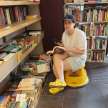

I heard that reading books and buying them are two different hobbies. I do read a lot, though if I am being honest it's mostly via audiobooks and when printed, the books come from the library. You'd think then, that my money is, in regards to books, safe in my wallet or in my bank.
Wrong!
No. Only my more financially conservative partner could slow down my book-bulk-buying (and is unfortunately semi-successful in her aim). But, oh lawd, there are those weeks where not even JC coming down from a golden cloud could stop me. And I fucking love it.
I even like the feeling of buying (and reading…sometimes) ebooks, audiobooks, etc. But the thrill of a book forever mine is something else, and it’s not only limited to the hormonal hit associated with any other purchase.
You may feel similarly about DVDs or watches, or I don’t know, ceramic pigs. But books, ay ay ay, books are an exquisite conundrum for someone like me, who would like to own less and save the planet more, but also believes literature and knowledge to be among the most precious things in existence.
And interestingly, there must be millions of people just in my own country who buy books (or other things) at an incredibly higher rate than I do. And hopefully, they read much more than I do too.
Completely immersed, once, in a phase of minimalism, I was comforted and resolute when I finally read (in Audiobook and before sleeping) Goodbye, Things by Fumio Sasaki. Of course, it would come as no surprise, that I never got in the mindset of, like Sasaki had, donating or throwing all of my books in exchange for a single Kindle.
My apartment wasn’t horribly messy; if my girlfriend was coming over for the weekend, I could do enough tidying up to make it look presentable. On a usual day, however, there were books stacked everywhere because there wasn’t enough room on my bookshelves. Most I had thumbed through once or twice, thinking that I would read them when I had the time.
‘I was miserable, and I made other people miserable, too’ …
The closet was crammed with what used to be my favourite clothes,most of which I’d only worn a few times. The room was filled with all the things I’d taken up as hobbies and then gotten tired of. A guitar and amplifier, covered with dust. Conversational English workbooks I’d planned to study once I had more free time. Even a fabulous antique camera, which of course I had never once put a roll of film in. — F. Sasaki. Goodbye, Things.
According to Sasaki, we hoard certain things — like books or vintage records — to tell ourselves and others that we are of value. Intellectual, cultured, etc. I neither agree nor disagree fully with such an argument.
Also, once I finished the book, I finally found the courage to throw t-shirts, pants, papers, and other chapalang. I felt better. I actually felt quite good, for a while. Then, as with things of mind that ebb and flow, I started buying stuff again and adopting a more “does it spark joy?” method of throwing away/donating.
However, since then, I have cured that toxic attachment part of me had with all the objects I collected. I was never a hoarder by any means, but I had difficulties (especially during my childhood) to even throw away the corner of a ripped envelope. Especially if I held it for a while.
I haven't talked about it with my shrink yet, but at the same time throwing away things like clothes (that have no sentimental or symbolic meaning) has become easier. Taking a second to consider buying or not buying something — happens…at times. But never. Never ever, would I throw a book in a bin. Donate, gift, maybe…in fact, I have (painful). But throw, or not make sure it’s in good hands. Never.
Of course, it is about meaning that I, like many, have attached to the category of knowledge. Possibly, it has even to do with telling myself I am intellectual. But Jesus, I believe in the value of possessing them. Or at least, a curated number of them.
This is not a case for consumerism. Aside from the obvious problems of waste, climate, and power, studies show that we don’t even actually like to buy that many things. In fact, after our most important needs are met, we tend to be sadder the more we buy. It isn’t an association we make of course, as buying makes us happy the moment that the purchase is made.
Then, as aforementioned, consumerism is destroying the planet. The global emissions are off the charts, especially in more consumeristic countries.
I believe we should decrease buying shite we don’t need. But I don’t think we need to condemn owning material, concrete things. Especially things that are important to us, and to society at large.
Books are something I never regret buying (even though I am not sure I’ll read all of them…especially if I continue borrowing from the library every week). But you may very well convince me about the importance of a good, real, perfect vinyl, CD, or Gandalf’s pipe. It's about what has 'purpose' for us, be it even passion.

Owning media can be a divisive argument. It may be easier to discuss audiobooks or even more direct to discuss movies here.
Reece Beckett may be an exception, owning more DVDs than a closed-down Block Buster. But for us, generally, we just don’t own media anymore. We don’t own what we stream, there is nothing in our hands that we can twist and check and look and use, and that is ours to keep. Forever.
Like, how did we get to not owning the video games we play? Streaming them, Netflix style, without considering the possibility that it may all disappear. Movie streaming is great, don’t get me wrong. But, differently than with books, do we even keep physical copies of the movies we’d like to see over and over without risking it being cancelled on our streaming platform of choice? What about that special one? That one you want with extended cuts, posters, cards, extra trailers, and interviews?
What about those books you need to — and you may find me weird, so be it — smell?
And as Ted Kutina said it best:
Let’s not even get into the dystopia of Spotify — The Importance of Real Things
Albums, books, and notebooks are objects of memories. Damn, how many photos I have lost between the time I got my first phone with a camera, and around 2019 when I started (sort of) using a cloud system to store them. My youngest sister, Elise, was born in the second half of the first decade of this new millennium and, let me tell you, we are struggling to find old photos of her at one, at two. Taken on crappy 2mb cameras with red and green filters, and lost with the changing of phone seasons. It’s sad.
And if we lose the memory of books what happens to the memory language(s) as we know it?
The association between books and language may sound, in my words, final. And I know it isn’t. For centuries we transmitted poetry orally, and, in the case of an ebook full of a million words and more, language, as written down in a book, is still there. I maintain that it does not hold the same memory, the same symbolism, and therefore the same place in our hearts.
There is also this: the holding, the unfolding. A different ritual made of different movements, behaviour that separates something like reading (or putting on a DVD, or reorganising your album collection) from something now mundane like scrolling, tapping, swiping.
Also, for that really special book…don’t you want to be able to read it under candlelight, if all electricity is out for a little too long to charge your Kindle?
I love ebooks, I love streaming movies, I love and wouldn’t want to live without YouTube. However, exceptions can be made, if wanted. And I want to.
Owning media also places a different value on the art and the artist that has created it.
But why own? Why not just rent, or borrow? You almost got me there, but not quite. Some things want to be revisited again and again. Others, want to be savoured slowly, with no rush, no timeline. Then, some things, just want to be with you, and you want to be with them. Possibly forever.

About the Creator
Avocado Nunzella BSc (Psych) -- M.A.P
Asterion, Jess, Avo, and all the other ghosts.
Keep reading
More stories from Avocado Nunzella BSc (Psych) -- M.A.P and writers in Geeks and other communities.
Not Just For Clean Up: A History Of The MCU's Department of Damage Control
Initially an organisation that seemed to exist to help the heroes of the Marvel Cinematic Universe, from Phase Four onwards, the Department of Damage Control has shifted into a more antagonistic role. Most recently seen in the Wonder Man series, the current incarnation of Damage Control seems to target superpowered individuals, regardless of whether that person poses an active or intentional threat.
By Kristy Anderson2 days ago in Geeks
Guest House Star Khalid Hafeez Khan Passes Away
Pakistan’s entertainment world is in deep mourning after the passing of Khalid Hafeez Khan, the veteran television actor best known for bringing the unforgettable character of Mr. Shamim to life in the classic 1991 Pakistan Television sitcom Guest House. The news of his death was confirmed on January 27, 2026, after he passed away in Islamabad, leaving fans, colleagues and an entire generation of viewers in sorrow.
By Salaar Jamali7 days ago in Geeks
Time to change your life.
Is it even possible for you to change your life? A lot of people, more than there should be, are unhappy with their lives. But what are they doing about it? Usually nothing. People talk about how shitty their lives are and want change, but are they not taking the actions to change?
By Jen Phillips3 days ago in Humans



Comments
There are no comments for this story
Be the first to respond and start the conversation.