
How Route 66 Forever Changed America.
From Dust Bowl Escape Route to Cultural Legend — How America’s Most Iconic Highway Became the Symbol of Freedom, Hope, and the Open Road.

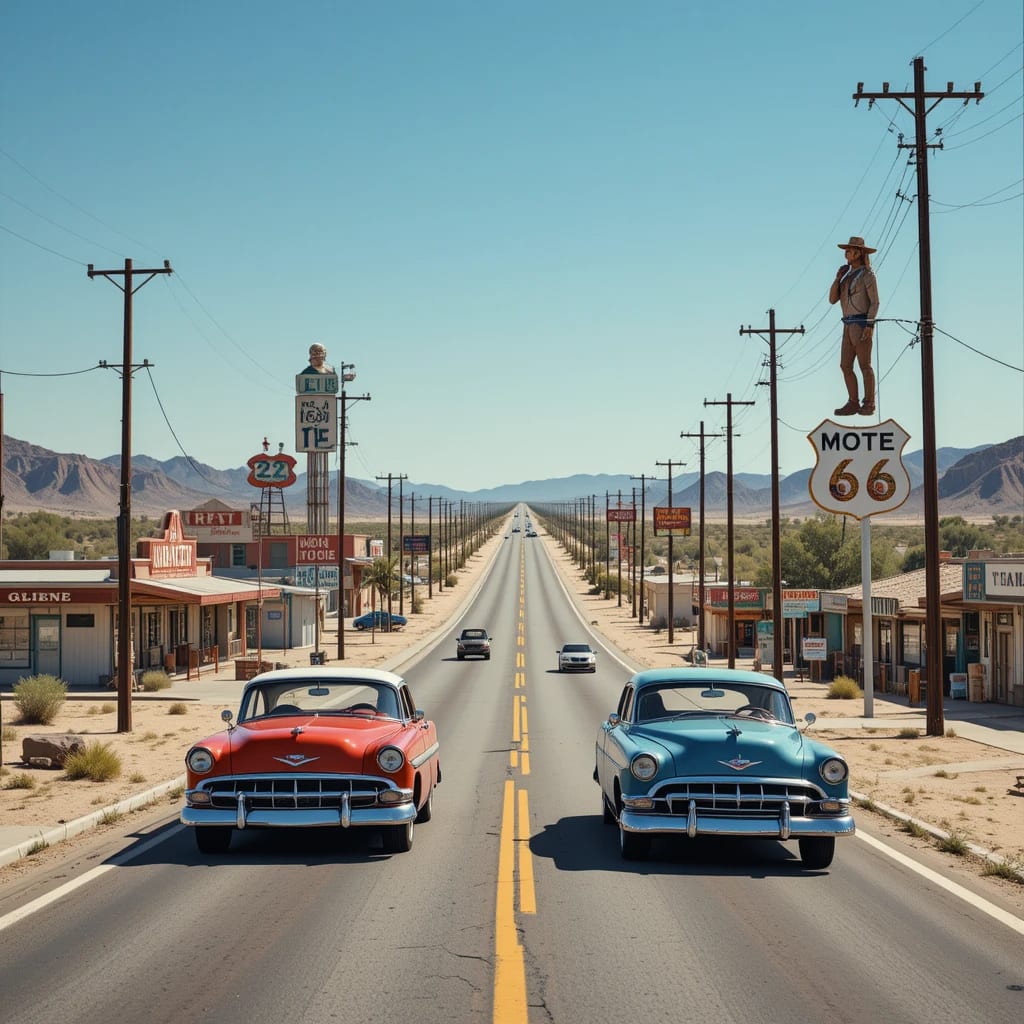
They close their eyes and see America, and Americans see an open road—an open road with no skyline on skyline before them, wind in the windows. That vision lay in part along one mythical route: Route 66. Nicknamed "The Mother Road," Route 66 is a highway from Chicago to Los Angeles, yes, but so much more: an enduring symbol of hope, migration, defiance, and the dogged American Dream.
History of Route 66
Route 66 started in America for the first time on 11th November 1926 as an American Highway, the first and most beloved Route 66, America's Road. It was 2,448 miles long from Illinois, passing through Missouri, Kansas, Oklahoma, Texas, New Mexico, Arizona, and California. A few other highways went around country towns, but Route 66 went the long way through country towns, and rural America was thriving with the rest of America.
Built under the boom prosperity, the highway was a highway to prosperity. The highway opened American markets to goods and tourist markets. People could travel from state to state for the first time in history without the use of the railroads.
A Lifeline During the Great Depression
While the nation slept in suspended animation during the Great Depression of the 1930s, Route 66 fared better with its people. The Dust Bowl that ruined Oklahoma's and Texas's crop agriculture and the region took its victims who filled as much as they could into dented cars and trucks and left on Route 66 to work and live better.
John Steinbeck's The Grapes of Wrath mythologized the migration to mean to call Route 66 "the road of flight." Others referred to it as a hope in hopelessness—a flight from poverty, home, and a new life in California's productive valleys.
WWII and Economic Boom
World War II sped up Route 66 even quicker. As military camps began to appear in the Southwest, the highway became the main route for troop transportation and war equipment shipment. Restaurants, motels, filling stations, and roadside rests were booming as soldiers were driving back and forth between their duty tours and their families back home waiting for them.
When the economy collapsed and car culture went wild post-war, Route 66 was a tourist utopia. Fords and Chevys were packed to capacity with uncles, cousins, and sisters to travel out to the Grand Canyon, eat in mom-and-pop restaurants in one-horse towns, or see the wacky roadside attractions. The road gave birth to dreams and the promise of the great American dream along the curve of the road.
The Cultural Icon
Route 66 was an icon during the 1950s and '60s. Route 66 was a cultural phenomenon. Bobby Troup's "Get Your Kicks on Route 66 cemented its coolness, good times. Films and television shows translated the highway into shorthand for rebellion, romance, and the open road.
And most importantly, it was an American milestone identity. With sleazy roadside motel bars, drive-ins, and trading posts, Route 66 pulsed with the sleazy, freaky ambiance of American culture, where cowboys and rock 'n' roll existed together, Native American sculpture and immigrant restaurants were linked.
The Decline and Revival
It was ironic that the fame Route 66 had achieved was the same one that brought its demise. It was President Eisenhower who signed the Federal-Aid Highway Act, creating the Interstate Highway System during the 1950s. Other faster interstates like I-40 and I-55 later bypassed small towns and traveled through the middle of America, relegating Route 66 to an anachronism.
Route 66 officially lost its U.S. highway number in 1985.
And that was just the start. Americans in general fell head over heels in love with Route 66 culture. People came together and kept some of that old road alive. Lots of Route 66 is still drivable today as a "Historic Route," the feel of old-time diners, neon lights, and those people of the road--such as Texas's Cadillac Ranch, or Oklahoma's Blue Whale.
Route 66 Today: A Road With a Story Yet to Tell
Route 66 appeals to something deep in the American psyche: the power to redo, discover, and reinterpret. Or perhaps you're a baby boomer who grew up with parents who took family vacations along America's roads in the '60s, or perhaps a Gen Zer seeking some retro-tinged Instagram selfie fun. Something on the road is for everybody.
A lovely reminder of where we came from, but where it is still possible yet to proceed.
As you drive past ghost townships and look in awe at the abandoned gas stops and refurbished diners, you know—a section of road called Route 66 is more than any road—it's a living archive of American culture and history. With each creased mile, it speaks softly in its stories: farmers, lovers, protesters, and regular people calling out for freedom.
The last time you ever heard anybody "get their kicks on Route 66," don't imagine they're singing along to song lyrics. They're talking about when the highway had the power to change your life.
About the Creator
Pen to Publish
Pen to Publish is a master storyteller skilled in weaving tales of love, loss, and hope. With a background in writing, she creates vivid worlds filled with raw emotion, drawing readers into rich characters and relatable experiences.
Keep reading
More stories from Pen to Publish and writers in History and other communities.
The American Revolution's Unsung Heroes.
Historically in America, history of independence has always been recounted in titles of great men: George Washington, Thomas Jefferson, Benjamin Franklin, etc. What if the real spirit of the American Revolution is actually not among signers of the Declaration of Independence or war generals but among regular people whose history has not so frequently been recounted?
By Pen to Publish9 months ago in History
Frederick the Great: Winning When Surrounded
Few leaders in history have faced danger as relentlessly as Frederick II of Prussia, better known as Frederick the Great. He ruled a small, newly elevated kingdom with powerful enemies on every border, a limited population, and an army that could never afford large losses. Yet time and again, Frederick survived—and often triumphed—when surrounded by foes who should have crushed him. His genius was not conquest for its own sake, but the art of winning when defeat seemed inevitable.
By Fred Bradford6 days ago in History
Dow Jones
The Dow Jones Industrial Average, often simply called the Dow, is one of the most recognized stock market indexes in the world. When people hear headlines like “Dow today jumps 200 points” or “DJIA today slides amid economic uncertainty,” they are witnessing a snapshot of investor confidence, economic expectations, and market psychology all rolled into one number. But behind those daily movements lies a much deeper story about how the modern U.S. economy operates. What Is the Dow Jones Industrial Average? The Dow Jones Industrial Average (DJIA) is a stock market index that tracks 30 major publicly traded companies in the United States. These companies are considered leaders in their respective industries and collectively represent a broad view of American corporate strength. Despite its name, the DJIA is no longer limited to industrial companies. Today, it includes businesses from sectors such as technology, healthcare, finance, and consumer goods. Unlike many modern indexes that are weighted by market capitalization, the Dow Jones is price-weighted. This means companies with higher stock prices have a greater influence on the index’s movement, regardless of their overall size. While this methodology is sometimes criticized, it has remained unchanged for over a century, preserving the index’s historical continuity. Why the Dow Still Matters In an era dominated by broader indexes like the S&P 500 and tech-heavy benchmarks, some investors question the relevance of the Dow. Yet the Dow continues to hold symbolic and practical importance. It is often the first index cited in market news, making it a key reference point for both seasoned investors and casual observers. When analysts discuss dow today, they are often speaking about more than just numbers. Daily movements in the DJIA reflect investor reactions to inflation data, interest rate decisions, corporate earnings, geopolitical tensions, and even consumer sentiment. Because its components are established blue-chip companies, the Dow offers insight into how major corporations are navigating economic conditions. How the DJIA Is Calculated The DJIA’s calculation is straightforward but unique. The prices of all 30 component stocks are added together and then divided by a figure known as the Dow Divisor. This divisor is adjusted over time to account for stock splits, dividends, and corporate restructuring, ensuring continuity in the index’s value. This structure means that a sharp move in one high-priced stock can significantly influence djia today, even if other companies remain stable. While this can create volatility, it also highlights shifts in investor sentiment toward specific market leaders. Interpreting Dow Jones Movements Understanding what drives the dow jones on any given day requires context. A rising Dow often signals optimism about economic growth, stable inflation, or strong corporate earnings. Conversely, a falling Dow may indicate concerns over recession risks, tighter monetary policy, or global instability. However, it’s important to look beyond daily fluctuations. Short-term moves in dow today can be influenced by news cycles or emotional reactions, while long-term trends often reflect deeper economic fundamentals. Investors who focus solely on daily point changes risk missing the broader narrative shaping the market. The Role of the Dow in Long-Term Investing While traders may focus on intraday movements, long-term investors often view the Dow as a historical benchmark. Over decades, the Dow Jones Industrial Average has demonstrated the power of compounding growth, despite periods of downturn, crashes, and uncertainty. Major events such as financial crises, pandemics, and political upheaval have all left their mark on the DJIA. Yet the index has consistently recovered over time, reflecting the resilience of the U.S. economy and its largest corporations. This long-term perspective is why many retirement portfolios and investment strategies still use the Dow as a reference point. Dow Today in a Changing Market Landscape The modern market environment is vastly different from when the Dow was first created. Technology now plays a dominant role, global markets are deeply interconnected, and information travels instantly. As a result, djia today often reacts quickly to developments far beyond U.S. borders. Interest rate policies from central banks, supply chain disruptions, and shifts in consumer behavior can all impact the Dow within minutes. This fast-moving environment underscores the importance of staying informed and understanding the forces that influence market behavior rather than reacting emotionally to daily swings. Limitations of the Dow Jones Despite its prominence, the Dow Jones has limitations. With only 30 companies, it does not represent the full diversity of the U.S. stock market. Smaller companies and emerging sectors are largely absent, which can sometimes make the index less reflective of broader economic trends. Additionally, its price-weighted structure can distort perception, giving outsized influence to higher-priced stocks. For this reason, many investors use the Dow alongside other indexes to gain a more balanced market view. A Symbol That Endures Even with its imperfections, the Dow remains a powerful symbol of market performance. It serves as a bridge between financial professionals and the general public, offering a familiar metric to gauge economic confidence. When headlines discuss dow today, they capture attention because the index represents more than stocks—it reflects hopes, fears, and expectations about the future. Final Thoughts The Dow Jones Industrial Average is more than just a number flashing across a screen. It is a living record of American business history, shaped by innovation, crisis, and recovery. Whether you are tracking djia today for investment decisions or simply to understand market sentiment, the Dow offers valuable insight into how the world’s largest economy is performing. By viewing the Dow with context and patience, readers and investors alike can appreciate its role not just as a market index, but as a long-standing indicator of economic momentum and resilience.
By Saboor Brohi a day ago in History
~ Fired ~
— Ai Intrusion ~ Are you Next ~ Is Ai Evolution after your job? — Few workplaces haven't been affected. Ai is in supermarkets, at doctors' offices, and even monitoring farms. I just can't think of anything this machine is not getting into, can you? For instance: Education ~ Law and Tech jobs will one day have a major influence or be taken over by these inanimate machines, with accuracy and vigor. From mechanics' diagnoses to a wide variety of everyday jobs, including fast food workers, with this input having the ability to cut their unnecessary work hours. I'm certain all of us have been touched by this with our short stories and colorful headings, have you? Even comments are very questionable 'Non-Robot' insertions.
By Jay Kantor7 days ago in Journal


Comments
There are no comments for this story
Be the first to respond and start the conversation.