Events
Silent Heroes: The Undeniable Impact of Women During World Wars
In the annals of history, tales of war often revolve around the valor and sacrifice of men on the battlefield. Yet, amidst the clamor of conflict, a silent but profound force emerged - the women. This is the story of how women's role during the World Wars proved indispensable, reshaping society and history forever.
By Luka Jovanovic3 years ago in History
This Gruesome List Of Some Of The Most Horrific Torture Methods Will Make You Lose Your Appetite
Before Google search or truth or dare became a mainstream thing, people used other methods to extract information. But not everyone had the gift of subterfuge. Torture was a popular way of getting people to reveal information or confess to crimes (which they sometimes did not commit). While impaling people or crucifying them or even laying them on a torture rack was pretty common in history, there have been other methods that are so screwed up that simply reading about them might make you shudder. No, seriously, if you’re easily rattled, reading further might not be the best idea.
By Edwin Kingsly3 years ago in History
Life as a Court Jester: Jovial Entertainer or Risky Maverick
In the 10th century, the daring jester Jing Xinmo found himself in a perilous situation after a playful encounter with a dog led to a teasing remark directed at the Chinese emperor's children. The emperor, taking offense, trained an arrow on Jing, ready to deliver a harsh punishment. However, instead of begging for his life, Jing fearlessly cracked yet another joke. Fortunately, this witty pun hit its mark, and the emperor's arrow missed. The existence of jesters, contrary to popular belief, extended beyond medieval Europe and thrived in various times and cultures. The earliest reliably recorded jester, You Shi, emerged in 7th century BCE China and declared that his jesting words could not give offense, a privilege central to the jester's role, though occasionally breached. Jesters held unique relationships with power, as they were both objects of mockery and cherished entertainers and confidants. Becoming a jester involved diverse paths, including appointments due to physical or neurological differences, selection from the pool of entertainers, or recruitment by a traveling courtier. An example of the latter occurred in the 1530s when a royal servant wrote to King Henry VIII's chief minister, recommending a young boy as a replacement for the aging jester Sexten, assuring that he would be far more pleasant than his predecessor.
By stephen kinyanjui3 years ago in History
Road to Pakistan
Elections are always a tool to decide any of the confict existing in the world. In history, for sorting the partition conflict in united India, also the concept of elections were proposed. The elections of 1946 have a unique significance in the Indian political history when a political party took part in the elections based on one point manifesto. In fact, Muslim League took part in these elections because of manifesto aimed at the creation of Pakistan. Before taking part in the 1946 elections, Quaid-i-Azam announced on 10 October 1945, “Our demand of Pakistan is quite clear. Those parts of India, where Muslims are in majority should be amalgamated to form a free and sovereign state. If the Muslims voted against Pakistan, I shall accept my defeat. The President of the Indian National Congress, Maulana Abdul Kalam Azad, sent a very detestable telegram to the Viceroy of India reacting against the announcement of these elections. Lord Wavell responded, “Azad [Maulana Abdul Kalam has sent me a very loathsome telegram in reaction of not consulting him in the announcement of election programme. Actually, he is trying to reprieve himself. He is trying to use these elections as an arm for the release of his other companions from jail. The daily Dawn published an appeal of Khan Abdul Qayyum
By Syed Ammar3 years ago in History
Color Pattern Names
If I were to present to you a paint chip and inquire about its color, what would be your response? Similarly, what about this one? And this one? Presumably, you would identify them as blue, purple, and brown, respectively. However, if your mother tongue is Wobé from Côte d’Ivoire, you would likely employ a single term for all three. This discrepancy arises from the fact that not all languages possess the same number of fundamental color categories. While English has 11, Russian has 12, and certain languages, such as Wobé, only have 3. Researchers have discovered that if a language has only 3 or 4 basic colors, they can typically anticipate what those colors will be. How do they accomplish this feat?
By Hanif Salahudin3 years ago in History
Is It OK
There exists a ubiquitous two-letter term that is commonly heard in various contexts. It is often expressed as "OK" or "okay". For instance, it is frequently used to inquire about someone's well-being, as in "Are you okay, Annie?" or to address a group of women, as in "Okay ladies...". It is widely recognized as one of the most familiar words worldwide. Its usage is also commonly expressed through the exclamation "OK!" or simply "OK".
By Hanif Salahudin3 years ago in History
The Revolutionary Legacy of Dr. Jose Rizal
This article will explore the life and legacy of Dr. Jose Rizal, a renowned Filipino nationalist, writer, and philosopher who is widely considered the national hero of the Philippines. Dr. Rizal was a key figure in the Philippine Revolution, a nationwide uprising to end Spanish colonial rule in the late 19th century. His writings, which helped to galvanize the Filipino people in pursuit of independence, have been translated into numerous languages and are still widely studied and discussed today. In addition to his writings, Dr. Rizal was also a medical doctor, a polymath, and a passionate advocate for human rights. This article will explore the life of Dr. Rizal and his impact on the Philippine nation.
By Ziain Morales3 years ago in History
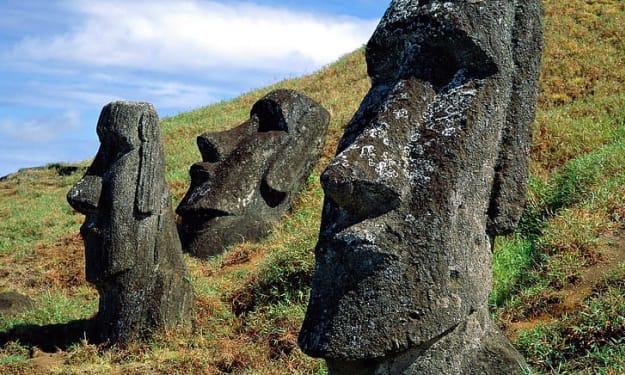
And Now We Know How Easter Island Giants Were Moved
For centuries, the Easter Island giant heads, known as the moai statues, have captivated people worldwide and even earned their own emoji. The true significance behind these enigmatic figures has remained a mystery for hundreds of years. However, recent discoveries shed light on how they were constructed and moved to their permanent locations. Each moai statue comprises three distinct parts: a large yellow body, a red hat or top knot, and white inset eyes with a coral iris. Approximately 1,000 of these remarkable statues were created on Easter Island.
By Makim Piodos3 years ago in History
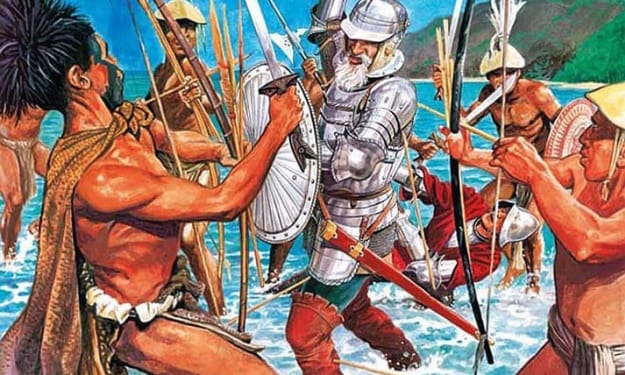
The Last Stand
The Battle of Mactan was a pivotal conflict in Philippine history. It took place in 1521 near the island of Mactan in the Visayas region of the Philippines. The battle pitted Lapu-Lapu, and his warriors against Portuguese explorer Ferdinand Magellan and his small force of Spanish soldiers and Filipino mercenaries. Lapu Lapu is one of the most famous figures in Philippine history. He was a native chieftain who led the battle of Mactan against the Spanish forces of Ferdinand Magellan in 1521. He is often considered to be the first Filipino hero to have resisted foreign rule. The city of Lapu Lapu was named in his honour, and his statue stands in the plaza at the city center, as a reminder of his bravery. As such, he is revered as a national hero by most Filipinos and is given much respect for his courage and determination.
By Ziain Morales3 years ago in History