Events
Lahore Resolution 1940
With the introduction of political reforms in India by the British, the Muslims realized that they would become a permanent minority in a democratic system and it would never be possible for them to protect their fundamental rights. The attitude of Congress leadership during 1920’s further endorsed what the Muslim leadership had realized. After the failure of Khilafat / Non-cooperation Movement, the Indian politics revolved around the process of introducing new political reforms for the upcoming Act. Simon Commission and Nehru Report were not welcomed by both the opponents. The first practical step which presented the change of attitude in the Muslim League leadership was a four days conference of the Sind Provincial Muslim League, held at Karachi from October 8 to 11, 1938. Jinnah presided over the conference. In his address, Jinnah very boldly said that there must be a separate state which would represent the Muslims. 27thAnnual session of the Muslim League, in which the party was all set to change its goal, was originally scheduled for December 28-30, 1939.When Lahore was selected as the venue and Sikandar Hayat and the Punjab chapter of the party was assigned the task to organize the meeting, they requested for a couple of extra months to make good arrangements and to help the event become a success. Date was finalized on the recommendation of Liaquat Ali Khan, who suggested it to be held during Easter Holidays. Jinnah, alongside, Fatima Jinnah, Liaquat, Nawab Ismail, Khan, Nawab Sadiq Ali Khan, Begum Mohammad Ali Johar etc. arrived in Lahore by a special train, decorated by Muslim League flags, at 9:45 hrs. on March 21, 1940. Though the main plan of reception was cancelled due to the Khaksar tragedy, yet a huge number of people including League leaders, members of thePunjab assembly and representatives of different organizations had assembled at Lahore railway station to greet their leader. On his arrival Jinnah told the print media that the All India Muslim League will make historic decision in the upcoming session. After a gape of fifteen months from the 26th annual session of the party, that was held at Patna, a huge pandal was set up at Minto Park Lahore on March 22, 1940. Though the function was scheduled for 14:30 hrs., Muslim League workers and general masses had started coming to the venue ever since morning. Though there were tickets 38 for the entrance in the pandal, yet the arena, with the capacity of around sixty thousand, was jam packed hours before the start of the session. Tens of thousands of people were forced to listen to the proceedings through loud-speakers installed outside, while standing directly under the sun. According to a rough estimate around 100,000 masses attended the public meeting. 39Moreover, the most significant feature of the session was the appearance of a huge number of Muslim women in a public meeting, something which was unheard off till that time. Archway leading to the entrance of the pandal was decorated by theMuslim League flags. Muslim League National Guards, who had the responsibility to make necessary arrangements, particularly the control of the huge crowd, were also wearing green cloths that matched with the color of the party’s flag. The session started with the recitation from the Holy Quran. Then a couple of selected poems including one by Mian Bashir Ahmad, ‘Millat ka pasban hai Mohammad Ali Jinnah’ were recited. He was zealously welcomed by the spectators, when he reached the dais. He started his speech in Urdu but soon he switched to English by saying that the ‘world is watching us, so let me have your permission to have my say in English. The other reason for switching to English was perhaps he was not fluent in speaking Urdu and in order to express his ideas, that too in an extempore speech which lasted for about hundred minutes, he was to Jinnah and the Lahore Resolution speak in a language in which he could express himself in the best possible way. However, the most interesting part is that though over whelming majority of the audience could not understand English, yet they not only listened to his long speech but that too with enthusiasm. His address was frequently sprinkled by a roaring applause. According to The Times of India, ‘Such was the dominance of the personality that, despite the improbability of more than a fraction of his audience understanding English, he held his hearers and played with palpable effect on their emotions. Jinnah also discussed about the austerities conducted by Congress Ministries in different provinces. He talked about the ill treatment and oppression of Muslims in all the Congress governed provinces and also in the Indian States like Jaipur, Bhavnagar and Rajkot. He specially threw light on the negative impact of Vidya Mandir Scheme in Nagpur and Wardha Scheme all over India. He said,‘I never dreamt that they would ever come down so low as that’. He claimed that several attempts were made to remind the British Governors and Governor-General about ‘their duties’ but without any positive response. He considered that the Muslims were caught ‘between the devil and the deep sea’. Yet, he was sure that neither the devil nor the deep sea would ‘get away with it’. He asserted that Muslims have ‘learnt many lessons’ from these experiences and had become more ‘apprehensive and can trust nobody. Next Jinnah talked about the Hindu-Muslim situation in India. He pointed out that several schemes had been sent by various well informed constitutionalists and others’ and the League had appointed a subcommittee to examine the details of the schemes that have come in so far. He held that it had always been taken for granted that Muslims were a minority .He stressed that Muslims were ‘a nation by any definition’. He added that even according to the British map of India, the Muslims occupy large parts of this country where they are in a majority – such as Bengal, Punjab, N.W.F.P, Sind and Baluchistan’. He quoted the letter written by Lala Lajpat Rai in 1924 to C.R. Das in which he clearly mentioned that the Hindus and the Muslims were two separate and distinct nations’ which could ‘never be merged into a single nation’. He questioned that when Lala Lajpat Rai that it was ‘not possible to rule this country on democratic lines’ it was all right, but when he had the ‘temerity to speak the same truth’why were there unstopped attacks of criticism on him? He supposed that the remedy for the Congress was to keep the Muslims in the minority and under the majority rule’ while the British Government, their parliament and nation ‘nurtured with settled notions about India’s future, based on the developments in their own country. A controversy related to Lahore Resolution is that if the resolution demanded for one or more states? It was the word ‘states’ and not ‘state’ which was used in the Resolution. However, a good look at the developments that followed, one could realize that either the word ‘states’ was included as a mistake or had a different meaning in the minds of the authors of the resolution. The dynamic leadership of Jinnah and the commitment and devotion of the followers made it possible for them to achieve an independent state within seven years of their struggle, and that too when the odds were against them.
By Syed Ammar3 years ago in History
The Amphibious Invasion of Sicily. Content Warning.
In today's video, we'll delve into the intriguing historical event known as the Amphibious Invasion of Sicily. This daring military operation took place during World War II and was proposed by Prime Minister Winston Churchill and the British Chiefs of Staff. The ambitious plan aimed to be the first large-scale offensive operation on the European mainland since the fall of France in 1940. Initially met with astonishment and skepticism, this pivotal campaign played a crucial role in reshaping the course of the war. In this article, we will explore the strategic planning, the challenges faced, and the decisive outcomes of Operation Husky.
By Malik Sarparah3 years ago in History
Which of the earliest languages is still used today?
Since spoken words don't physically impact the world, tracing the beginnings of human language can be challenging. Additionally, language is always evolving, with words and their connotations changing with each new generation. Therefore, identifying one language as the oldest in the world would be misleading.
By Francis Dami3 years ago in History
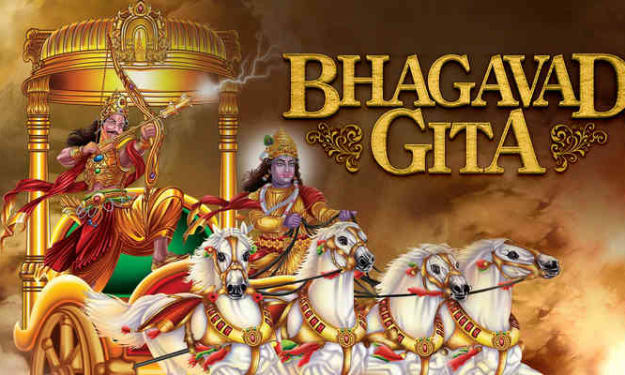
"The Bhagavad Gita: Wisdom and Guidance for Spiritual Seekers"
The Bhagavad Gita, also known as the Gita, is a sacred Hindu scripture that contains a conversation between Prince Arjuna and the god Krishna, who serves as his charioteer. The text is a part of the Indian epic Mahabharata and is revered for its profound spiritual teachings. Here is a summary of the Bhagavad Gita without any plagiarism:
By Go With Trend3 years ago in History
Socrates Was Right: Embracing the Value of Intellectual Inquiry. Content Warning.
Throughout history, many great minds have left an indelible mark on human civilization, shaping the way we think and perceive the world. Among these luminaries, Socrates, the ancient Greek philosopher, stands tall as a paragon of wisdom and intellectual pursuit. Socrates' method of relentless questioning and emphasis on self-examination have not only influenced philosophical thought but also have enduring relevance in our contemporary world. In this essay, we will explore some of the core aspects of Socratic philosophy and demonstrate why Socrates was right in advocating for the importance of critical thinking, self-awareness, and the pursuit of knowledge.
By Asim hussain3 years ago in History
"The Day the Dinosaurs Died: A Look into the Asteroid Collision that Changed Earth Forever"
66 million years ago, a giant asteroid collided with the Earth, causing one of the most massive disasters in our planet's history. This event led to the extinction of the dinosaurs and many other species. In this article, we'll take a closer look at what happened during this catastrophic event, and how it shaped our planet.
By Valentina Kwarteng3 years ago in History
Mutiny War 1857
In 1600, after the death of Aurangzeb Alamgir, the empire of Mughals begun to Trumbell. Muslims started facing the downfall but not in a definite order. The downfall begun when East India Company entered Subcontinent for the trade purposes. When they noticed that the Mughal Government has become too much lazy in governance and they do not pay attention on the defense of their territory. East India Company gradually increased its military numbers in the name of the security of their trade goods. They were required the permission of the Mughal Government to increase their military. As the Mughlas were too easy on their borders, they happily agreed to increase their military. After some of the years, East India Company properly invaded in some parts of subcontinent and conquered them. In 1757, East India Company invaded subcontinent from Bengal, they conquered it. After that the path was open for East India Company to invade in any part of the subcontinent. It is quite strange to know that before East India Company, every of the invader who invaded subcontinent, he never used Bengal route to invade, whether they used Sindh like Mohammad Bin Qasim and others. So, as the time passed, a proper was started. This war is often known as Rebellion war, Mutiny or War of Independence. Their were certain causes of war which included political, social, economic, military and religious affairs. It is important to remember that this war was not initiated all over the subcontinent. It was only limited to Meerut, Delhi, Kanpur, Lukhnow etc. The main event which became the immediate cause of war was the refusal of sepoys to use the grease covered catridges on 23 January, 1857 on 23 January, 1857. At the same time an Indian Sepoy killed two British Militants. The case was investigated and the Sepoy was hanged to death on April 8th, 1857. This news spread like fire of jungle. On 6th May, 1857 85 of 90 soldiers refused to use catridges, all those soldiers were court martialled and their badges were removed in front of the entire public. This raised fierce among Indians. On 10 May, 1857 the Indian Soldiers at Meerut open a revolt against East India Company. They released their companions and killed the Britishers. On the night of 11th may the mutineers marched towards Delhi and reached Delhi on 12th may. The revolutionaries entered Delhi on 11th may and the small garrison of Delhi was not able to resist against them and they fell into their hands within 2 days. The Mughal emporer Bahadur Shah Zafar was the proclaimed emporer of India. In order to regain Delhi Sir John Lawrence sent a strong force to Delhi in the command of John Nicolson. After a long siege of 4 months Britishers managed to regain Delhi. The Mughal emperor Bahadur Shah Zafar was captured his two sons were assassinated before him and he was kept in Rangoon jail where he died later in 1862. At Kanpur the struggle was led by Nana sahib. He was generous firstly but when he came to know the actual behavior of Britishers, he killed the English refugees. General Havelock took Kanpur from Nana Sahib but later on in December 1857, Britishers managed to take it back. Then talking about Bihar, the revolt was led by Kunwar Singh. He played a prominent role in the war. He died on 27th April, 1858. Most of the European historians have pointed out that it was a revolt of Indian Soldiers who were offended at the use of greased catridges. They further assert that it was not a national war of independence, in as much as the revolt was confined to a particular region and not to the whole country. One can admire the efforts of revolutionaries. The revolt left an impression on the minds of the Indian people and thus paved the way for the rise of a strong national movement.
By Syed Ammar3 years ago in History