Research
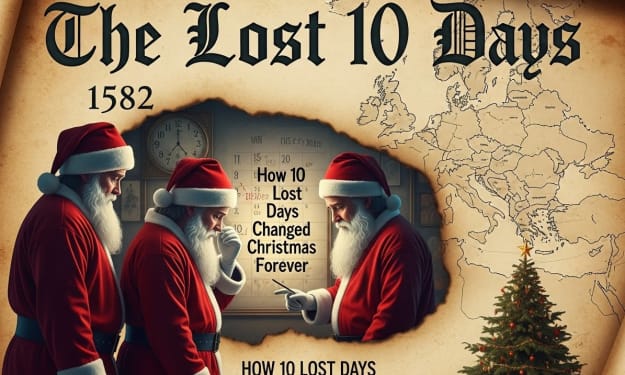
"How Did a 10-Day Shift in 1582 Change Christmas Forever?"
The Hidden History of Christmas and the Calendar Shift Christmas is one of the most celebrated holidays in the world, but its association with December 25th was not always so simple. While we take it for granted today, did you know that Christmas, for a time, wasn’t universally celebrated on the same day? This wasn’t due to some quirky holiday tradition, but because of an error in how time was calculated.
By Daily Motivation2 months ago in History
The Man Who Wouldn’t Die
Imagine this: It's a chilly evening in 1745, and you're sipping coffee in a dimly lit London tavern, the kind where whispers of revolution mix with the clink of coins. Suddenly, the door bursts open, and authorities drag in a mysterious stranger-pockets bulging with diamonds, violin in hand, refusing to utter his name. Who was this guy? And why, centuries later, do people swear he's still out there, unchanged, meddling in the world's biggest moments? That's the hook that pulled me into the wild tale of the Count of Saint Germain, and honestly, it left me scratching my head in wonder.
By KWAO LEARNER WINFRED2 months ago in History
The History of Sheikh’s Spear
It wasn't always called Sheikh’s Spear. In the beginning, it was just a length of strong, straight wood, chosen from an acacia tree that grew alone in a dry valley. The man who found it was a young herder named Khalil. He needed something to guide his goats and lean on during long walks. He smoothed the wood with sand and stone until it felt like a part of his own arm.
By LegacyWords2 months ago in History
Khamlia, Morocco: A Desert Village Where Music Carries Memory
At the edge of Morocco’s golden dunes, far from imperial cities and busy medinas, lies Khamlia—a village whose influence is cultural rather than architectural. Small in size and modest in appearance, Khamlia is known across Morocco for preserving one of the country’s most powerful musical traditions: Gnawa music.
By Ariel Cohen2 months ago in History
Sijilmassa, Morocco: The Lost City That Once Controlled the Trans-Saharan Trade
Long before imperial cities like Fes and Marrakech rose to prominence, Sijilmassa stood as one of Morocco’s most powerful and influential cities. Today, its name rarely appears on tourist itineraries, yet for centuries it was the beating heart of trans-Saharan trade, linking North Africa with West Africa and the wider Islamic world.
By Ariel Cohen2 months ago in History
Amazigh Tattoos: Meanings, Symbols, and Cultural Heritage
Amazigh tattoos, often referred to as Berber tattoos, are among the oldest forms of body art in North Africa. For generations, these markings served as a visual language communicating identity, spirituality, and social status. Though the practice has largely disappeared, the symbols remain an important part of Amazigh cultural memory.
By Ariel Cohen2 months ago in History
History Would’ve Burned This Page Challenge Winners
The Page They Couldn’t Burn” They called it a ledger. To the untrained eye, it looked like a simple leather-bound journal, dusty and cracked with age, kept behind lock and iron key in the furthest cellar of the monastery’s library. Only a few even knew it existed, and fewer dared to read it. Brother Eli knew both the danger and the weight of what was hidden in its pages.
By Abdul Rauf2 months ago in History
Who is John Snow? What is John snow real name?
Early Life and Birth Kit Harington, best known for portraying Jon Snow in the globally acclaimed television series Game of Thrones, was born on December 26, 1986, in Acton, London, England. His full name is Christopher Catesby Harington. He comes from a historically notable family; his ancestry can be traced back to English nobility, including ties to King Charles II. However, despite this lineage, Kit was raised in a relatively modest and grounded environment.
By Daily Motivation2 months ago in History
Cults of Gods: Dionysus, God of Peoples
Among the Olympian gods, Dionysus occupies a unique and often misunderstood position. He was not merely the god of wine or ecstatic madness, but a deity whose worship belonged to crowds rather than kings, festivals rather than palaces, and shared frenzy rather than private prayer. Dionysus was a god experienced collectively—through procession, theater, initiation, and ritual excess—and for this reason he may best be understood as the god of peoples. His cult reveals how ancient Greek society made room for disorder, emotional release, and sacred transgression within an otherwise highly ordered world.
By Alex Smith2 months ago in History