

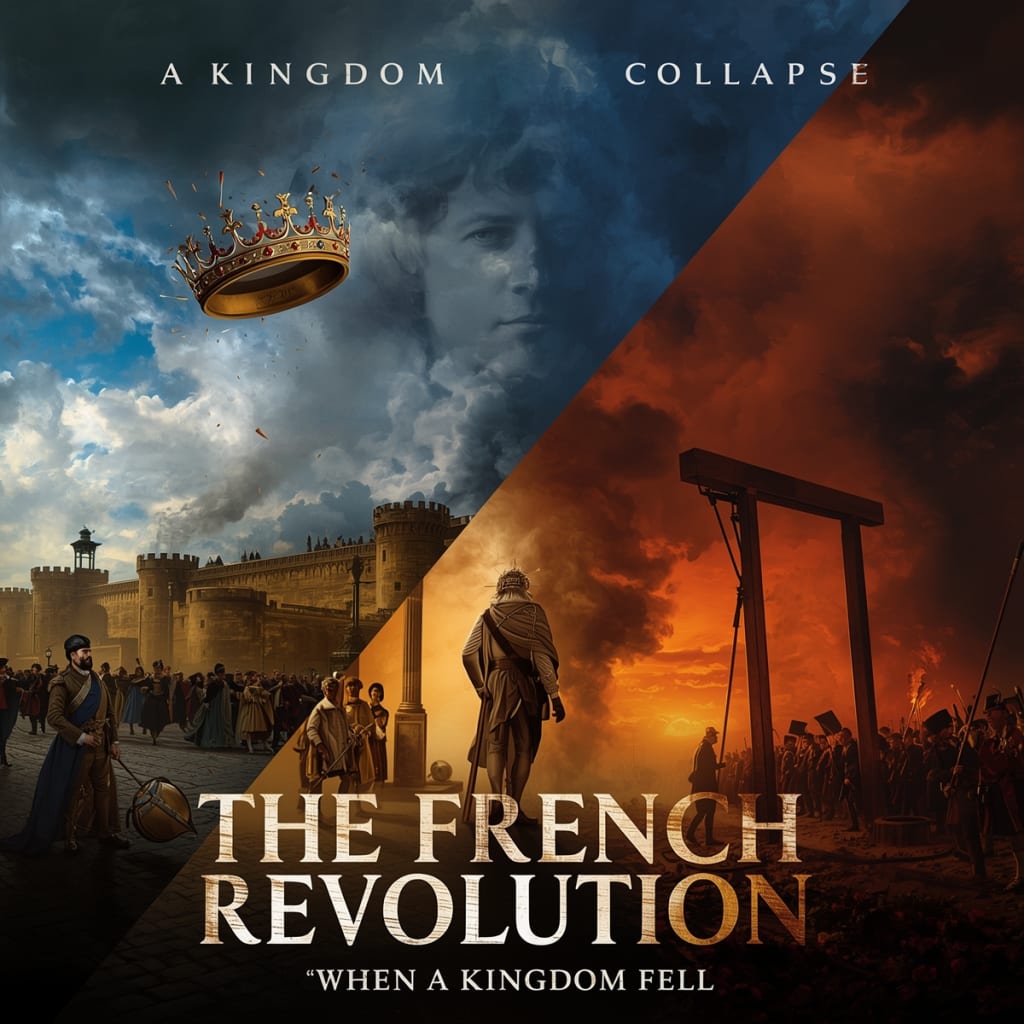
In 1789, France stood at the edge of collapse. For centuries, kings had ruled by divine right, and at the center of that power stood Palace of Versailles, a glittering symbol of absolute monarchy. But beneath the gold and marble, the kingdom was crumbling. Years of costly wars, including support for the American Revolution, had drained the treasury. Heavy taxes fell almost entirely on the common people, while the nobility and clergy enjoyed privileges and exemptions. Harvest failures drove up bread prices, and hunger spread through the streets of Paris. When King Louis XVI called the Estates-General in May 1789 to solve the financial crisis, he unintentionally unleashed forces he could no longer control.
The Estates-General divided society into three estates: clergy, nobility, and the Third Estate—the vast majority of the population. Frustrated by unequal voting rules, representatives of the Third Estate declared themselves the National Assembly, claiming the right to speak for the nation. In June, they swore the Tennis Court Oath, vowing not to disband until France had a constitution. Tension mounted. On July 14, 1789, crowds stormed the Bastille, a medieval fortress-prison in Paris that symbolized royal tyranny. The fall of the Bastille became a powerful image of revolution, and across the countryside, peasants rose up against feudal lords. Fear and fury reshaped the nation almost overnight.
By August, the National Assembly abolished feudal privileges and issued the Declaration of the Rights of Man and of the Citizen, proclaiming liberty, equality, and popular sovereignty. The old order was being dismantled piece by piece. Yet the revolution did not bring immediate stability. Political factions emerged, and mistrust deepened. In 1791, the king attempted to flee France but was captured and returned to Paris, his authority shattered. War soon followed, as European monarchies threatened to crush the revolution. Under pressure from foreign invasion and internal rebellion, the monarchy was abolished in 1792, and France was declared a republic.
In January 1793, Louis XVI was executed by guillotine in a public square, a moment that stunned Europe and marked the irreversible fall of the kingdom. What followed was the Reign of Terror, led by figures such as Maximilien Robespierre. Revolutionary tribunals sent thousands to their deaths in the name of defending liberty. Suspicion ruled daily life, and the revolution devoured many of its own leaders. By 1794, Robespierre himself was executed, and the Terror came to an end, leaving a nation exhausted and divided.
Out of chaos emerged a new order. In 1799, a young general named Napoleon Bonaparte seized power in a coup, promising stability and glory. The revolution had destroyed the old monarchy, but it had also opened the door to a new form of authority. Over the next decade, Napoleon would crown himself emperor and reshape Europe through war. Yet the ideas born in 1789—citizenship, rights, equality before the law—could not be undone. The French Revolution had toppled a kingdom, executed a king, and shaken the foundations of Europe. In less than a decade, France moved from absolute monarchy to republic, to empire. Its legacy endures not only in French history, but in the modern world’s understanding of power, freedom, and the rights of the people.
Out of chaos emerged a new order. In 1799, a young general named Napoleon Bonaparte seized power in a coup, promising stability and glory. The revolution had destroyed the old monarchy, but it had also opened the door to a new form of authority. Over the next decade, Napoleon would crown himself emperor and reshape Europe through war. Yet the ideas born in 1789—citizenship, rights, equality before the law—could not be undone. The French Revolution had toppled a kingdom, executed a king, and shaken the foundations of Europe. In less than a decade, France moved from absolute monarchy to republic, to empire. Its legacy endures not only in French history, but in the modern world’s understanding of power, freedom, and the rights of the people.




Comments
There are no comments for this story
Be the first to respond and start the conversation.