
The Great Train Robbery — 8th August 1963 Part 1
Greatest Train Robbery of All Times

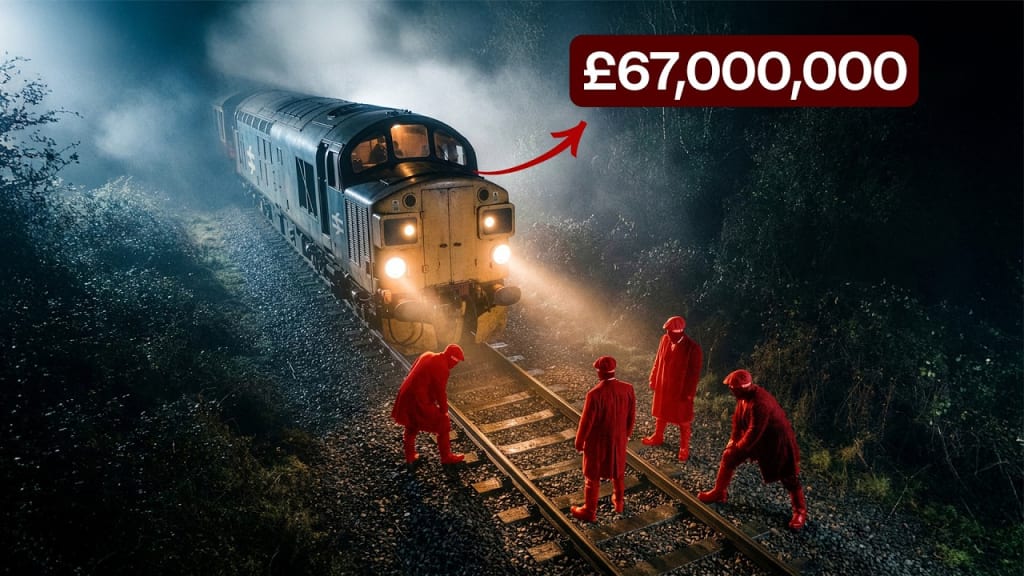
On the dark night of 8th August 1963, a Royal Mail train was traveling from Glasgow to London.
Inside one of its carriages were bags filled with cash—worth nearly 67 million pounds today, or around ₹800 crore.
The train driver, Jack Mills, was speeding through the darkness when suddenly, at a crossing, a red signal light flashed.
For the driver, this was extremely unusual, because at that time and place, the signal being red made no sense.
Still, Jack Mills immediately applied the brakes and stopped the train on the deserted track.
For a few moments, silence took over…
But hidden behind that silence was a master plan—one that would become one of the biggest robberies of the century:
The Great Train Robbery
Welcome back to My story
Viewers, this may sound like a movie plot…
But in real life, criminals carried out a suspense-filled operation and looted millions of pounds from Britain’s government train—without firing a single bullet.
The Plan Begins
Everything started months earlier, when a group of well-known London criminals sat down to plan a new major crime.
The mastermind was Bruce Reynolds.
He had received secret information about the Royal Mail system from a senior security officer—whose identity remains unknown to this day.
The information was about a special carriage on the Glasgow-to-London train known as:
HVP — High Value Packages
On a particular day, this carriage would be carrying an unusually large amount of money.
And that was the carriage they planned to rob.
Building the Team
Although Bruce Reynolds and his gang were experienced criminals, they had never robbed a train before.
So they brought in another London gang with train robbery experience:
The South Coast Raiders
Slowly, the team grew, and more than 15 men became part of the plan.
Their goal was clear:
Rob the train without firing a single shot.
But this was no ordinary robbery.
It required months of planning.
The Train’s Journey
On 7th August 1963 at 6:50 PM, the train departed from Glasgow Central Station.
It was scheduled to arrive at London’s Euston Station at 4:00 AM the next morning.
The train had:
12 total carriages
72 Post Office staff onboard
A system designed to drop mail at stations without stopping
The train was mainly used for parcels and postal deliveries across different cities.
A Major Security Weakness
The carriage meant for the robbery was still not attached when the train departed.
It was safely parked at Nene Valley Station.
This was the HVP carriage.
Earlier, in 1960, the Post Office Investigation Branch had ordered security alarm systems to be installed in these carriages.
By 1961, three HVP carriages had alarms installed.
Older carriages without alarms were kept in reserve.
But on the robbery day…
The alarm-equipped carriages were out of service.
So a reserve carriage, M3024M, was used instead—with no security system at all.
This was a huge insider tip.
Even More Money Than Usual
Normally, an HVP carriage carried about 300,000 pounds.
But because the previous week was a bank holiday weekend…
That day, it carried nearly:
3 million pounds in cash
Twelve times more than usual.
This wasn’t coincidence.
The criminals had planned everything perfectly.
The Signal Trap
At around 3:00 AM on 8th August, one gang member tampered with the signal at Sears Crossing.
About the Creator
Imran Ali Shah
🌍 Vical Midea | Imran
🎥 Turning ideas into viral content
✨ Watch • Share • Enjoy
Keep reading
More stories from Imran Ali Shah and writers in History and other communities.
Plane: 121 People SilThe Ghost ent at 34,000 Feet part 2
At that moment, the engineer remembered something important. Before the flight, the same engineer had checked the aircraft’s pressurization system, because its controls were close to the controls the captain seemed confused about.
By Imran Ali Shaha day ago in History
The Mirage of Separation: Why Autonomy Under Moroccan Sovereignty Is the Only Viable Path Forward
For nearly five decades, the dispute over the Moroccan Sahara has lingered as a frozen conflict—sustained less by the will of its people than by entrenched political narratives and regional rivalries. What began as a decolonization question has evolved into a geopolitical stalemate, one that has trapped generations in uncertainty and hindered integration across North Africa.
By Rachid Zidineabout 8 hours ago in History
6 Bizarre Taxes From History That Will Make You Thank Modern Life
Throughout history, taxes haven’t always been about income or property. Some levies were downright bizarre, targeting everyday life, personal habits, and even your body. From medieval England to ancient Rome, here are six of the strangest taxes ever recorded.
By Areeba Umairabout 4 hours ago in History
Super Bowl LX Recap: A Team Called Hawks
Sixty. The Super Bowl turned 60! Still amazes me that this was the sixtieth Super Bowl played in NFL history. It seems like yesterday that I watched Super Bowl XXVII, the first SB I ever watched. The QB who won Super Bowl XXVII has since called a few SBs, and will call next year's game, but that's another story. Super Bowl LX took place at Levi's Stadium in Santa Clara, California, the home stadium of the San Francisco 49ers. However, it was one of their division foes who represented the NFC, as the Seattle Seahawks faced off against the New England Patriots.
By Clyde E. Dawkins7 days ago in Unbalanced

Comments
There are no comments for this story
Be the first to respond and start the conversation.