
The Wright Brothers
The Invention That Gave Humans the Sky

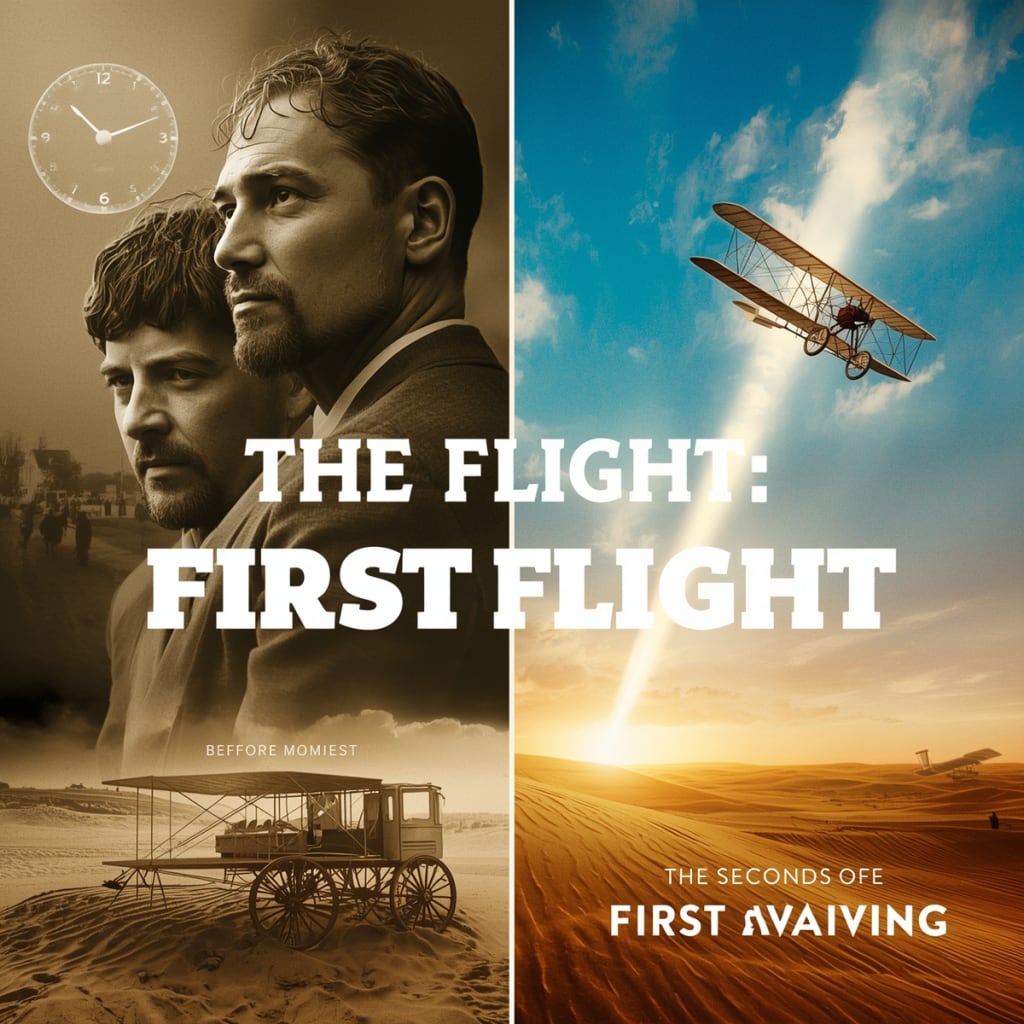
At the dawn of the twentieth century, when human flight was still a dream confined to myths and sketches, two quiet bicycle makers from Dayton, Ohio, set out to challenge the limits of gravity. Wilbur and Orville Wright were not wealthy, formally trained engineers, nor backed by powerful institutions. What they possessed instead was patience, curiosity, and an unshakable belief that controlled flight was possible. While others focused on building stronger engines, the Wright brothers understood that the true problem of flight was control. Through years of careful observation, they studied birds in motion, experimented with kites, and built their own wind tunnel to test hundreds of wing designs. This relentless experimentation led them to master lift, drag, and balance in ways no one else had achieved.
In December 1903, on the windswept dunes of Kitty Hawk, North Carolina, their work reached a historic turning point. The Wright Flyer, a fragile machine of wood, wire, and fabric, rose from the ground under its own power. Orville piloted the first flight, staying aloft for just twelve seconds and covering 120 feet. Though brief, this moment marked the first successful powered, sustained, and controlled flight of a heavier-than-air aircraft. Over the course of that day, the brothers flew three more times, with Wilbur’s final flight lasting nearly a full minute. The age of aviation had begun, quietly witnessed by only a handful of people.
Yet recognition did not come easily. For years, the Wright brothers struggled to convince the world of their achievement, facing skepticism from governments and scientists alike. Undeterred, they continued refining their designs, improving stability, range, and reliability. By 1908, public demonstrations in the United States and Europe silenced all doubt, as their aircraft performed controlled turns, figure-eight maneuvers, and sustained flights lasting over an hour. Military leaders and innovators quickly realized the implications: warfare, transportation, and global communication would never be the same.
The invention that gave humans the sky transformed the modern world. From commercial air travel to space exploration, the legacy of the Wright brothers extends far beyond their first fragile flights. Their greatest contribution was not just a flying machine, but a method—a disciplined approach to problem-solving rooted in observation, experimentation, and persistence. In proving that human flight was possible, Wilbur and Orville Wright did more than conquer the air. They redefined what human ingenuity could achieve, lifting civilization itself into a w era.
At the dawn of the twentieth century, when human flight was still a dream confined to myths and sketches, two quiet bicycle makers from Dayton, Ohio, set out to challenge the limits of gravity. Wilbur and Orville Wright were not wealthy, formally trained engineers, nor backed by powerful institutions. What they possessed instead was patience, curiosity, and an unshakable belief that controlled flight was possible. While others focused on building stronger engines, the Wright brothers understood that the true problem of flight was control. Through years of careful observation, they studied birds in motion, experimented with kites, and built their own wind tunnel to test hundreds of wing designs. This relentless experimentation led them to master lift, drag, and balance in ways no one else had achieved.
In December 1903, on the windswept dunes of Kitty Hawk, North Carolina, their work reached a historic turning point. The Wright Flyer, a fragile machine of wood, wire, and fabric, rose from the ground under its own power. Orville piloted the first flight, staying aloft for just twelve seconds and covering 120 feet. Though brief, this moment marked the first successful powered, sustained, and controlled flight of a heavier-than-air aircraft. Over the course of that day, the brothers flew three more times, with Wilbur’s final flight lasting nearly a full minute. The age of aviation had begun, quietly witnessed by only a handful of people.
Yet recognition did not come easily. For years, the Wright brothers struggled to convince the world of their achievement, facing skepticism from governments and scientists alike. Undeterred, they continued refining their designs, improving stability, range, and reliability. By 1908, public demonstrations in the United States and Europe silenced all doubt, as their aircraft performed controlled turns, figure-eight maneuvers, and sustained flights lasting over an hour. Military leaders and innovators quickly realized the implications: warfare, transportation, and global communication would never be the same.
The invention that gave humans the sky transformed the modern world. From commercial air travel to space exploration, the legacy of the Wright brothers extends far beyond their first fragile flights. Their greatest contribution was not just a flying machine, but a method—a disciplined approach to problem-solving rooted in observation, experimentation, and persistence. In proving that human flight was possible, Wilbur and Orville Wright did more than conquer the air. They redefined what human ingenuity could achieve, lifting civilization itself into a new era.
About the Creator
The Spanish Donkey: A Dark Instrument of Punishment in European History
History is often told through kings, wars, and revolutions. But hidden between those grand narratives are quieter, darker stories. Stories of ordinary people, unnamed in records, who experienced history not as progress, but as pain. One such story is tied to an object known as the Spanish Donkey, also called the Wooden Horse, an instrument of punishment used in parts of Europe during the late medieval and early modern periods.
By Salman Writes4 days ago in History
Frederick the Great: Winning When Surrounded
Few leaders in history have faced danger as relentlessly as Frederick II of Prussia, better known as Frederick the Great. He ruled a small, newly elevated kingdom with powerful enemies on every border, a limited population, and an army that could never afford large losses. Yet time and again, Frederick survived—and often triumphed—when surrounded by foes who should have crushed him. His genius was not conquest for its own sake, but the art of winning when defeat seemed inevitable.
By Fred Bradford3 days ago in History



Comments
There are no comments for this story
Be the first to respond and start the conversation.