
Dracula in Instanbul
Turkey, 1953

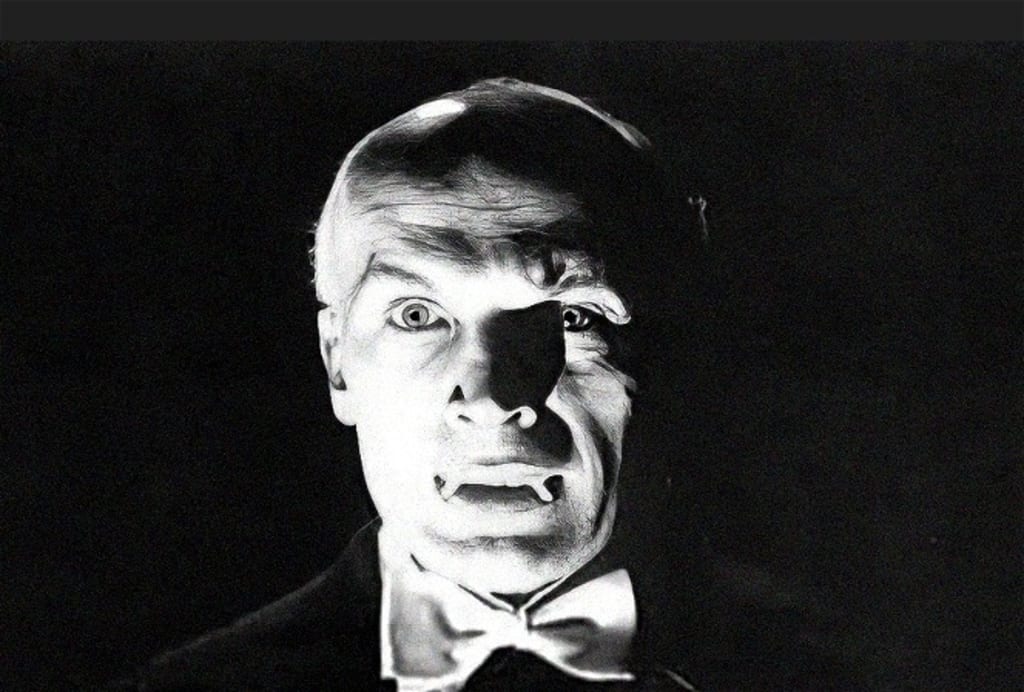
Not a turkey but from Turkey. Snappy title, no?
Dracula in Istanbul is a 1953 Turkish production that is stark, grainy, lost, and has that air of being more a museum piece curiosity than an actual piece geared toward entertainment. But, alas, it's not a bad picture, if a dated one.
Modern Turkey under Erdogan is reverting to a theocratic religious state, but in 1953 women still danced erotically in night clubs, and this is a central tenet of the action in this Dracula, which begins with a train ride to Transylvania, wherein Azmi (the Johnathan Harker character, portrayed here by Bülent Oran) disembarks from a train and enters an inn. The inside is immediately striking for the way the director uses space and geometry, the angled composition of the scene, to depict the lurking and increasing sense of unease. The film, despite the wear and tear of its age, is acually somewhat beautiful in this regard.
Azmi is warned by the superstitious peasants that the 14 is a sort of Turkish Walpurgisnacht--the night when witches, werewolves, and let's not forget most especially VAMPIRES walk, along with Satan himself, the world with Earthly, if cloven, feet. He poo-poos the warning and proceeds to take the old familiar carriage in the old familiar way to the Borgo Pass--which, here, is not called the Borgo Pass.
Making it to Castle Drac, he is greeted by a Count (Atif Kaptan) that has apparently made off with Bela Lugosi's old wardrobe. The Count, who appraises him that "time has no meaning here," leads him upstairs while seeming to transform into another being, perhaps the carriage driver, while his back is turned. The film has those dream-like touches.
There is a sort of stand-in Renfield character (in Todd Browning's Dracula, Renfield replaces Harker on the opening journey to Transylvania) with a deformed nose and a walrus moustache, hunchbacked, a grotesquerie that fares not very well at the hands of his master (but remember, neither did Renfield). Drac commands Azmi to compose postdated letters, much as in the original novel, thus giving Azmi as he did Harker, an idea of when the Count means to kill him. Famously Azmi, like Harker, and Renfield, and countless permutations of this often-composited character, falls asleep in the castle in a place he has been warned against. Although it is usually a trio of Dracula's weird wives that accost the sleeping man, here it is only one; standards and practices probably forbade the depiction of multiple succubi.
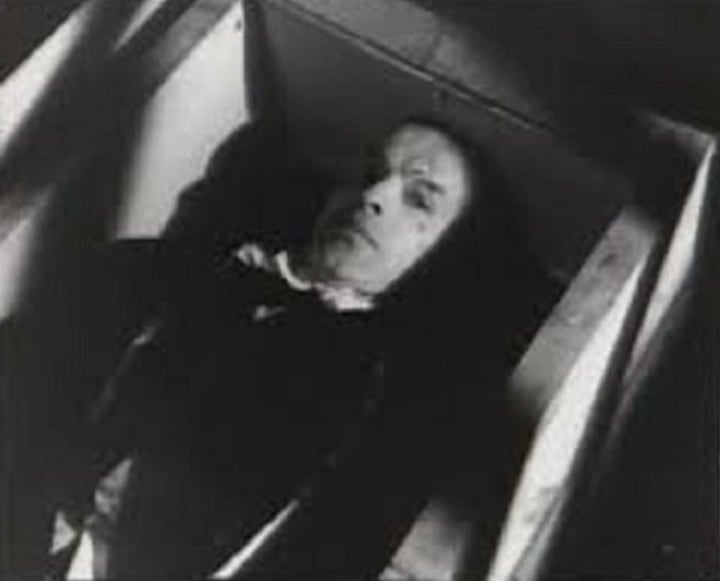
Azmi discovers a book on vampires, but the pages on how to destroy them are gone (no surprise) and he mostly learns that vampires drink blood, fly by night, sleep in the dirty boxes of soil of their native home, and that Dracula, the worst of all, was also called "Vlad the Impaler."
Vlad Tepes was a fifteenth century Wallachian warlord of ill-repute, chiefly because of his sadism and cruelty (having the turbans of Turkish ambassadors nailed to their heads because they refused to take them off out of respect, was one example), who led his troops to stunning victories against the Ottoman Turk invaders--who, as brutal as they were were not quite prepared for the level of psychopathy that was exhibited by Prince Vlad, whom the called the "Son of the Dragon"; i.e. "Dracula".
The Bloody Forest
Picture if you will an advancing army confident of their victory, riding through the weed-choked plains, down dusty and rocky roads toward what they assume will be a battle that will end in their overwhelming victory. Suddenly, in the pale, trickling light of the setting sun, as darkness embraces the belly of the Earth, they see a sight as strange and horrifying as any they've ever seen.
They cannot believe their eyes. It's like something from a nightmare.
Row after row of slain men, some of them still twitching spasmodically, crying out in their death throws, in their agony, impaled on tall wooden stakes, dripping their life's blood out onto the brittle, sunbaked earth, creating red torrents and pools, burbling brooks of blood.
But that's another tale, for another time.
At the end of the film, Dracula traps the desirable, kewpie-doll cute and so-elegant Duzin in a theater, making her to dance for him. "You are a delicious treat. You will dance for me, and me alone!" Or something to that effect, he tells her.
His stone-cold stare is often glowing in close-up, bathed or washed in a weird light. Previous to this, Guzin's friend Sadan (Ayfer Feray) has been found to be sleepwalking by her mother, an elderly woman suffering a heart condition. Down a staircase she goes to the sea, to be near Dracula, her deathly lover risen from the grave, who has brought the vessels (boxes) of his sacred soil so that he might sleep in the local graveyard the sleep of death--waiting.
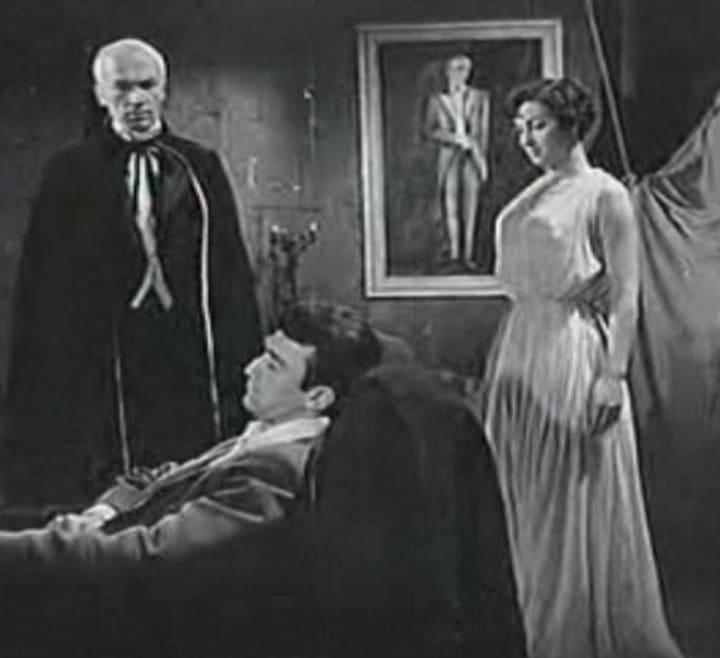
Sadan, much like poor Lucy in the original novel of Dracula, the "Bloofer Lady" who kidnapped children and became a wandering, white-shrouded ghost in her burial cerements. Here she is confronted by vampire hunters, Drs. Akif (the Seward character, played by Münir Ceyhan) and Dr. Nuri (the Van Helsing character, portrayed by Kemal Emin Bara), along with the returned Azmi and Turan (Cahit Irgat), the fiance of Sadan, and is dispatched, after dropping an exsanguinated infant from her stiff, cold grasp.
Dracula, at the end playing the piano with invisible, psychokinetic fingers, bolts from the theater as Azmi, producing the dreaded garlic, chases him through the rain-soaked, neon lit streets of 1953 Istanbul to a graveyard, where he rests in an open coffin, in a shallow declivity not quite a grave. Azmi quickly dispatches him with a stake, returning to Guzin and telling her they must never allwo garlic in their home. Not even for cooking.
Dracula in Istanbul is a curious artefact, a cultural translation of the English tale, filtered through the lens of a society that viewed the legendary Vlad the Impaler as a true, literal bloodthirsty demon (to his own people he is a national hero for repelling the invading Ottoman Turks). The social climate of Turkey poised unceratinly between an Islamic past and a present that as neon lights, night clubs, permissive dancing, a little flash of flesh--this strange dichotomy unsettles the viewer.
But, as it sat riding two side of the fence in 1953, there is little doubt as to which side tradition, like the deathless revenant himself, was waiting, lurking, keeping alive, in an undead sense, a past that is as ancient and strange to us as a body that refuses its own end.
Based on a Turkish adaptation of Stoker by Ali Riza Seyfi: Kazıklı Voyvoda, written in 1928. Adapted by Mehmet Muhtar with Turgut Demirag, Umit Deniz, and directed by Mehmet Muhtar. The cinematography is stark, coldly and elegantly beautiful at times, having a strange, eerie verisimilitude. The special effects are primitive at best.
Otherwise, an interesting, forgotten artefact of the cinematic bloodsuckers of ages and cultures far removed from us in time and place.
Dracula in Istanbul (1953) | HQ English Subtitles | Drakula İstanbul'da
Author's website
Author's YouTube channel
My book: Cult Films and Midnight Movies: From High Art to Low Trash Volume 1
Ebook
My book: Silent Scream! Nosferatu, The Cabinet of Dr. CAligari, Metropolis, and Edison's Frankenstein--Four Novels.
Ebook
My book: Theater of the Worm: Essays on Poe, Lovecraft, Bierce, and the Machinery of Dread by Tom Baker
About the Creator
Tom Baker
Author of Haunted Indianapolis, Indiana Ghost Folklore, Midwest Maniacs, Midwest UFOs and Beyond, Scary Urban Legends, 50 Famous Fables and Folk Tales, and Notorious Crimes of the Upper Midwest.: http://tombakerbooks.weebly.com
Killing him slowly
There’s an intruder in my house again. He stumbles through the door, wet carrier bags in hand. He’s bought me offerings. I show my appreciation, letting him caress my beautiful body. He wants to touch me. I rub myself against his legs. He sighs, dropping the bags. He can’t resist touching me. Running his hand slowly down my spine, I arch my back towards his caress, let out a low purr. It’s what we both need.
By N J Delmas5 days ago in Horror
Ajit Pawar: Power, Controversy, and Influence in Maharashtra Politics
Ajit Pawar: Power, Controversy, and Influence in Maharashtra Politics Ajit Pawar is one of the most influential and controversial political figures in Indian politics, particularly in the state of Maharashtra. Known for his sharp political instincts, administrative experience, and decisive style, Ajit Pawar has played a central role in shaping state politics for decades. His career has been marked by rapid rises, dramatic political shifts, and continued relevance across changing political alliances.
By America today 5 days ago in Horror
One Unchecked Box
"Republished" because it was the only way to add the embed for the newly recorded audio version of this story due to the Top Story badge. Plus it serves as a nice, informal announcement of the podcast's revival for another season (go subscribe!):
By Stephen A. Roddewig6 days ago in Fiction




Comments (1)
I enjoyed this. I was fortunate enough in grad school to take a Poe seminar with Scott Peeples. I’ll check out your book when I get some $$.