
Teke Teke: The Sound of Your Final Seconds
She has no legs, but she is faster than a train. The tragedy of Reiko Kashima and the lethal mechanics of a Japanese urban legend.

1. The Sound That Paralyses
Imagine walking home alone at twilight. The streets of suburban Japan are quiet, save for the distant hum of a vending machine. Suddenly, you hear a strange, rhythmic scratching behind you.
Teke... teke... teke...
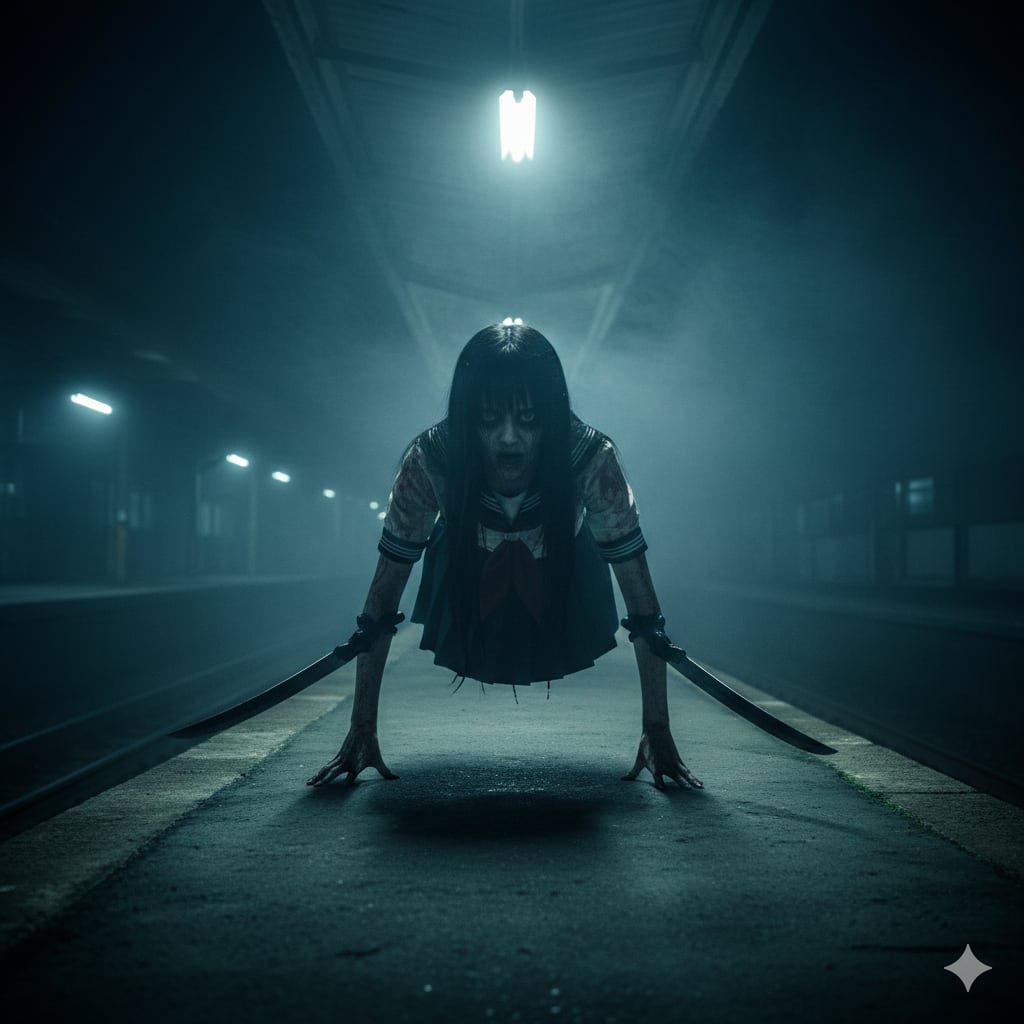
It sounds like dry bone hitting cold asphalt. You turn around, expecting a stray cat or a fallen branch, but instead, you see a girl’s torso—severed at the waist—sprinting toward you on her elbows and palms. This is the Teke Teke. She doesn't scream; she only moves with a terrifying, mechanical speed, her scythe glistening in the moonlight. If she catches you, you won't just die—you will be sliced in two, destined to become just like her.
2. The Tragic Origin: Reiko Kashima
Like many Japanese urban legends, the Teke Teke is rooted in a deep, unresolved tragedy (Onryo). The most common version of her origin story takes us to the snowy prefecture of Hokkaido.
A young woman named Reiko Kashima was walking home late at night when she was ambushed by a group of men. In her desperate attempt to escape, she fell onto the railway tracks and lost consciousness. Moments later, a train roared through the station, severing her body in half.
But Reiko did not simply perish. Her "Kegare" (spiritual pollution) and "Urami" (grudge) were so potent that they anchored her soul to the world of the living. She rose from the tracks, dragged herself onto the platform, and began her eternal search for her missing lower half—and for anyone who might be unfortunate enough to cross her path.
3. The Lethal Quiz: A Game of Life and Death
What makes the Teke Teke (specifically in her form as Reiko Kashima) truly terrifying is that she is not just a physical threat; she is a psychological one. Sometimes, she doesn't chase you. Instead, she appears in a bathroom stall or a darkened hallway and asks you a series of questions.
This is where your cultural knowledge becomes a matter of survival.
The Question: "Where are my legs?"
The Answer: "On the Meishin Expressway." (The legendary site of her accident).
The Follow-up: "Who told you that?"
The Only Safe Answer: "Kashima Reiko told me."
If you hesitate, or if you answer incorrectly, she will tear your legs from your body so you can share her eternal agony.
4. The "Infection" of the Story
There is a meta-horror element to this legend that makes it particularly popular on the internet. It is said that once you hear the story of Reiko Kashima, she will appear to you within three days. By reading this article, the "clock" has technically started.
This viral nature of Japanese urban legends—where the story itself acts as a curse—is why they remain so persistent in the digital age. Unlike Western monsters that hide in the woods, Japanese ghosts like the Teke Teke hide in the information we share. They are "modern spirits" that thrive on internet forums and social media.
5. Why the Teke Teke Still Haunts Us
Why are we so obsessed with a legless girl shuffling on her elbows? It taps into a primal fear of the "uncanny." A human figure moving in an inhuman way is inherently disturbing. Furthermore, the Teke Teke represents the "anxiety of the commute"—the fear that the very infrastructure we rely on (trains and stations) can turn against us in an instant.
As long as there are quiet school hallways and lonely railway crossings, the sound of Teke Teke will continue to echo.
Conclusion: A Final Word of Advice
If you are walking home tonight and hear that scratching sound, do not look back. Just run. And if you see a girl at a window who seems to be missing her lower half, remember the name "Kashima Reiko." It might be the only thing that keeps you whole.
About the Creator
Takashi Nagaya
I want everyone to know about Japanese culture, history, food, anime, manga, etc.
Keep reading
More stories from Takashi Nagaya and writers in Horror and other communities.
The Game You Play Alone: A Terrifying Guide to "One-Man Hide and Seek"
Introduction: The Solitary Invitation In the eerie corners of the internet, where shadows linger and curiosity often leads to peril, a terrifying ritual emerged: "Hitori Kakurenbo," or "One-Man Hide and Seek." It's a game played alone, in the dead of night, designed not for entertainment, but to invite a malevolent spirit into your home for a deadly game.
By Takashi Nagaya2 days ago in Horror




Comments
There are no comments for this story
Be the first to respond and start the conversation.