
The Day Humans Stopped Thinking
How Artificial Intelligence Is Quietly Rewiring the Human Mind
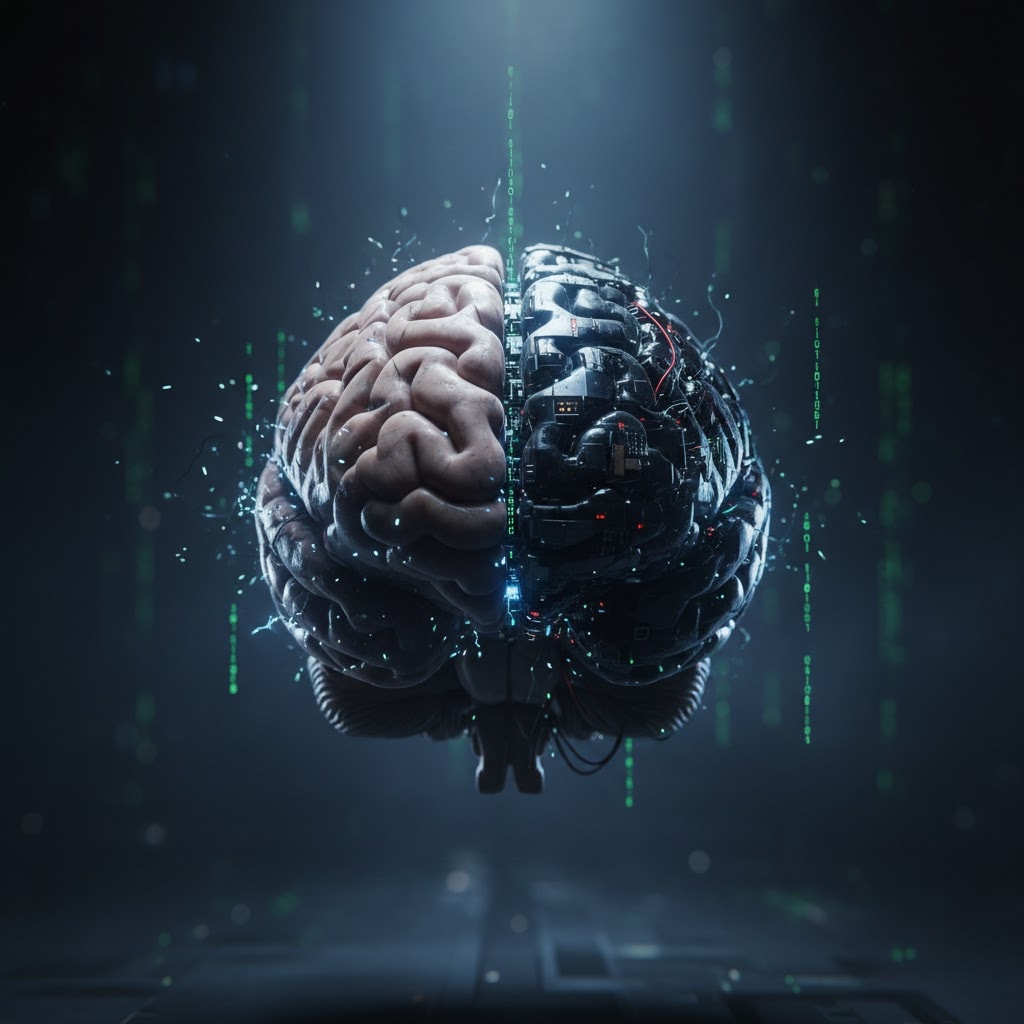
There was no explosion.
No announcement.
No dramatic headline declaring the end of human thought.
It happened quietly.
One day, instead of remembering a fact, we searched for it.
Instead of calculating, we asked.
Instead of struggling to solve a problem, we delegated it.
And slowly—almost invisibly—the responsibility of thinking began to shift.
This is not a story about machines taking over the world. It’s about something far more subtle.
It’s about us.
________________________________________
The Comfort of Convenience
Human history has always been shaped by tools. Fire expanded survival. The wheel expanded movement. The printing press expanded knowledge. Each invention changed how we lived—and how we thought.
Artificial Intelligence is different.
It doesn’t just extend our physical abilities.
It extends—and sometimes replaces—our cognitive ones.
Navigation apps remember roads so we don’t have to.
Search engines remember facts so we don’t have to.
AI systems draft emails, generate ideas, summarize books, even suggest life decisions.
Convenience feels harmless. Helpful, even.
But what happens to a muscle that is never used?
It weakens.
The human brain thrives on challenge. When we struggle to recall information, we strengthen neural pathways. When we wrestle with complex problems, we build critical thinking skills. When we debate, imagine, and reflect, we refine judgment.
If AI handles the heavy lifting of cognition, are we outsourcing intelligence itself?
________________________________________
Thinking vs. Knowing
There is a difference between having access to information and truly understanding it.
Before the digital age, learning required effort. You read full books. You formed arguments. You memorized foundational knowledge. The process was slow—but depth was inevitable.
Today, information is instant.
We skim headlines.
We read summaries.
We rely on algorithms to filter reality.
The illusion is powerful: because information is available, we feel informed.
But thinking is not the same as retrieving data.
Thinking requires synthesis.
Comparison.
Reflection.
Doubt.
When AI provides polished answers in seconds, it removes friction. And friction is often where understanding is born.
The danger is not that AI is intelligent.
The danger is that we might stop being intellectually patient.
________________________________________
The Dopamine Loop
There is another invisible shift happening.
Every time we receive an instant answer, our brain rewards us. Quick resolution triggers dopamine—the same chemical involved in pleasure and habit formation.
The faster the answer, the stronger the reward loop.
Why wrestle with a difficult concept for an hour when an AI can explain it in seconds?
Why brainstorm for days when a machine can generate 50 ideas instantly?
The human mind begins to adapt to speed over depth.
We become less tolerant of confusion.
Less comfortable with uncertainty.
Less willing to sit in silence with a difficult question.
And yet, creativity and innovation are born from exactly those uncomfortable spaces.
________________________________________
Dependency or Evolution?
Some argue this is not decline—it’s evolution.
After all, calculators didn’t destroy mathematics. They changed it. Search engines didn’t eliminate knowledge. They expanded access.
Maybe AI is simply the next cognitive upgrade.
Perhaps by outsourcing memory and routine analysis, humans can focus on higher-level thinking—strategy, empathy, philosophy, creativity.
The real question is not whether AI thinks better than us.
It’s whether we will choose to think differently because of it.
Will we become passive consumers of machine-generated insight?
Or active directors of machine-assisted intelligence?
________________________________________
The Subtle Erosion of Critical Thought
Critical thinking requires effort. It demands questioning sources, identifying bias, and challenging assumptions.
AI systems are designed to be smooth. Polished. Confident.
When answers sound authoritative, we’re less likely to interrogate them.
Over time, reliance can turn into trust.
Trust can turn into dependence.
Dependence can quietly become intellectual surrender.
If we stop questioning outputs, we risk dulling the very skill that separates humans from machines: judgment.
Machines calculate probability.
Humans evaluate meaning.
And meaning cannot be automated.
________________________________________
The Emotional Shift
There is something else happening—something psychological.
We are beginning to interact with machines as if they understand us.
We thank them.
Confide in them.
Ask for advice.
The line between tool and companion blurs.
When technology feels responsive, we attribute intelligence—and sometimes empathy—to it.
But empathy is not pattern recognition.
Consciousness is not computation.
If we begin to lean on machines not just for answers but for affirmation, guidance, and validation, we risk weakening human-to-human connection.
The irony is striking.
In a world more connected than ever, genuine human dialogue may quietly decline.
________________________________________
The Day Humans Stopped Thinking
It won’t be marked on a calendar.
It won’t arrive as a dramatic collapse of intelligence.
It will look like convenience.
Efficiency.
Optimization.
It will look like progress.
The real danger is not that AI becomes smarter than humans.
It’s that humans become comfortable being less thoughtful.
The day humans stop thinking is not the day machines surpass us.
It is the day we stop questioning.
Stop analyzing.
Stop reflecting.
Stop challenging ourselves to wrestle with complexity.
It is the day we trade depth for speed—and don’t notice the difference.
________________________________________
A Different Future Is Possible
But this story does not have to end in decline.
AI can be a partner instead of a replacement.
It can amplify creativity rather than suppress it.
Enhance research rather than eliminate effort.
Spark new questions rather than provide final answers.
The key lies in intention.
Use AI to explore ideas—but challenge them.
Use AI to generate—but refine with human judgment.
Use AI to assist—but never to replace curiosity.
The most powerful combination in history may not be human versus machine.
It may be human with machine.
________________________________________
The Final Question
So ask yourself:
When was the last time you struggled with a problem before seeking an instant answer?
When was the last time you sat with uncertainty instead of escaping it?
When was the last time you truly thought—deeply, independently, patiently?
Artificial Intelligence is not the enemy of humanity.
Complacency is.
The future will not be decided by machines alone.
It will be decided by whether we choose to remain thinkers in an age where thinking is optional.
Because the day humans stop thinking…
Will not be caused by technology.
It will be caused by choice.
About the Creator
Mind Meets Machine
Mind Meets Machine explores the evolving relationship between human intelligence and artificial intelligence. I write thoughtful, accessible articles on AI, technology, ethics, and the future of work—breaking down complex ideas into Reality
Keep reading
More stories from Mind Meets Machine and writers in Horror and other communities.
“The Day AI Learned to Think Like Us (And Why That Should Scare You a Little)”
There was a time when machines were predictable. You pressed a button, and they followed instructions. They calculated, processed, and obeyed. They never surprised us. They never understood us.
By Mind Meets Machine13 days ago in Horror
The House That Watched
The house at the end of Willow Lane had been empty for nearly twenty years. Its windows were dark, its garden overgrown, and its gate hung crooked on rusted hinges. Children dared each other to touch its door before running away in panic. Adults avoided speaking about it altogether. Rumors drifted through the town like cold wind—strange noises at night, shadows moving behind curtains, lights flickering in rooms without electricity. But no one had ever confirmed anything. The house simply existed, silent and waiting.
By Sudais Zakwan3 days ago in Horror


Comments
There are no comments for this story
Be the first to respond and start the conversation.