
The Importance of 'Peeping Tom'
Challenging society sixty years after its rocky release.

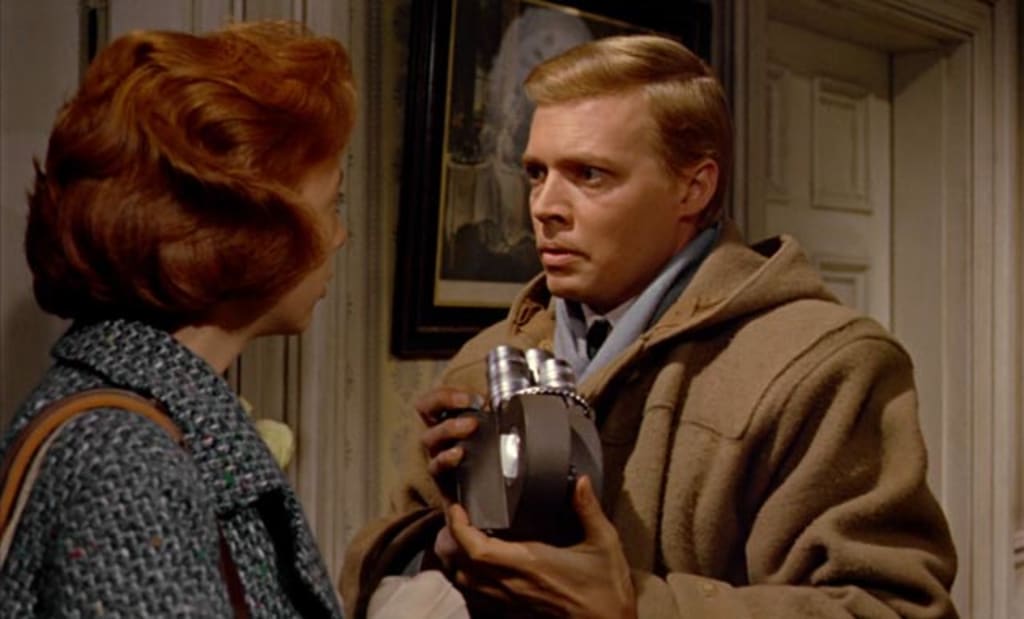
So absorbing and successful at focusing on the camera as a tangible concept that you quickly forget this film is being directed by the late great Michael Powell, rather than aspiring director and psychopath Mark Lewis. The film focuses on a young man who murders women and uses a camera to film their final moments, immortalising them in his growing filmography. Peeping Tom was incredibly controversial upon its release and sent critics and audiences into uproar with it’s sleazy, sexual themes mixed with overt violence. As a result, it’s initial release only lasted five days before being pulled and single-handedly crumbling Michael Powell’s illustrious career. However, years on it, is now considered a masterpiece of both horror and British cinema and is widely considered as a spiritual partner to Hitchcock’s game-changing Psycho (1960) and also Rear Window (1954), connected in character types, subject matter and style. But this film did not get a chance to reach the box-office heights of it’s American counterparts.
Powell challenged themes that were yet to be seriously considered by the film community and would not be examined or even named until Laura Mulvey’s seminal essay “Visual Pleasure and Narrative Cinema,” which discusses cinema having a male biased gaze. He uses the film as a psychoanalysis of this very topic among others such as the directors quest for realism, childhood trauma and sexual crises. All of these ideas are set up from the beginning, which puts the audience in the driver's seat as they are now informed of the director both inside and outside of the film. The antagonist, Mark Lewis, played brilliantly by Carl Boehm, challenges the stereotypical mould of the cold-blooded killer. He is robotic, reclusive, obsessed and seems to function purely to carry out his "artistic endeavour." Powell explores his backstory through the character’s obsession with home videos from his childhood, slowly revealing the source of his "motive." As a result, the audience is thrown further into the director’s discussion on voyeurism while still in the conventional horror narrative. All of which shocked audiences, the idea of feeling sympathy for a perverted serial killer in what was considered a hyper-sexualised slasher film.
The camera work is unique and plays such an important role as a focal point in the narrative. Instead of functioning with anonymity, the director draws the audiences attention to the camera. As it shifts between Mark’s smaller handheld 16mm, which he uses to film his killings and as his murder weapon, and the classical cinematic 35mm. The camera confronts the audience and implicates them in the crimes being committed through handheld POV’s that gaze on its victims for slightly longer than what is comfortable. While masterfully building suspense through tighter framing, leaving the audience to second-guess how these killings are being followed out, before finishing off with murder that is overtly sexualised and violent, a combination which shocked and horrified.
Peeping Tom is a masterpiece; it’s a concoction of ideas that were yet to be considered in cinema. Michael Powell uses "high-art" horror tropes to critique cinema’s perspective by turning the camera back on cinema to psychoanalysis and reflect on the power and influence it has. This influence can be positive and negative and Mark Lewis embodies the negative, acting as a living, breathing warning to the audience for what happens when the camera and its influence are used in the wrong way. From beginning to end, it’s disturbing and sits with you long after the credits roll. It’s a narrative that is totally plausible, even more so in 2019, in a generation of vlogging, social media, and live streaming. The idea of having your audience be there beside you has taken on a life of its own, and in recent years has become far too real, in-particular with phone footage showing us more horrifying images than any horror film ever could. Powell was ahead of his time with Peeping Tom; this is a film that will continue to challenge audiences for generations as our quest for realism spirals further into the unknown.
About the Creator
Conor Crooks
Living in Newcastle Upon Tyne, born in Belfast. Studying a masters in Film, I'll watch anything starring Bugs Bunny and Michael Jordan.
All credit goes to the respective creators of the images in my articles.
Keep reading
More stories from Conor Crooks and writers in Horror and other communities.
'The Dead Don't Die' (2019) Review
A bizarre melting pot of comedy, conventions, and concepts. From its hyped opening at Cannes, to its wide release, the reception for Jim Jarmusch’s The Dead Don’t Die (2019) has been a mixed bag. The same can be said of the film itself. Riffing off of films such as Zombieland (2009) and more directly the Romero classics, Night of the Living Dead (1968) and Dawn of the Dead (1978). In it’s humour and genre-informed characters and also in it’s critiques of humanity and society. The Dead Don’t Die is a zombie film with something to say, but what that is exactly gets lost in translation.
By Conor Crooks7 years ago in Horror
The Voice Above the Ceiling
The apartment I rented was small but quiet, which was all I wanted. After years of living with noisy roommates, the silence felt like a gift. The building was old, with thin walls and creaking floors, but it seemed peaceful enough. At least, it did at first.
By Sudais Zakwana day ago in Horror



Comments
There are no comments for this story
Be the first to respond and start the conversation.