
Please Stay on the Line
What we lose when we automate empathy.

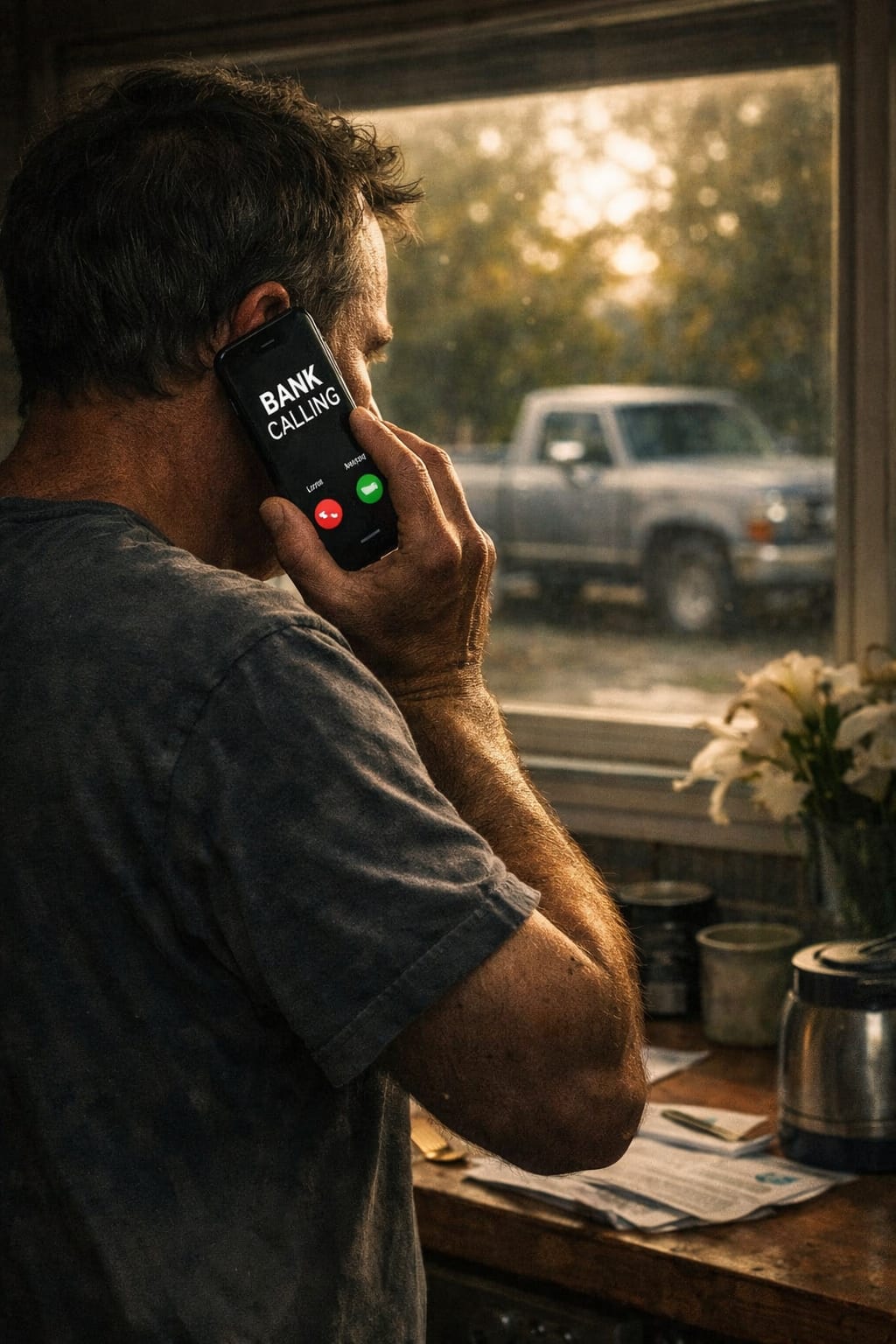
The phone rang on a Tuesday. I knew who it was before I looked at the screen. The bank.
It had been ringing for three days. Same time. Same number. I let it go to voicemail the first two times. On the third day, I answered.
"Regarding your account," the voice said. It wasn't a person. It was a recording. Smooth, calibrated, perfectly friendly. "We need to verify some recent activity."
My father had been dead for four days.
We were still in the thick of it. The house smelled of lilies and stale coffee. There were casseroles in the freezer that no one wanted to eat. My mother was sitting on the couch, staring at the wall, wearing the same sweater she'd worn to the funeral.
And the bank was calling.
I stood in the kitchen, holding the phone, looking out the window at the driveway where his truck still sat. The voice continued. It gave me options. Press one for checking. Press two for savings. Press three to speak to a representative.
I pressed three.
The music started. It was a piano piece. Light. Bouncy. Completely inappropriate for a house where someone had just stopped breathing.
I know how systems work. I work in tech. I understand algorithms, routing, efficiency metrics. I know that this call was triggered by a flag. A large withdrawal. Maybe the final medical bill. The system saw an anomaly and reacted. It did what it was told.
But standing there, listening to the piano loop for the fourth time, I felt a surge of anger so sharp it made my hands shake.
This system wasn't broken. Technically, it was functioning perfectly. It detected risk. It initiated contact. It managed volume.
But it was misaligned. It was operating on a logic that didn't account for the reality of the person on the other end. It assumed I was a user. It assumed I was a variable. It didn't know I was a son who was currently trying to figure out how to turn off his dad's email account without crying.
When the representative finally came on, her voice was bright. "Thank you for calling, how can I help you today?"
"My father passed away," I said. I didn't soften it. I didn't say "passed." I said "died."
There was a pause. I could hear the click of a keyboard. "I'm sorry for your loss," she said. It was fast. Too fast. It was the script. "To proceed with the estate account, I'll need the death certificate and your account number."
"I don't have the account number."
"It should be on the statement."
"He didn't get statements. He went paperless."
"Okay," she said. The keyboard clicked again. "I can send a form to the address on file."
"He's dead," I said. "No one is checking the mail."
"I understand," she said. She didn't. She couldn't. She was bound by the same walls I was. She had a timer on her screen. She had a quota. If she spent too long on this call, her supervisor would see it. If she deviated from the script, she might get flagged.
We were both trapped. She in her cubicle, me in my kitchen. The system was the cage around both of us.
"I need to talk to someone who can just close it," I said. My voice cracked. I hated that. I hated showing weakness to a stranger, even one who was paid to listen.
"I can escalate this," she said. "But there's a wait time."
"How long?"
"Twenty-four to forty-eight hours."
"Okay," I said.
"Is there anything else?"
"No."
I hung up. I stood in the kitchen for a long time. The silence of the house rushed back in.
This is what we lose when we automate empathy. We don't just lose time. We lose the space to be human.
We build these systems to scale. We want to serve millions of people without hiring millions of employees. We want consistency. We want predictability. And we get it. But the cost is nuance. The cost is grace.
A human being, faced with a grieving son, might have said, "Take your time. Don't worry about the bill right now." A human being might have seen the tremor in my voice and paused. A human being might have understood that the address on file was now a house of mourning, not a mailbox.
But the system cannot pause. The system cannot see. The system only knows input and output. If the input is "death," the output is "form 104-B." There is no variable for grief. There is no code for mercy.
I thought about the design meetings where this was decided. I imagined people in a conference room, whiteboards covered in flowcharts. User Journey: Bereavement. They probably talked about it. They probably had a protocol. But somewhere along the line, the protocol became more important than the person.
Efficiency became the goal, not care.
We see this everywhere. It's in the healthcare portal that logs you out while you're reading a diagnosis. It's in the job application software that rejects you because your resume doesn't match the keywords, even though you're qualified. It's in the social media algorithm that keeps showing you ads for baby clothes after you've had a miscarriage.
The system doesn't know. It doesn't care. It just runs.
And we adapt. We learn to harden ourselves. We learn to anticipate the friction. We prepare our documents before we call. We brace ourselves for the hold music. We practice what we're going to say so we don't stumble. We become efficient too. We become like the machines.
But that day, in the kitchen, I couldn't do that. I was too tired. I was too sad. I just wanted the phone to stop ringing. I wanted the world to acknowledge that something had changed.
When the callback came two days later, it was a different person. A man. He sounded older.
"I have your file," he said. "I see the note."
"Okay," I said. I was bracing for the fight.
"We can waive the fees," he said. "And I'll send the forms to your email instead. Whatever is easier for you."
"Oh," I said. The tension in my shoulders dropped. "Thank you."
"Don't worry about the timeline," he said. "Take care of your family."
He hung up.
It was a small thing. He didn't change the system. He didn't fix the bank. He just found a way around the wall for me. He used his human discretion to bypass the automation.
But why should it depend on luck? Why should peace depend on getting the one agent who is willing to break the rules?
The system isn't working because it assumes we are all operating at full capacity. It assumes we are all rational actors with perfect information and steady hands. It doesn't account for the messiness of life. It doesn't account for death, or illness, or panic, or confusion.
It demands order from a world that is inherently chaotic.
I still get calls from them sometimes. Automated reminders. Update your profile. Verify your identity. I let them go to voicemail.
I look at the notification on my screen. Missed Call.
I think about the person on the other end. Maybe it's a recording. Maybe it's someone like me, trying to navigate a maze that wasn't built for them.
I don't call back immediately. I wait. I sit with the silence. I let the phone ring until it stops.
Because sometimes, the only way to keep your sanity in a system that isn't working is to refuse to play the game. To step out of the queue. To remember that you are not a ticket number. You are not a data point.
You are a person. And you are allowed to take your time.
The music stops. The line goes dead. And for a moment, there is just quiet. No requests. No forms. No verification.
Just us.
About the Creator
Edward Smith
I can write on ANYTHING & EVERYTHING from fictional stories,Health,Relationship etc. Need my service, email [email protected] to YOUTUBE Channels https://tinyurl.com/3xy9a7w3 and my Relationship https://tinyurl.com/28kpen3k
Keep reading
More stories from Edward Smith and writers in Humans and other communities.
Training the Brain in Spite of A.I.
While A.I. is being shoved down our throats, it's more important than ever to keep our minds sharp the old fashioned way. Letting a machine think for you might be tempting at first. How many times have you heard, "Work smarter, not harder," in reference to letting A.I. handle a report at work. Sounds innocent enough. But don't get carried away because let's remember that machine learning has its flaws.
By Leslie Writes7 days ago in Humans


Comments
There are no comments for this story
Be the first to respond and start the conversation.