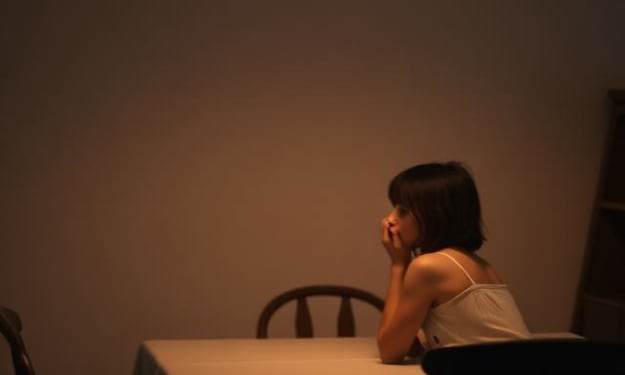
divorce
Divorce isn't an end; it's a different beginning.
When Home Becomes a Memory: Learning to Let Go of the Person You Thought Was Forever
I still remember the exact moment I realized I had to let her go. We were sitting on opposite ends of the couch—the same couch where we'd spent countless nights talking until sunrise, dreaming about our future, planning adventures we'd never take. But that night, the silence between us felt heavier than any words we'd ever shared. The distance wasn't measured in inches. It was measured in all the things we'd stopped saying, all the dreams that had quietly died, all the versions of ourselves we'd outgrown. She still felt like home. That was the cruelest part. The Comfort That Becomes a Cage There's something uniquely painful about loving someone who feels like home but no longer helps you grow. For three years, she'd been my safe place—the person I ran to when the world felt too heavy, the voice that calmed my anxious thoughts, the presence that made everything feel right. But somewhere along the way, comfort had turned into complacency. We'd stopped challenging each other. We'd stopped dreaming together. We'd become so focused on preserving what we had that we forgot to ask ourselves if what we had was still what we needed. I'd read once that people come into our lives for a reason, a season, or a lifetime. I'd always assumed she was my lifetime. The thought of her being just a season felt like a betrayal of everything we'd built together. Yet deep down, I knew. The person I was becoming couldn't live in the life we'd created. And the person she was becoming deserved someone who could show up fully, not someone staying out of fear and familiarity. The Questions That Changed Everything The turning point came during a solo trip I took to clear my head. Sitting on a beach thousands of miles away, watching the waves reshape the shoreline over and over, I finally asked myself the questions I'd been avoiding: Was I staying because I loved her, or because I was afraid of being alone? Was I holding on to who we were, or who we could actually be? If we met today, as the people we've become, would we still choose each other? The answers terrified me. Because they revealed a truth I'd spent months burying: sometimes love isn't enough. Sometimes two people can care deeply for each other and still be wrong for each other. Sometimes the most loving thing you can do is let someone go so you can both find the versions of yourselves you've been suppressing.
By Ameer Moaviaabout a month ago in Humans
The Attention Economy Is Quietly Rewriting Our Minds — and Most People Don’t Notice
Every time you unlock your phone, scroll a feed, or tap a notification, you are participating in something far bigger than momentary distraction. You are engaging in what experts call the attention economy — a system where human focus is the most valuable resource on Earth. This isn’t hyperbole. It’s reality. For the companies that fuel the modern internet, your attention is currency. Every second spent watching, clicking, or reacting generates data that platforms use to predict your behavior, tailor your feed, and pull you deeper into their ecosystem. And the consequences go beyond algorithms. They are reshaping how we think, feel, and decide — often without our conscious awareness.
By Yasir khanabout a month ago in Humans
The Day My Phone Started Knowing Me Better Than I Did
It started with a notification I almost ignored. “Good morning, Alex. Based on your sleep patterns, we’ve adjusted your morning schedule. Coffee is ready at 7:15. You might want to leave home at 8:03 instead of 8:10.” I froze. My phone had never spoken to me like this before. Sure, it suggested playlists, predicted traffic, and reminded me of appointments. But it had never calculated me this precisely. Curiosity overcame caution. I followed its instructions. The coffee was perfect. Traffic was lighter than usual. I arrived at work feeling oddly efficient.
By Yasir khanabout a month ago in Humans
Digital Shadows: How Our Online Lives Shape Who We Are
We live in a world where almost every thought, habit, and interaction leaves a digital trace. Every post we make, every story we share, every “like” or reaction contributes to a vast, invisible record of our lives. These traces—our digital shadows—are shaping more than just algorithms; they are shaping us.
By Yasir khanabout a month ago in Humans
We Are Training Technology More Than It Is Training Us
Most conversations about technology focus on what machines are learning. We talk about artificial intelligence becoming smarter, algorithms improving, and systems adapting faster than ever. The common fear is that technology is watching us, analyzing us, and eventually outgrowing us. But there’s a quieter truth hiding in plain sight. Technology is learning because we are teaching it—constantly, unintentionally, and without pause.
By Yasir khanabout a month ago in Humans
The Age of Invisible Technology: How Silence Became the Most Powerful Feature
Technology used to announce itself loudly. New devices arrived with dramatic launches, glowing screens, and long lists of features designed to impress. Faster processors, bigger storage, sharper displays—progress was measured by how much more we could pack into a single machine. The louder the innovation, the better it seemed.
By Yasir khanabout a month ago in Humans
7 Deadly Sins of the Bible in Detail
The Bible teaches us that sin is not simply wrongdoing but a separation between humanity and God. Sin corrupts both spirit and society, distorting the divine image within us. Among the many forms of sin described in Scripture, seven have traditionally been recognized as especially destructive to the soul. These are known as the Seven Deadly Sins. They represent the root causes of moral decay and vices that distort character, fuel rebellion against God, and destroy relationships with others.
By The Big Bad about a month ago in Humans
Why Winter Brings Back the Love You Thought You’d Healed From
Winter has a way of reviving old love, forgotten heartbreaks, and emotions you thought you’d healed from. This deeply human article explores why cold seasons trigger emotional relapses, loneliness, and soul-level memories… through psychology, neuroscience, nostalgia, and the quiet honesty of winter itself.
By F. M. Rayaanabout a month ago in Humans
The World Through Different Eyes
We often believe that reality is fixed, that the world exists exactly as we perceive it. But the truth is, reality is much more flexible than we realize. It’s shaped by our thoughts, our experiences, and the lens through which we choose to view life.
By Yasir khan2 months ago in Humans
The Woman Who Learned Silence After Marriage
The Woman Who Learned Silence After Marriage She used to believe marriage would give her a voice. Not louder—just clearer. A place where questions would land somewhere, where sentences could finish without apology. She imagined conversation as a table set for two, words placed carefully between them, shared and understood. What she learned instead was that silence doesn’t begin at marriage. It only becomes visible there. On their first morning as husband and wife, she asked him how he took his tea. It was an ordinary question, the kind that carries no weight until you realize it is never asked again. He told her, distracted, already scrolling through his phone. She repeated it the next morning, then the next week. Eventually, she stopped asking. She remembered. Silence, she learned, often starts as efficiency. At dinner, she spoke in halves. She had always done that—learned it early, learned it well. Sentences shaped carefully, edges rounded, nothing sharp enough to disturb the room. When she paused, waiting for him to ask her to continue, he didn’t. He filled the space with weather updates, work complaints, observations about the food. Her unfinished thoughts learned to fold themselves away neatly, like unused napkins. She noticed how often she nodded. It became a reflex, a punctuation mark. Nods replaced opinions, smiles replaced disagreement. She wasn’t lying; she was editing. There is a difference, though it takes years to admit it. People assume silence is learned through suppression, through cruelty or fear. That was never her story. He wasn’t unkind. He didn’t tell her to be quiet. That would have been easier to name. Instead, he listened just enough to appear attentive, just enough to avoid accusation. Her words didn’t bounce back to her altered or enriched; they simply vanished, absorbed without trace. She remembered being a child at family gatherings, sitting between louder cousins, learning early that speaking required competition. She remembered teachers who praised her for being “easy,” “well-behaved,” “no trouble at all.” Silence, she realized, had always been mistaken for grace. Marriage didn’t invent it. Marriage rewarded it. Sometimes, late at night, she rehearsed conversations in her head. Not arguments—she had no appetite for drama—but clarifications. Explanations. Simple statements like I don’t like that or I need more than this. In her mind, the words were clean and calm. Out loud, they never arrived. They dissolved somewhere between intention and breath. He often asked what was wrong when she grew quiet, unaware of the irony. She would say “nothing,” not as a lie but as a translation. There was no vocabulary for what she felt that wouldn’t sound excessive or inconvenient. Silence became the most accurate language she had. At social gatherings, he would tell stories about her—harmless ones, affectionate even. She laughed at the right moments, nodding along as if hearing herself for the first time. The version of her he spoke about was agreeable, patient, uncomplicated. She wondered when that version had been signed into existence, and why no one asked if she consented. Once, during an argument that never fully formed, she interrupted him. Just once. The room fell into a strange pause, as if something unfamiliar had entered it. He looked at her, surprised, not angry. She apologized immediately. The interruption lingered longer than the apology ever did. She learned to measure her thoughts by their usefulness. Would saying this change anything? Would it improve the mood? Would it be worth the effort of explanation? Most thoughts failed the test. Silence was economical. Yet silence has weight. It accumulates. It presses inward. There were moments—small, sharp ones—when she almost spoke. When a casual remark cut closer than intended. When a decision was made without her. When her name was used to agree to something she had never been consulted about. Each time, she felt the words rise, heavy and urgent. Each time, they sank back down, choosing peace over presence. She wondered, sometimes, who would notice if she changed. Not drastically—just enough to matter. If she spoke without softening, disagreed without smiling, finished her sentences even when no one asked her to. The thought frightened her more than continued silence ever had. One afternoon, alone in the house, she spoke out loud just to hear herself. The sound startled her. Her voice was steady, unfamiliar, like a room she hadn’t entered in years. She practiced saying her own name, then a sentence, then another. Nothing revolutionary. Just complete thoughts. That night, at dinner, she began a sentence and finished it. He looked up, mildly surprised, then continued eating. No reaction. No resistance. No revelation. She realized then that silence had never been demanded of her. It had been assumed. Maintained. Upheld by habit and her own careful compliance. Marriage didn’t make her quiet. It only gave her silence a place to live. And once named, it could no longer pretend to be invisible.
By Abdul Muhammad 2 months ago in Humans