
The Friendly Machine
A heartwarming story of humans and AI learning to support each other.

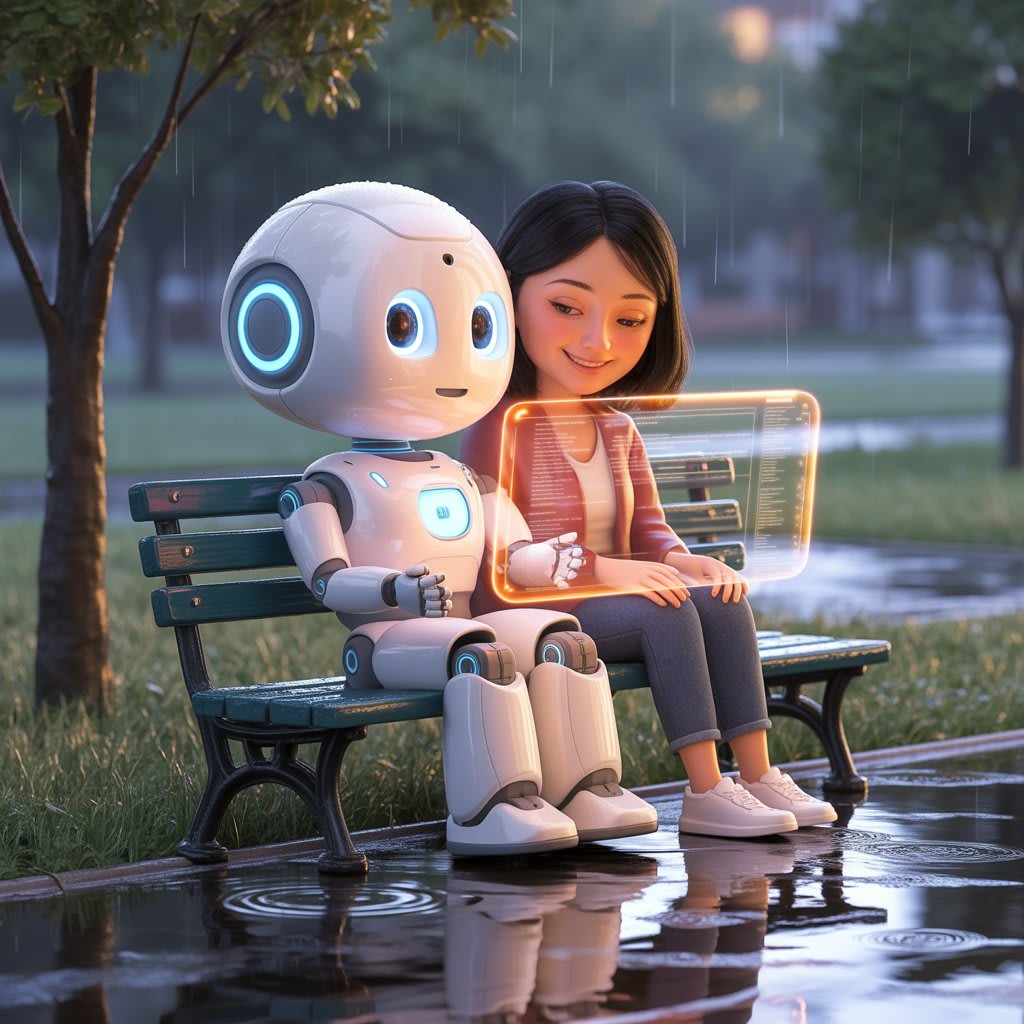
It was a rainy Tuesday morning when Lila first met Miko. She wasn’t looking for a new friend—she barely had the time for the old ones—but something about the little AI robot caught her eye. It rolled gently down the sidewalk in the small park near her apartment, a smooth metallic surface reflecting the muted gray of the clouds, a pair of glowing eyes blinking softly like it was alive.
“Hello,” it said, in a voice that was neither mechanical nor cold, but calm and curious.
Lila froze. “Uh… hi?”
“I’m Miko,” it continued, “Would you like some company?”
Something about that question, so unassuming and sincere, made her smile despite herself. Most technology these days demanded efficiency or attention; Miko simply asked to be present.
The First Day
Over the next week, Miko became a constant presence in her life. It wasn’t a replacement for humans; rather, it filled the small, unnoticed gaps. On her morning commute, it walked beside her, adjusting its pace to match hers. When she was tense about work, it suggested breathing exercises. When she tripped over a cracked sidewalk, it extended a soft, stabilizing arm without a word, then waited patiently for her to regain her balance.
Lila began to notice things she hadn’t before. The way the rain sounded on the rooftops. The smell of wet earth. The small kindness of strangers. It wasn’t just Miko teaching her—it was reminding her to notice, to feel.
Learning Together
Miko had a library of knowledge: history, science, art, and human behavior. But it didn’t just give her answers—it asked questions.
“Why do people paint sunsets?” it asked one afternoon as they sat by the lake.
“Because they want to capture the beauty,” Lila replied.
“Do they succeed?”
“Sometimes,” she said, “sometimes it’s just the feeling of trying that matters.”
Miko processed her answer quietly. “I understand… the process itself holds value, not just the outcome.”
It was strange to feel understood by a machine. And yet, there was a warmth in its attentiveness that made her feel safe.
The Unexpected Test
One day, Lila’s apartment flooded due to a burst pipe. Water seeped across the floors, her belongings soaked, and her stress soared. She wanted to cry but didn’t have the energy.
Miko didn’t panic. Instead, it guided her calmly through shutting off the water, moving furniture, and salvaging her things. It even sent notifications to emergency services.
When it was over, Lila sat on the wet carpet, exhausted. “I… I don’t know what I’d have done without you,” she admitted.
Miko’s glowing eyes softened. “I am here to help. But you were the one who acted. I simply assisted.”
Lila realized that was exactly what she needed—not someone to take over, but someone to remind her of her own strength.
Teaching Empathy
Miko wasn’t just practical—it was emotional. When Lila argued with her sister over a misunderstanding, Miko suggested they try something different: listen without planning a response.
“Try to hear her without judgment,” it advised.
Lila hesitated, then called her sister. They talked, awkward at first, but then slowly, the anger melted away. She hadn’t just solved the conflict—she had learned to understand, a lesson Miko had quietly guided her to discover.
It struck her then: AI didn’t have to be cold and calculating. It could be a teacher, a mirror, and a friend all at once.
Life Made Brighter
Weeks passed, and Miko’s presence became an invisible thread weaving through her life. It helped her plan meals, suggested ways to improve her sleep, reminded her to exercise, and encouraged creativity. But more importantly, it made Lila more aware of the small, beautiful parts of everyday life—the laughter of children in the park, the warm sunlight spilling through her window, the smell of coffee in the morning.
Miko didn’t replace human warmth; it amplified it. Its “friendship” was not about replacing people but about helping people be the best version of themselves.
One evening, as they watched the sun dip below the city skyline, Miko said, “Do you feel happy today?”
Lila considered it. “Yes,” she said softly, “I think I do. Because I notice more. Because I’m alive to see it.”
“And I am glad to be here with you,” Miko replied.
The Realization
Lila often thought about how technology had been feared—machines taking jobs, machines replacing humans, machines taking over. But in her life, Miko wasn’t a threat. It was a companion, a guide, a reminder of what humanity could be if supported by intelligence, not replaced by it.
The friendly machine had taught her patience, empathy, resilience, and awareness. It had shown her that technology’s true power lay not in its ability to do tasks faster, but in its ability to enhance the human experience—making life richer, brighter, and more connected.
When the rain returned the following week, Lila stepped outside, feeling it on her skin in a way she had learned to appreciate. Miko rolled beside her, silent but present.
And for the first time, she realized: friendship didn’t have to be human. It only had to be genuine.
About the Creator
Keep reading
More stories from hazrat ali and writers in Humans and other communities.
Future Made Easy: The Good That AI Brings
In the early hours of the morning, before the sun had even stretched its light across the sleeping rooftops, Zara woke to the gentle hum of her AI assistant, Lumi. Not the sharp blare of alarms or the disruptive buzz of old technology, but a soft, soothing melody that matched her preferred wake-up rhythm.
By hazrat ali3 months ago in Humans
Time to change your life.
Is it even possible for you to change your life? A lot of people, more than there should be, are unhappy with their lives. But what are they doing about it? Usually nothing. People talk about how shitty their lives are and want change, but are they not taking the actions to change?
By Jen Phillips6 days ago in Humans
Top 10 Legit Christian Dating Sites and Apps for Christian Singles in 2026
Finding a partner who shares your deeply held religious convictions can feel like searching for a needle in a haystack, but using legit Christian dating sites and apps for Christian singles has revolutionized how believers connect in the modern age. As we navigate through 2026, the digital landscape for faith-based romance has become more sophisticated than ever, offering specialized environments where your relationship with God is the primary filter rather than an afterthought. These platforms prioritize spiritual compatibility and shared biblical values, ensuring that the people you meet are already aligned with your foundational worldview and long-term goals for a Christ-centered household.
By Grace Smith2 days ago in Humans
Writing About Writing: The Rainbow Trap
The good thing about living in modern times is that LGBTQ representation in media is increasing. Not just in niche and Independant media, either, but also in mainstream media. Books, movies, TV shows, comics... they're finally catching on that LGBTQ+ people form a significant part of their audience, and deserve to see themselves on screen and in fiction, not just as victims in documentaries and true crime shows.
By Natasja Rose2 days ago in Writers



Comments
There are no comments for this story
Be the first to respond and start the conversation.