
The Museum Between Errands
A small journey through ordinary moments that quietly become art when you pause to notice them.
I didn’t plan to find art on a Tuesday that tasted like burnt coffee and bus exhaust.
I was rushing—phone in one hand, tote bag in the other—doing the kind of adult choreography that looks graceful from far away and feels like dropping plates up close. Groceries. A forgotten form. A stop at the pharmacy. The day had no room for beauty, I told myself, which is usually the first sign I need it most.
At the corner near my apartment, the crosswalk button was stuck, so everyone waited in that loose, impatient semicircle people form when they don’t know where to put their bodies. A teenager with a backpack balanced on one strap. A man in paint-splattered boots. A woman in a coat the color of wet pavement, staring into her own reflection on a dark phone screen.
Then the light changed, and we moved.
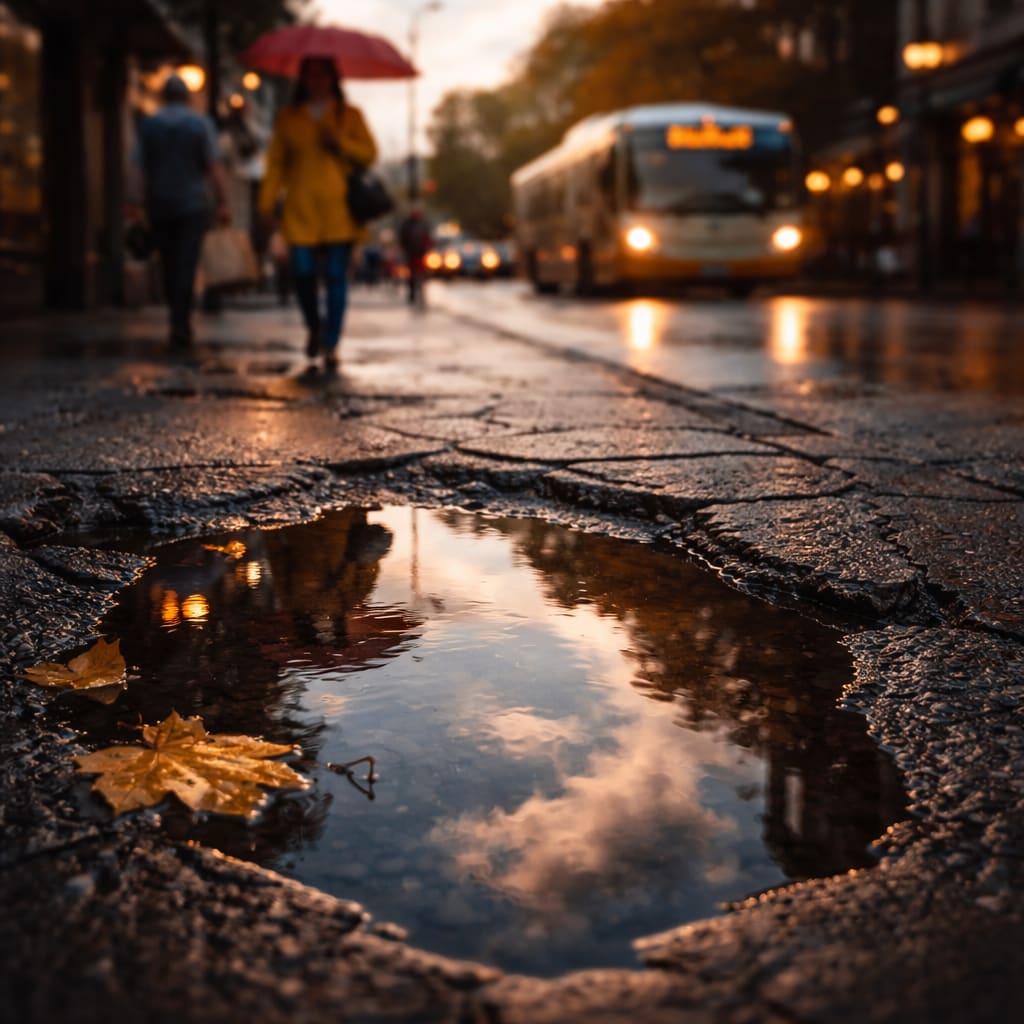
Halfway across, I looked down—just a reflex—and saw a thin crack in the asphalt filled with rainwater. It caught the sky like a small, careless mirror. A strip of pale blue. A drifting cloud with a torn edge. A little sun trying to get in.
It was nothing, technically. A puddle. A crack. But the reflection made it feel like a portal the street hadn’t meant to leave open.
For a second, my pace slowed. My shoulders unclenched. My mind—so busy narrating what I hadn’t done yet—went quiet enough to notice what was already here.
That’s the thing about art when it finds you outside galleries: it doesn’t arrive with a placard. It doesn’t ask if you’re the kind of person who “gets it.” It just… shows up. Sometimes in a puddle. Sometimes in the way two strangers step around each other without colliding, like a silent dance they both learned by living.
The Exhibit Nobody Advertised
The grocery store had its own lighting—bright, honest, slightly cruel. Everything looked exactly like itself: plastic, labels, the chilled breath of the freezer aisle. I reached for eggs, then paused because I heard a sound I didn’t expect.
A kid—maybe five—was humming while his father compared prices. Not singing a recognizable song. Just humming like the body does when it’s happy enough to make noise. The tune rose and fell in small arcs, like a pencil doodle. The father, without looking up, started tapping the cart handle in time.
It was brief. Nobody clapped. The store didn’t dim the lights or lower the music. The moment dissolved as quickly as it formed.
But I carried it the way you carry a scent that reminds you of someone: softly, almost without permission.
I used to think art was something you went to on purpose. Something you scheduled. A museum ticket, a concert seat, a book you vowed to finish. And those things matter—deeply. I don’t want to pretend the world doesn’t need studios, stages, and patrons who keep the lights on.
But lately, the most sustaining art in my life has been the kind that happens in the margins: between errands, between messages, between the thought of “I should” and the act of “I am.”
It’s the art of noticing.
The Hand That Made a Line
In my apartment, there’s a mug I don’t really like. The glaze is uneven and the handle is a little too thick, like it’s wearing a padded coat. I bought it at a craft fair because the person selling it had clay under their fingernails and a smile that looked tired but proud.
When I drink from it, I can feel the ridge where the handle meets the cup—an imperfect seam that no factory would allow. I used to think imperfections were flaws.
Now I think of them as proof.
A human hand made that line. A human hand decided it was good enough to put out into the world. A human hand accepted that someone else might hold it and feel the bump and still keep drinking.
That seam reminds me of my mother’s hands when I was small. She used to peel oranges over the sink, letting the oils spray into the air. Her fingers moved quickly, practiced and sure, as if they had memorized the exact pressure needed to separate peel from fruit. She never called it art. She would have laughed if I did.
But I remember the spiral of orange skin growing longer, the way she held it up like a ribbon, the bright scent that filled the kitchen. I remember thinking she was doing magic.
Maybe art is just magic we agree not to name.
The Gallery Called Public Transit
On the bus, I watched a man sketch in a notebook. He wasn’t trying to be discreet. He drew with the confidence of someone who has learned that other people’s opinions are mostly weather—loud, temporary, not worth reorganizing your life around.
He was sketching hands.
Not perfect hands. Not romantic hands. Real hands: a woman’s fingers curled around a railing; an elderly man’s knuckles swollen like small stones; a teenager’s hands moving while they talked, conducting an invisible orchestra.
The bus jolted, and his pencil line wobbled. He didn’t erase it. He just kept going, like the wobble was part of the truth.
I wanted to lean over and see more, but I didn’t. Some art feels like a bird you can admire only by not reaching for it.
When I got off, I realized my own hands had been clenched around my phone for most of the ride. The screen was warm from my grip. I hadn’t even been reading anything important. Just refreshing, scrolling, scanning for a reason to feel either entertained or outraged.
In my head, I heard the quiet scratch of his pencil and felt embarrassed—gently, not cruelly—the way you feel embarrassed when you catch yourself missing something beautiful because you were busy chasing something louder.
What the City Makes Without Asking
There’s a mural near the pharmacy that changes depending on the weather. On dry days, it’s just paint—bold shapes and a face too large to belong to any one person. But when it rains, the colors darken and shine, and the wall looks freshly made again.
Today, the rain had left streaks. Water ran down the painted cheek like a tear. It wasn’t intentional, I’m sure. The artist didn’t plan for that exact drip pattern. The building manager probably didn’t want it.
But it was beautiful anyway—beauty by accident, or beauty as a collaboration between pigment and gravity.
I stood there longer than I needed to, holding my prescription bag like it was an excuse. A couple walked past and didn’t look. A cyclist glanced, then kept moving. A woman in a bright scarf stopped too, and we shared a brief smile that said, without words: Yes. This is something.
That was the whole interaction. No introductions. No follow-up. Just the rare comfort of being in the presence of someone else’s noticing.
Sometimes, the most human thing you can do is witness what another person witnesses. It makes you feel less alone in your attention.
The Quiet Practice
When people ask why art matters, they often expect a grand answer: because it saves lives, because it changes minds, because it builds empathy.
All of that can be true.
But I’ve started to think art matters for a smaller, steadier reason: it returns you to your own senses.
It makes you feel the weight of your body in a chair. The taste of fruit. The shape of sunlight on a wall. It interrupts the endless internal monologue of tasks and worries and self-judgment. It reminds you that you live in a world, not just in your head.
And the best part is that you don’t have to be “an artist” to participate.
You can participate by watching how steam curls out of a pot. By noticing the rhythm of footsteps on a sidewalk. By paying attention to the way someone laughs when they think nobody’s listening. By letting a song on the radio be more than background noise.
This doesn’t replace museums or books or concerts. It doesn’t claim that “everything is art” in a way that flattens the skill and labor of people who dedicate their lives to making it.
It’s just another doorway.
A daily doorway.
Leaving With Something You Can’t Bag
By the time I got home, my tote bag was heavier and my schedule was still full. Nothing about the day had changed on paper.
But I felt different—like my inner room had been aired out. Like I’d opened a window I didn’t know was stuck.
I put the groceries away. I poured water into that imperfect mug. The seam pressed against my fingers, and I thought about the sketchbook on the bus, the humming in the grocery aisle, the puddle holding the sky.
The world had been offering small exhibits all day.
All it asked was that I look.
So tomorrow, when I’m rushing again—because I will be—I’m going to try one small thing: I’m going to let my eyes land on something ordinary and stay there long enough for it to become strange, or beautiful, or true.
Not because I’m trying to be profound.
Just because I’m trying to be here.
About the Creator
Keep reading
More stories from writers in Humans and other communities.
The Angry Man in Your House
"If you grow up with an angry man in your house, there will always be an angry man in your house" This statement has caused plenty of controversy online, people say its a statement that blames victims while also undermining those who break traumatic cycles to form health relationships... but if I'm honest now that I'm in my 30s it makes more sense to me than ever, and I'd argue that its not just about fathers and uncles.
By S. A. Crawford6 days ago in Humans
The Weight of Small Acts
Mariam had always believed that big actions changed the world. She thought that unless someone did something extraordinary, like saving lives or leading movements, their efforts didn’t matter. She had watched the news for years, filled with stories of disasters, wars, and crises, and it made her feel small. She wondered if one person could ever make a difference in such a large, complicated world.
By Sudais Zakwan4 days ago in Humans
I've Just Realized
The President doesn't understand music. There. It felt very good to write that; it's some thing I just realized today. Oh , yes; he plays it. He TRUMPets it in rallies and meetings, pumps it across the airwaves when he gathers up our minutes waiting for his late arrival.
By Judey Kalchik 4 days ago in Beat
Analyse this!
Wanna know how to improve your writing? There is a simple, quick, tried and tested method. Tried and tested by who? By me, as it happens, and I can guarantee that it will work for you. I know what I am talking about. Not always, of course, but certainly in this case.
By Raymond G. Taylor5 days ago in Writers

Comments
There are no comments for this story
Be the first to respond and start the conversation.