
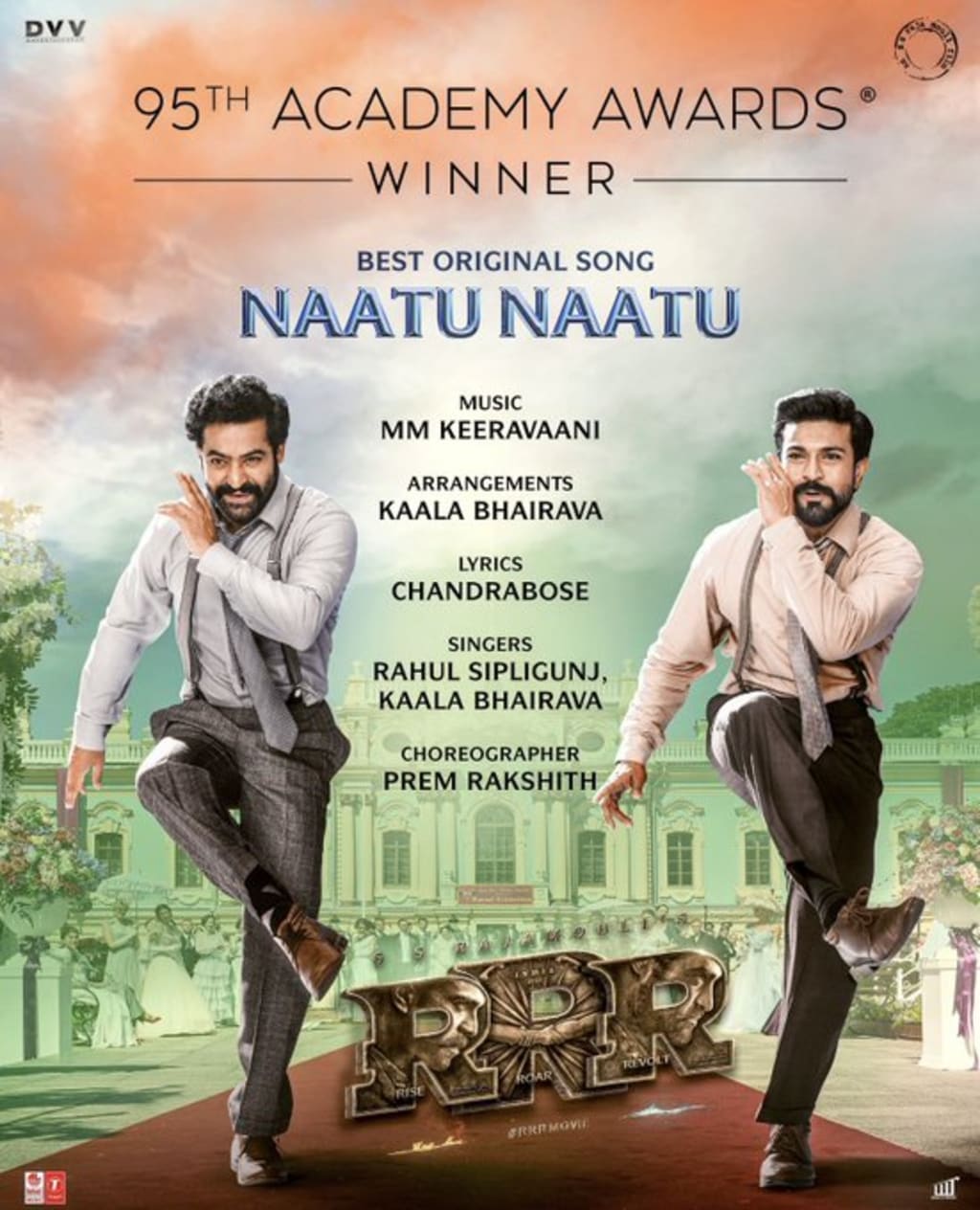
The popular song defeated Lady Gaga and Rihanna to win Best Original Song at the 95th Academy Awards.
The renowned poet Chandrabose and composer M.M. Keeravani, who worked together to create the soundtrack for the film and all of its songs, received the honour. Following a powerful performance of "Naatu Naatu" by song and dance, which was acclaimed as one of the telecast's highlights this year, they were victorious. Keeravani wowed the audience with a lengthy nod to a Carpenters hit during his winning speech. Before beginning to perform the song's melody, he added, "I grew up listening to the Carpenters, and now here I am with the Oscars.
Even before "Naatu Naatu" won the Golden Globe for best song in January, it was thought to be a front-runner and had a high chance of winning.
The song "Naatu Naatu," which is a candidate for the Academy Awards, is described as "a true banger" and "the first song ever from an Indian production to be nominated for an Oscar" by presenter Deepika Padukone.
Social media users instantly copied the "hook step" choreography that was seen in footage made available before the movie's American debut, and it swiftly rose to fame as the most popular movie-music meme of the year.
Keeravani and Chandrabose aren't the first Indians to receive the prize for best song, though they are the most recent. Jai Ho, the greatest song from the "Slumdog Millionaire" soundtrack, gave composer A.R. Rahman a double victory in 2019. Slumdog, on the other hand, was an Indian-set British production. Rahman is one of several who have praised "Naatu Naatu's" historical importance and commended the illustrious Keeravani for causing what has been referred to as "a paradigm shift" for Indian film outside.
In an interview with Variety, Keeravaani claimed that the song's beat was a crucial component in its popularity. The beat is 6/8, which, according to the composer, is more typically heard in India, sometimes in Africa, and other places like that rather than the West. In truth, it resembles the South Indian beat more than the North Indian beat. However, this beat took on a new depth and a level of BPM in "Naatu Naatu" that is exceedingly uncommon in the West. So, that was the main thing that caught the Western audience's attention.
The artist did, however, name the vocalists he choose to reprise their soundtrack at the Oscars: "I selected Rahul Sipligunj and Kaala Bhairava. The song "Naatu Naatu," according to Keeravani, should help you forget about everything. In order for the audience viewing the movie as well as the characters from the plot to fully engage with the song, they must set aside everything else that is happening in the world. The song's coda, or final section, is also more of an action sequence than a song because it requires such endurance.
India received a second Oscar for The Elephant Whisperers, which took home the prize for Best Documentary Short Film.
The documentary is the first work from India to win in its category. The story revolves around a couple who take care of a wounded baby elephant after it gets lost in the herd.
In the movie The Elephant Whisperers, a close friendship that develops between people and animals as they learn to live together is explored. The stunning Nilgiri mountains in southern India are where it was filmed.
Nonetheless, India's biggest success remained Naatu Naatu, a popular tune that has thousands of listeners bopping to its beats.
When the song won the Golden Globe in January, it already made history by becoming the first original song from India to do so. In the same month, it also won the Critics' Choice Award for the best song.
The song represents "the pride of every Indian," according to composer MM Keeravani, who accepted the award.
After mentioning that he had grown up listening to The Carpenters, the rest of his speech was given in song to the tune of their popular song Top of the World.
To laughter and applause from the audience, he declared that RRR had "placed me on top of the world."
About the Creator
Keep reading
More stories from Time is Now and writers in Interview and other communities.
Basic T shirt Hack
A basic t-shirt can be fashionably hacked in many ways. With a little creativity, you can take this wardrobe staple and turn it into a stylish piece that expresses your unique personality. Here are some ideas to get you started.Assuming you want a long-style article on the topic "fashion hack with basic t shirt":
By Time is Now3 years ago in Styled
Center Stage with Paul Stewart
*** I'm keen to republish the interviews I did for my series with Vocal creators. It's been a few years and I thought it might be nice to revisit these wonderful conversations. I'll be releasing them one at a time for a few weeks/months.
By Heather Hubler22 days ago in Interview
Fumfer Physics 40: Cosmic Ratios, Large Numbers, and the Information Structure of the Universe
In this exchange, Scott Douglas Jacobsen asks Rick Rosner about striking ratios in physics that appear across vastly different scales. Rosner points to large-number disparities, such as the enormous strength difference between electromagnetism and gravity at the particle level, and contrasts microscopic lengths with the scale of the observable universe. He cautions against misapplied figures, noting that some famous numbers belong to entirely different physical contexts. While no single cosmic object strikes him as anomalous, Rosner emphasizes unresolved questions about cosmic maturity, heavy-element origins, and the nature of time. He ultimately frames time as closely tied to information flow, arguing that our lack of a rigorous definition of information remains one of physics’ deepest gaps.
By Scott Douglas Jacobsen5 days ago in Interview




Comments
There are no comments for this story
Be the first to respond and start the conversation.