
Automotive Sensors Market: Why Cars Are Getting Smarter
How sensing technology is powering safety, efficiency, and new mobility features
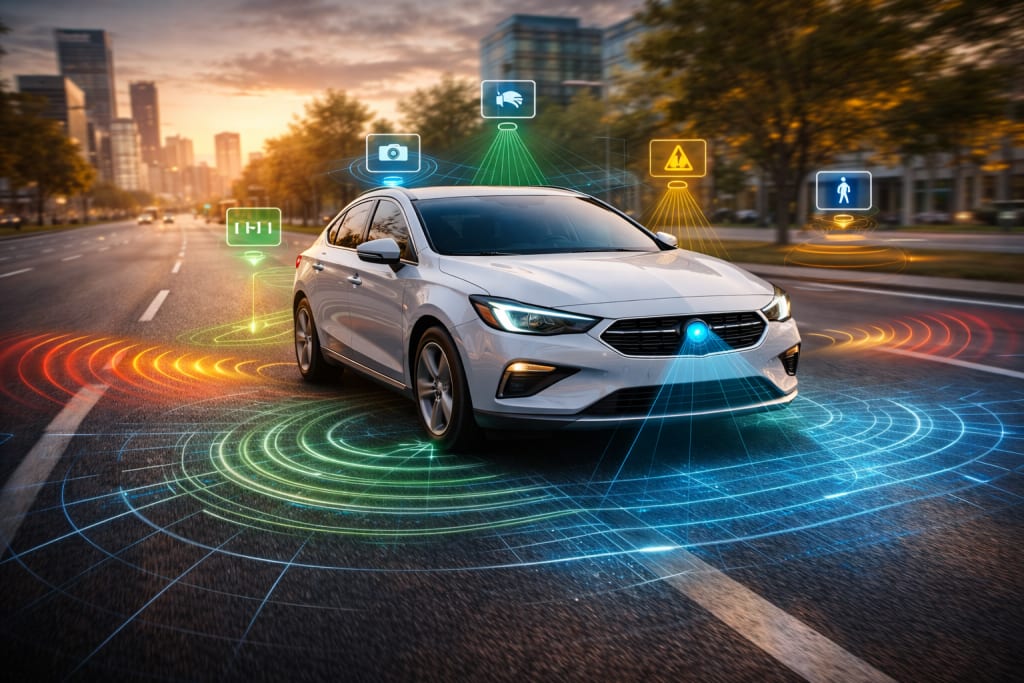
You merge onto the highway. From the corner of your eye, a notification flashes. A gentle beep reminds you that a vehicle is approaching in your blind spot. Behind the wheel, your reflexes are ready. Ahead, your vehicle’s sensors are watching.
This is not science fiction. It is everyday driving powered by sensing systems that monitor speed, distance, environment, and even driver behaviour. These technologies are quietly transforming how vehicles operate. At the heart of this transformation is the Automotive Sensors Market, where tiny components deliver huge impacts on safety, performance, and connectivity.
Why Sensors Are Becoming Core to Vehicles
Modern vehicles are no longer mechanical machines that rely only on human control. They are systems that react, adapt, and anticipate. Sensors form the foundation of these capabilities by detecting changes in the environment and feeding that data into vehicle control systems.
Sensors measure speed, pressure, temperature, light, distance, and motion among many other parameters. They support critical functions such as engine management, braking systems, stability control, airbag deployment, and advanced driver assistance systems.
According to Mordor Intelligence, the Automotive Sensors Market size is projected to grow from USD 28.83 billion in 2026 to USD 38.67 billion by 2031, at a CAGR of 6.05%, driven by increasing integration of advanced driver assistance systems (ADAS), rising vehicle electrification, growing demand for enhanced safety and emission control technologies, and the expansion of connected and autonomous vehicle platforms.
Breaking Down the Automotive Sensors Market
The Automotive Sensors industry comprises various sensor types working together to deliver safe and efficient vehicle operation. Key sensor categories include:
• Pressure sensors that monitor fluid and air pressures
• Temperature sensors that regulate engine and battery systems
• Position sensors that guide throttle, steering, and suspension
• Proximity and motion sensors used in parking and collision systems
• Optical and camera sensors that support lane assist and adaptive cruise control
The Automotive Sensors Market share is influenced by the rapid adoption of advanced driver assistance systems in both luxury and mass market vehicles. Safety features once found only in premium models are now becoming standard across segments, increasing overall sensor demand.
Regions such as Asia Pacific lead growth due to large production volumes, while North America and Europe show strong uptake of connected and autonomous features.
Trends Shaping Sensor Adoption
Several Automotive Sensors Market trends are driving innovation and adoption.
• Increased use of sensors for automated safety features
• Growth of electric vehicles with battery and powertrain sensors
• Integration of long range radar and lidar for precise object detection
• Use of sensor fusion to combine data from multiple sources
These trends reflect a shift from basic monitoring to intelligent sensing. Sensor fusion technologies allow vehicles to combine camera imagery, radar inputs, and motion data to make informed decisions in real time.
As connectivity and over the air updates become more common, sensors also provide critical inputs for predictive maintenance and diagnostics.
Challenges and Technical Considerations
Despite strong momentum, the market faces challenges. Sensors must operate reliably under complex conditions such as extreme temperatures, vibration, and electrical noise. Ensuring accuracy, durability, and long-term performance requires rigorous design, testing, and calibration.
Another consideration is data management. Vehicles equipped with dozens of sensors generate massive amounts of data. Efficient processing and secure transmission are essential to deliver real time insights without overwhelming on board computers.
Manufacturers are investing in improved sensor designs, robust algorithms, and secure communication protocols to address these challenges.
Automotive Sensors Market Forecast
The Automotive Sensors Market forecast points toward sustained growth as vehicles become more automated, connected, and intelligent. Sensors are not only supporting safety systems but also shaping future mobility features such as autonomous driving, predictive alerts, and adaptive performance control.
As vehicle platforms evolve toward electrification and self driving capabilities, sensing systems will play an even larger role in functional differentiation and consumer value.
This evolution positions sensors as fundamental components of modern vehicles.
About the Creator
Keep reading
More stories from james robert and writers in Journal and other communities.
Car Audio Market: How In-Car Sound Is Becoming a Premium Experience
The driving experience is no longer defined only by horsepower and handling. Today, sound quality plays an equally powerful role. Whether it is music streaming, navigation prompts, or hands free calls, in car audio systems shape comfort, entertainment, and connectivity on every journey.
By james robert2 days ago in Journal




Comments
There are no comments for this story
Be the first to respond and start the conversation.