
A Life Spent Sitting.
And the reasons why you're not only so uncomfortable but also tired.
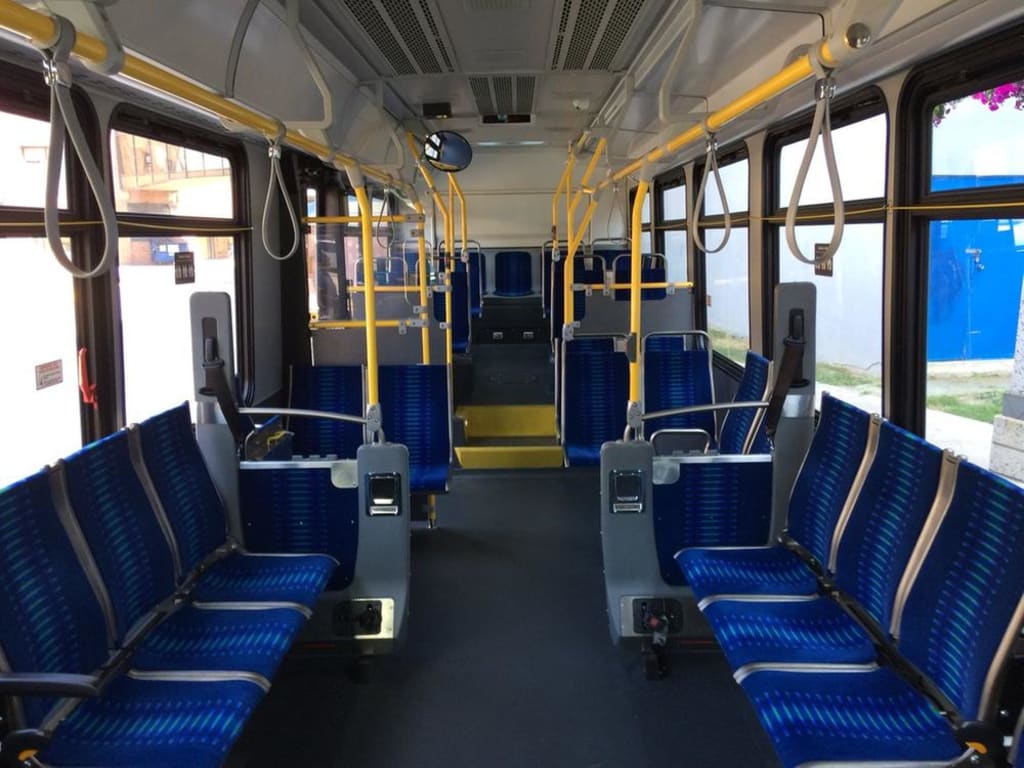
I want you to imagine the last time you were sat on a bus or a train for a reasonably long journey, and now I want you to remember how your body felt. Chances are you were uncomfortable and shifted your weight an awful lot. If it were an especially long journey, then chances are it was also exhausting. Yet all you did is sit there. So why were you so tired?
I have due to the nature of my work, spent many years sat on many chairs on many forms of public transport. Having come to consider myself an unintentional connoisseur of sitting, I would like to share with you my insight into why you are so persistently uncomfortable and tired.
You see, when you are sitting down, typically 75% of your body weight is supported by 4 square inches of what is commonly referred to as the sit bone, or the ischial tuberosity, if you want to get specific. Now in that spot alone there is an obscene amount of pressure to contend with, one estimate being 85-100 pounds per square inch. This is quite frankly an intolerable pressure, and explains why it remains so difficult to sit still for such lengths of time. We adapt to this pressure over time, but it does not stop haunting us.
One aid commonly employed to help lessen the burden imposed by the sit bone is decent cushioning, which helps distribute the pressure to the lesser inflicted parts of our backside. The last bus chair I sat on had adequate cushioning but still was not enough, and that is, as I consider it, the fundamental problem of cushioning. It is forever going to be a question of balance. Either the cushion will not be soft enough and your sit bone will eventually begin to hurt again, or the cushion will be far too soft and you will be trapped, sunken into a soft mass, like a beanbag chair, unable to find your feet and any sense of stability. And feet are often the unsung heroes in our daily battles with public transport and chairs, let me tell you that. I'll never forget seeing a young girl at around the age of 6 fly forwards when the bus came to a halt simply because her feet never touched the floor. Feet ground us and help us displace weight.
The issue of feet is commonly addressed by seat height. Generally speaking it is better to make a chair too low than too high. If a chair is too high then not only might we sacrifice our footing, weakening our body’s stability and putting more pressure on our sit bone, mine hurts just thinking about it, but we could also cause a restriction in blood flow to the underside of our thighs, which in the worst case can cause a blood clot. A tall person can use a low chair with ease, whereas a short person will struggle with a tall chair. So it just makes more sense to keep on making chairs smaller than larger, and this is something I have to keep telling myself every time I slump into a chair on the bus, with my knees touching my chin.
Another important factor in sitting relates to thigh length and seat length. This one is a little less obvious at first. Feeling discomfort in our sit bone, we will often shift around in our chairs, either further forwards, or backwards, and here is where we encounter the problem of chair depth. If we find ourselves sitting too far down and back, the surface of the seat might end just beneath our knees. If it does then this will, like earlier, force us into similar problem of vascular constriction; there will be a lack of circulation to our legs as well as our feet this time. This irritation or discomfort will then cause us to shift our weight again, but this time forwards, in which case we face another issue, one of poor back support. Lumbar support is another important element in maintaining stability in a seated position, and a lack of it, once again, throws our body further out of alignment. I saw a man the other week headbutt the chair in front of him when the bus stopped because he was leaning forward texting.
It is extremely fortunate then for us that we possess these other body parts to help stabilise us because if we were to rely solely on our sit bone we would be extremely unstable. You only need to watch a toddler propped on a chair, reliant only on its bottom for support, to see the ways in which there is a terrifying lack of stability to its world. If we remove layer by layer, each system of stability I have described, we encounter disbalance that adds more to our discomfort and more to our fragility. Essentially what you end up with is a child, and if you take anything away from all of this, I hope it's how painful sitting still must be for a child who lacks all of these stabilising factors we take for granted.
The chairs we use therefore, are designed with the very specific aim of addressing as many of these issues as possible. Unfortunately, however, discomfort exists for two reasons that I can see. One of them is due to design of chairs and the other due to the design of us. In regard to the chairs, it is, quite simply, that you can only do so much on a bus or a train, and this is sad fact that I will need to learn to live with.
The second reason, our design, is biological in nature and annoys me slightly for what I perceive, as a terribly unfit man, as its cruelty. You see, the way we sit down is not passive and this is where our sense of tiredness also comes from. We often think, getting on a bus or train, and sitting down, that we are affording our bodies some great chunk of respite, but this far from the truth. With everything said about balance and equilibrium, I might have fooled you into thinking that what we can under certain conditions possess a sort of relaxing harmony, but this far from accurate.
Not only will we constantly have to shuffle to accommodate our sit bone, but our center of gravity isn't even close to it. Instead, our center of gravity, when sat upright, is actually a couple of centimetres in front of our navel, and what this essentially means for us is that our body wants to fall inwards into it. Our body has to actively work all the time in keeping all of its bits in place throughout the duration of our journey. It's sort of like being made to run a marathon without knowing it. Our bodies will always have to work with our musculature system in adapting postures. The result is, even during what we might think of as rest, our body is at work. Sitting down is far from being passive. Instead it pushes us into unintentional continuous activity.
When you feel exhausted after a long day of sitting on buses or trains there are valid reasons. Not only have you had to constantly shift postures to accommodate those 4 square inches, but you've also had to deal with a constant pull towards your center of gravity. Sitting down is not only uncomfortable but exhausting.
About the Creator
Keep reading
More stories from Matthew Steventon and writers in Longevity and other communities.
A Date in Two Parts
Henry. Henry arrived an hour and half early, as was his right as an obsessive neurotic. He had been ready for the date for several hours, but had elected to spend the best part of the remaining three ruminating over his journey. He was familiar with it, but still found it worthy of concern on account of having never made it in the dark before. This made Henry, in many respects, much closer to the age of 65 than to 25.
By Matthew Steventon5 years ago in Humans
FridaBaby Faces Backlash Over Alleged Sexualized Marketing of Infant Products
The baby-care brand FridaBaby, known for products such as the NoseFrida nasal aspirator and infant thermometers, is facing a surge of online backlash following the resurfacing of old marketing materials featuring suggestive and sexualized language. Social media users have widely circulated screenshots of posts and product packaging, criticizing the brand for content deemed inappropriate for items designed for infants.
By Story Prisma day ago in Longevity
from death into life
Young Aldin of Wiloh had never contemplated death. It was almost strange — so many around him had the tendency to obsess over it, to clamor and claw almost desperately at their own perceptions of the end to know death as much as they could: when it would come, why it would come, where it would take them when it did.
By angela hepworth6 days ago in Fiction




Comments
There are no comments for this story
Be the first to respond and start the conversation.