
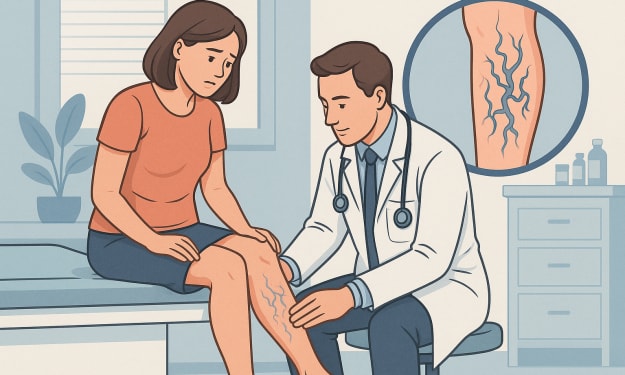
Swelled up, enlarged or twisted veins that appear dark purple or blue in colour lead to a condition called Varicose Veins.
• It is caused by faulty valves in the veins.
• It usually appears on the calves, legs or feet.
• Increased blood pressure inside the veins can be a cause. Like in case of a tumor, constipation, obesity or even during pregnancy.
• Seen in 3 out of 10 adults.
• Women are more likely to suffer from this condition.
• Common in men and women between the age of 40 to 80 years.
• Prevalence estimates of this condition are higher, 1% to 73% in females and in males it is 2% to 56%.
Symptoms
swollen, lumpy veins
feeling of heaviness in legs after exercise or at night
veins appearing blue or dark purple
frequent leg cramps
aching legs
Varicose veins can cause uneasiness even in the initial stages and should be treated before it worsens and causes economic burden. If not treated, the situation can even lead to you not being able to walk properly all your life. Treatment of Varicose veins by MOCA is not very expensive and results in a speedy recovery.
Treatments for Varicose Veins
Varicose Veins Stripping
It is a surgical procedure of removing varicose veins from the thighs or the legs. It involves some risks:-
Heavy Bleeding
Blood Clots
Allergic reaction
Bruising/ Scarring
Laser Ablation Treatment
In this procedure, strong bursts of laser lights are sent onto the vein resulting in the vein fading away or disappearing. It does not involve any incision. Laser ablation is comparatively lesser invasive and safer compared to surgery.
Radiofrequency Ablation (RFA)
This is another minimally invasive treatment which uses radiofrequency instead of laser energy to damage the wall of the affected vein with heat. The RF heat is sent into the vein through a thin and flexible tube (catheter). This treatment results in the closing of blood flow to the main problematic vein.
Mechanochemical Endovenous Ablation ( MOCA)
It the latest technique used to treat Varicose Veins. The Mechanochemical ablation uses mechanical trauma & sclerotherapy to ablate varicose vein. This treatment uses no heat, surgery or anaesthesia. It reduces the risk of varicose veins coming back which normally happens in case of the surgical method. The complications seen in the thermal techniques are comparatively rare in this procedure. MOCA has a higher success rate.
As one of the pioneers of the minimally invasive procedures in India, Interventional Radiologist Dr Sandeep Sharma has vast experience and knowledge in the treatments of ailments such as the Varicose Veins. His unique technical skill is unparalleled .When getting treated by Dr Sharma, he ensures you receive the most advanced care ever available, which is effective yet super safe.
About the Creator
Keep reading
More stories from irfacilities x and writers in Longevity and other communities.
Is Varicose Vein Treatment Right for You? Signs to Watch For
Do your eyes catch that thick, tortuous, swollen vein of the leg? If it looks bluish or purplish, you are seeing varicose veins. Almost everyone has one; at times, it is just a cosmetic problem, while at times it can actually hurt and create real trouble.
By irfacilities x10 months ago in Journal
Global Atherectomy Devices Market Size and Forecast 2025–2033
Introduction The global healthcare industry is witnessing a steady shift toward minimally invasive procedures, and atherectomy devices are playing a crucial role in this transformation. These specialized medical tools are designed to remove plaque from arteries, restoring blood flow in patients suffering from conditions such as coronary artery disease (CAD) and peripheral artery disease (PAD). With cardiovascular diseases remaining one of the leading causes of death worldwide, the demand for effective, less invasive treatment options continues to rise.
By shibansh kumar4 days ago in Longevity
The No-Exercise Cholesterol Hack: How I Ate My Way Out of a Medical Mess
I’ve spent most of my life as an athlete and a soldier, which means I’m used to treating my body like a machine. In that world, you don’t ask how the engine feels; you just put the fuel in and demand results. But hit fifty, throw in a few major surgeries, and suddenly that machine starts looking more like a rusty tractor.
By Feliks Karića day ago in Longevity



Comments (1)
This article provides a helpful overview of varicose veins and their management. I appreciate the emphasis on lifestyle modifications and the use of compression stockings, which are foundational in managing this condition. To further enrich the discussion, it's worth noting several additional treatments that have shown efficacy: 1. Sclerotherapy: A minimally invasive procedure where a solution is injected into the vein, causing it to collapse and fade. It's particularly effective for smaller varicose veins and spider veins. 2. Endovenous Thermal Ablation: This minimally invasive procedure utilizes laser or radiofrequency energy to close off affected veins, offering a less invasive alternative to traditional surgery. 3. Medical Adhesive: A newer, non-thermal technique where a medical adhesive is used to seal the affected vein. This method doesn't require tumescent anesthesia and allows for a rapid return to normal activities. Incorporating these treatments into the discussion can provide readers with a more comprehensive understanding of available options. As always, consulting with a vein specialist can help determine the most appropriate treatment based on individual needs and the severity of the condition.