
Why Do Crocodiles Not Eat Capybaras?
The science behind nature’s most surprising coexistence Why the world’s largest rodent often escapes a deadly fate Calm behavior and smart timing keep capybaras safe Not friendship, but survival strategy What this unusual relationship reveals about predator logic How risk and reward shape animal behavior Myth vs reality behind viral wildlife photos

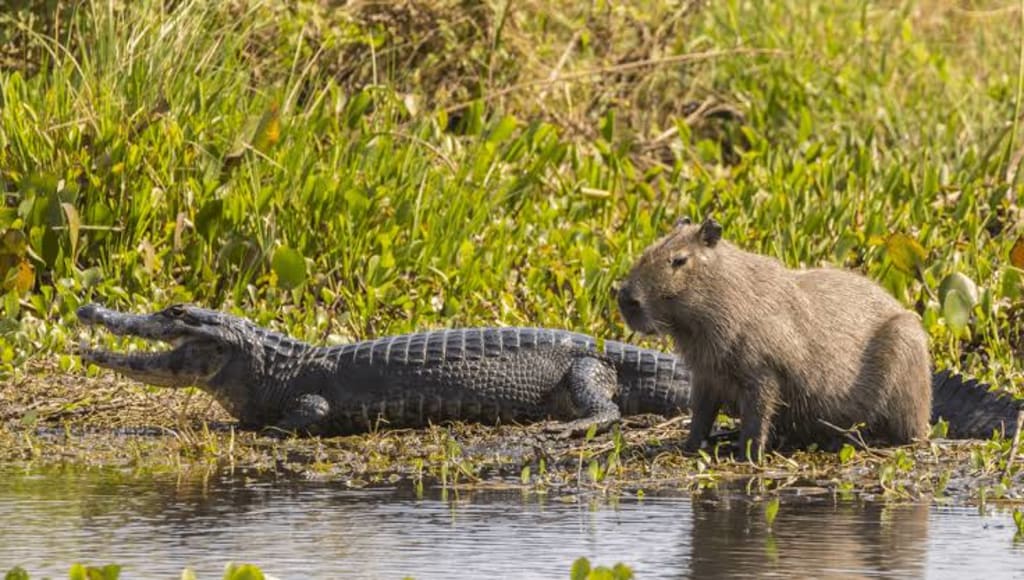
Images of capybaras calmly sitting beside crocodiles and caimans have fascinated the internet for years. These giant rodents are often seen lounging near some of the world’s most dangerous predators without appearing afraid. This unusual coexistence raises a simple but intriguing question: Why do crocodiles not eat capybaras?
The answer lies not in friendship, but in biology, behavior, and survival strategy. While crocodiles are capable of killing and eating capybaras, they often choose not to—unless conditions are right.
A Predator That Conserves Energy
Crocodiles are ambush predators designed to conserve energy. Unlike mammals that hunt frequently, crocodiles can survive weeks or even months between meals. Because hunting carries risks, they prefer prey that offers a high reward with minimal effort.
An adult capybara can weigh more than 50 kilograms (110 pounds) and is surprisingly fast and powerful in water. Attacking such an animal requires a sudden strike, a strong grip, and a struggle that could injure the crocodile. For a predator that values efficiency, a large, alert capybara is not always an attractive target.
Crocodiles tend to focus instead on:
Fish
Birds
Smaller mammals
Young or injured animals
Unless a capybara appears weak, distracted, or isolated, it may not be worth the energy or risk.
Capybaras Do Not Behave Like Prey
One of the main reasons crocodiles ignore capybaras is their behavior. Capybaras are exceptionally calm animals. They move slowly, avoid splashing, and remain watchful. Crocodiles rely heavily on movement to trigger their hunting instinct. Sudden motions, struggling, or panic signal an opportunity to strike.
A capybara that sits quietly near the water does not activate this response. Its relaxed posture communicates that it is aware and ready to flee. This reduces the likelihood of attack.
Capybaras have evolved alongside crocodilians for thousands of years in South America. Over time, they have learned how close is too close and when danger is real. This awareness helps them coexist safely most of the time.
Safety in Numbers
Capybaras live in groups that can range from 10 to more than 50 individuals. Group living provides protection. With many eyes watching the surroundings, crocodiles find it difficult to approach unnoticed.
When danger appears, one capybara will sound an alarm, and the entire group will flee into the water or dense vegetation. This collective vigilance discourages predators from attempting an attack unless the odds are clearly in their favor.
A lone capybara is far more vulnerable than one sitting among others. Many of the peaceful photographs seen online show group settings where crocodiles are less likely to strike.
Crocodiles Choose Timing Carefully
Crocodiles are most aggressive when hungry and active. However, many encounters with capybaras occur when crocodiles are basking in the sun. During basking, crocodiles are regulating their body temperature and digesting food. They are less inclined to hunt at these times.
Capybaras appear to recognize this pattern. They often share riverbanks with resting crocodiles, taking advantage of moments when the predators are least motivated to attack.
This is not a sign of trust but of instinctive risk assessment.
Capybaras Are Excellent Swimmers
Both animals are semi-aquatic, but capybaras are extremely agile in water. They can dive, swim quickly, and hide among aquatic plants. If a crocodile makes a sudden move, the capybara often escapes by submerging or sprinting toward shore.
Because crocodiles depend on surprise, losing that advantage greatly reduces their success rate.
Not a Friendship, but Tolerance
Despite popular myths, crocodiles and capybaras are not friends. Crocodiles do eat capybaras—especially young ones. There are documented cases of crocodiles attacking and killing capybaras when:
the capybara is injured
it is unaware of danger
it strays too close
food is scarce
The peaceful scenes seen online represent moments when both animals calculate that conflict is unnecessary. It is coexistence, not companionship.
Environmental Balance
In natural ecosystems, predators and prey often develop relationships based on mutual awareness rather than constant conflict. This balance reduces wasted energy and unnecessary injury for both sides.
Capybaras benefit by staying calm and alert. Crocodiles benefit by waiting for easier opportunities. Over generations, this has produced a pattern where attacks are selective rather than constant.
Why Humans Find It Fascinating
Humans expect predators to attack prey whenever possible. Seeing a crocodile ignore a capybara challenges that assumption. It reminds us that animal behavior is governed by logic, not emotion. Survival depends on calculation, not aggression alone.
These encounters also reveal how evolution shapes interactions between species that share the same habitat.
Conclusion
Crocodiles do not eat capybaras most of the time because it is often not worth the risk or energy. Capybaras remain calm, stay in groups, and understand when predators are least likely to strike. Crocodiles, in turn, prefer easier prey and conserve their strength.
This relationship is not peace—it is practical survival. Nature does not run on friendship, but on balance. When both animals judge that conflict brings more danger than benefit, they coexist quietly along the riverbanks.
And that is why the world keeps seeing one of nature’s most unlikely standoffs: the calm capybara beside the patient crocodile.
About the Creator
Fiaz Ahmed
I am Fiaz Ahmed. I am a passionate writer. I love covering trending topics and breaking news. With a sharp eye for what’s happening around the world, and crafts timely and engaging stories that keep readers informed and updated.
Keep reading
More stories from Fiaz Ahmed and writers in Longevity and other communities.
India’s Snakebite Crisis Is Killing Tens of Thousands Every Year
India is facing a silent but devastating public health emergency: snakebites kill tens of thousands of people every year, making the country home to the highest number of snakebite deaths in the world. Despite being largely preventable and treatable, snakebite envenoming continues to claim lives in rural and underserved communities, exposing deep gaps in healthcare access, awareness, and infrastructure. According to health experts and international organizations, India accounts for nearly half of all global snakebite deaths annually. Most victims are farmers, laborers, and children living in villages where encounters with venomous snakes are common and medical care is often hours away. A Rural Tragedy Snakebites occur most frequently in agricultural regions during the monsoon season, when snakes are displaced from flooded habitats and human activity in fields increases. Farmers working barefoot or sleeping on floors are especially vulnerable. In many cases, victims are bitten while harvesting crops, walking at night without lighting, or sleeping in homes without protective barriers. Children are also at risk when playing outdoors in tall grass or near water sources. “For rural families, a snakebite can mean sudden death or lifelong disability,” said a public health researcher based in New Delhi. “It is one of the most neglected health problems in the country.” Delayed Treatment Costs Lives Medical experts agree that snakebite deaths are largely preventable if victims receive timely anti-venom and proper care. However, delays remain common. Many people first turn to traditional healers instead of hospitals, losing critical hours. In remote areas, transportation to medical facilities can take several hours or even days. Some clinics lack trained staff or sufficient supplies of anti-venom. Others are unable to identify the type of snake involved, leading to inappropriate treatment. “Time is everything with snakebite,” said an emergency physician in Uttar Pradesh. “If anti-venom is given early, survival rates are high. But too often patients arrive too late.” Compounding the problem is the shortage of high-quality anti-venom. India produces most of its supply using venom from just four snake species, even though many more venomous snakes cause bites. This mismatch reduces treatment effectiveness in some regions. Economic and Social Impact Snakebite deaths are not just a health issue; they are an economic and social crisis. Most victims are working-age adults who support families through farming or manual labor. Their deaths push households deeper into poverty. Survivors often suffer permanent injuries such as paralysis, kidney damage, or amputations, leaving them unable to work. Medical bills further strain already vulnerable families. “Snakebite is both a cause and consequence of poverty,” said a development economist. “It hits the poorest communities hardest and keeps them trapped in cycles of hardship.” Lack of Awareness and Data One major challenge in tackling snakebite deaths is poor data collection. Many cases go unreported because deaths occur at home or in small clinics that do not maintain official records. This undercounting weakens policy responses and funding priorities. Public awareness about prevention remains limited. Simple measures such as wearing protective footwear, using torches at night, raising beds off the floor, and clearing vegetation around homes could significantly reduce risk. Yet these steps are not widely practiced due to lack of education and resources. Health campaigns about snakebite prevention are rare compared to those for diseases like malaria or tuberculosis. Government and Global Action The Indian government has begun acknowledging the severity of the crisis. Snakebite envenoming is now recognized as a notifiable disease in several states, meaning hospitals must report cases. Training programs for healthcare workers are being expanded, and efforts are underway to improve anti-venom distribution. At the international level, the World Health Organization has launched a global strategy to halve snakebite deaths and disabilities by 2030. India plays a central role in this effort due to its large burden of cases. However, experts warn that progress will be slow without sustained investment. “This requires better roads, stronger rural health systems, and community education,” said a WHO adviser. “It cannot be solved by medicine alone.” Climate Change Worsens the Risk Climate change is expected to intensify the snakebite crisis. Rising temperatures and unpredictable rainfall are altering snake habitats and increasing human-snake encounters. Flooding forces snakes into homes, while drought pushes people into areas where snakes live. Urban expansion into rural land also raises the risk as people move closer to wildlife environments. Researchers warn that without adaptation measures, snakebite incidents could rise further in coming decades. Stories Behind the Statistics Behind the statistics are countless personal tragedies. In one village in Bihar, a young farmer died after being bitten while walking home at night. His family waited hours for transport to a hospital that had no anti-venom in stock. In another case in Maharashtra, a teenage girl survived a bite but lost the use of her hand due to delayed treatment. “These stories repeat every year, in every state,” said a rural doctor. “And most of them could be prevented.” Conclusion India’s snakebite crisis is one of the country’s most overlooked public health disasters. Tens of thousands of deaths each year reflect failures in access to healthcare, education, and infrastructure. While anti-venom and treatment exist, they remain out of reach for many who need them most. Reducing snakebite deaths will require coordinated action: stronger rural health systems, reliable supplies of anti-venom, public awareness campaigns, and improved reporting. Until then, snakebite will continue to quietly claim lives in villages across India — a tragedy that no longer needs to be inevitable.
By Fiaz Ahmed about 9 hours ago in Longevity
Day 4 of Quitting
If this is how sobriety feels, maybe it’s better to go through life a little buzzed… this, along with other hits like, I want to kill myself, I wish I was dead, and I’m going to throw myself off a bridge have been the only thoughts on rotation these past few days. I promise myself that if, in a month, I still feel like this (‘this’ meaning despondent, full of rage, and simultaneously numb) I can go back to smoking. Until mid-February though? Nicotine is off the table.
By sleepy drafts26 days ago in Longevity
The Foundation of Balance: Why Ankles Matter More Than Core Strength
When balance becomes a concern, the conversation often turns toward core strength. While the core plays an important role in posture and movement, balance itself starts much closer to the ground. The feet and ankles are the body’s primary interface with the world, constantly collecting information and sending signals that guide stability.
By AhmedFitLife4 days ago in Longevity


Comments
There are no comments for this story
Be the first to respond and start the conversation.