
Am I Disabled Enough?
Tackling the politics of a disabled parking badge

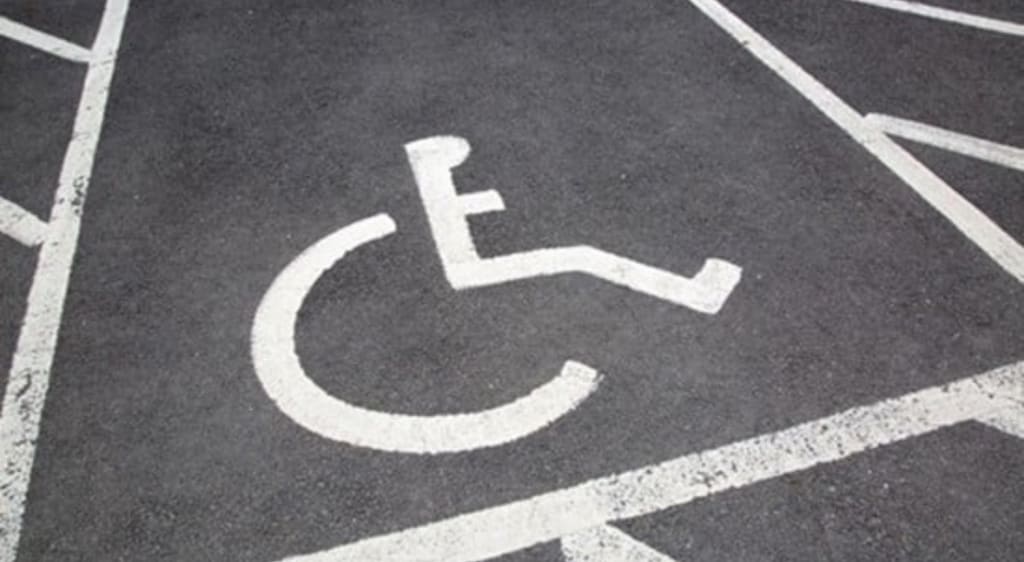
The hardest part of using my disabled parking badge isn’t the walking.
It’s the watching.
The moment I step out of the car, I feel it. The pause. The glance. The subtle double-take as someone tries to reconcile what they see with what they believe disability should look like. Their eyes flick from my face to the badge, then back again, searching for evidence that justifies my presence.
I have learned that using a disabled parking space without looking visibly disabled is, in itself, a political act.
The Blue Badge sits on the dashboard like a quiet declaration: I belong here. I need this. I am entitled to this access. But entitlement, in this context, doesn’t feel like privilege. It feels like exposure.
Disabled parking spaces exist to reduce distance, risk, and physical strain. They exist because walking across a large car park can mean pain, exhaustion, instability, or injury. They exist to make participation possible. Yet their use is constantly policed — not just by authorities, but by the public.
Especially when disability isn’t immediately visible.
There is a cultural image of disability that is deeply ingrained: a wheelchair, an elderly person, a visible injury. Anything outside of that narrow framework invites suspicion. When I step out of the car without fitting those expectations, I become a question mark in someone else’s mind.
What’s wrong with her?
Does she really need that space?
Is she taking advantage?
These questions are rarely spoken aloud. They don’t need to be. They exist in the tension of prolonged eye contact, in the way someone lingers, in the silent audit of my body.
The irony is that the badge doesn’t remove difficulty. It reduces it.
Without it, something as ordinary as going to the supermarket becomes physically demanding. Fatigue builds before I’ve even reached the entrance. My balance becomes less reliable. Pain increases. By the time I arrive inside, part of my energy has already been spent simply getting there.
Access isn’t convenience. It’s preservation.
But invisible disability complicates access in ways that visible disability does not. When your needs are not immediately obvious, you are forced into a position of constant self-justification — even when no one says a word. You become hyper-aware of how you move, how quickly you walk, whether you appear “disabled enough” in that moment.
There is an unspoken pressure to perform disability in ways that make others comfortable.
To limp, so the badge makes sense.
To move slowly, so the space feels earned.
To visually signal limitation, so suspicion softens into acceptance.
This performance is exhausting. And it reinforces a dangerous idea: that access must be justified through visible suffering.
The Blue Badge is not a reward for looking disabled. It is a tool that acknowledges limitation, whether visible or not.
What many people don’t understand is that invisible illness fluctuates. There are days when I move more easily, and days when every step requires careful attention. The badge exists for both realities. It exists because disability is not always consistent or obvious.
Public judgment doesn’t account for fluctuation. It operates on snapshots, not lived experience. This very mentality is the base of the PIP assessment that awarded me PIP for my anxiety and NOT for my MS … but that’s a story for another day.
Sometimes, the looks make me question myself. Not my eligibility, but my right to exist in that space without explanation. Ableism is insidious in that way. It teaches you to see yourself through the eyes of those who doubt you.
It makes you feel like an imposter in your own reality.
But the truth is simple: I have this badge because I need it, and the council at least agree with me. Not because I look a certain way. Not because I fit someone else’s expectations. But because my body requires access in order to function safely in the world.
The real problem isn’t people using disabled parking spaces who don’t look disabled.
The real problem is a culture that believes disability must be visible to be valid.
Disabled parking badges are not symbols of weakness. They are symbols of participation. They allow people like me to work, to shop, to engage with the world instead of withdrawing from it.
Every time I use mine, I am choosing access over approval.
The stares haven’t stopped. They may never stop. But they no longer control my decisions.
I would rather be stared at in a disabled parking space than stranded at home by fear, fatigue, or injury.
Visibility is uncomfortable. But invisibility is isolating, and I refuse to disappear just to make other people comfortable.
And don’t even get me started on the selfish idiots who use disabled bays without a badge purely because it’s “just a quick trip”…
About the Creator
Keep reading
More stories from Millie Hardy-Sims and writers in Motivation and other communities.
One Hard Thing
Stop me if you’ve heard this one before: You have the number, you know your schedule- you’ve even picked out the perfect day and time to make this appointment. Shoot, you’ve even picked out alternative days and times just in case their schedules can’t accommodate you!
By Taylor Rigsby18 days ago in Motivation
Holding the Line: Courage in the Face of Injustice
There are moments in history, and in everyday life, when the machinery of society seems to falter. Rules meant to protect, systems designed to safeguard, and authorities tasked with maintaining fairness sometimes fail. They falter not always out of malice, but through indifference, inertia, or simple oversight. Yet, in the spaces where these failures occur, a remarkable human quality often emerges: resilience. It is in these moments, when the world might expect retreat or silence, that individuals and communities discover an extraordinary courage—the courage to hold the line, to insist that fairness, safety, and normality are not negotiable.
By Algieba5 days ago in Motivation




Comments
There are no comments for this story
Be the first to respond and start the conversation.