
Dreams And Destiny
Where Hard Work Meets Destiny
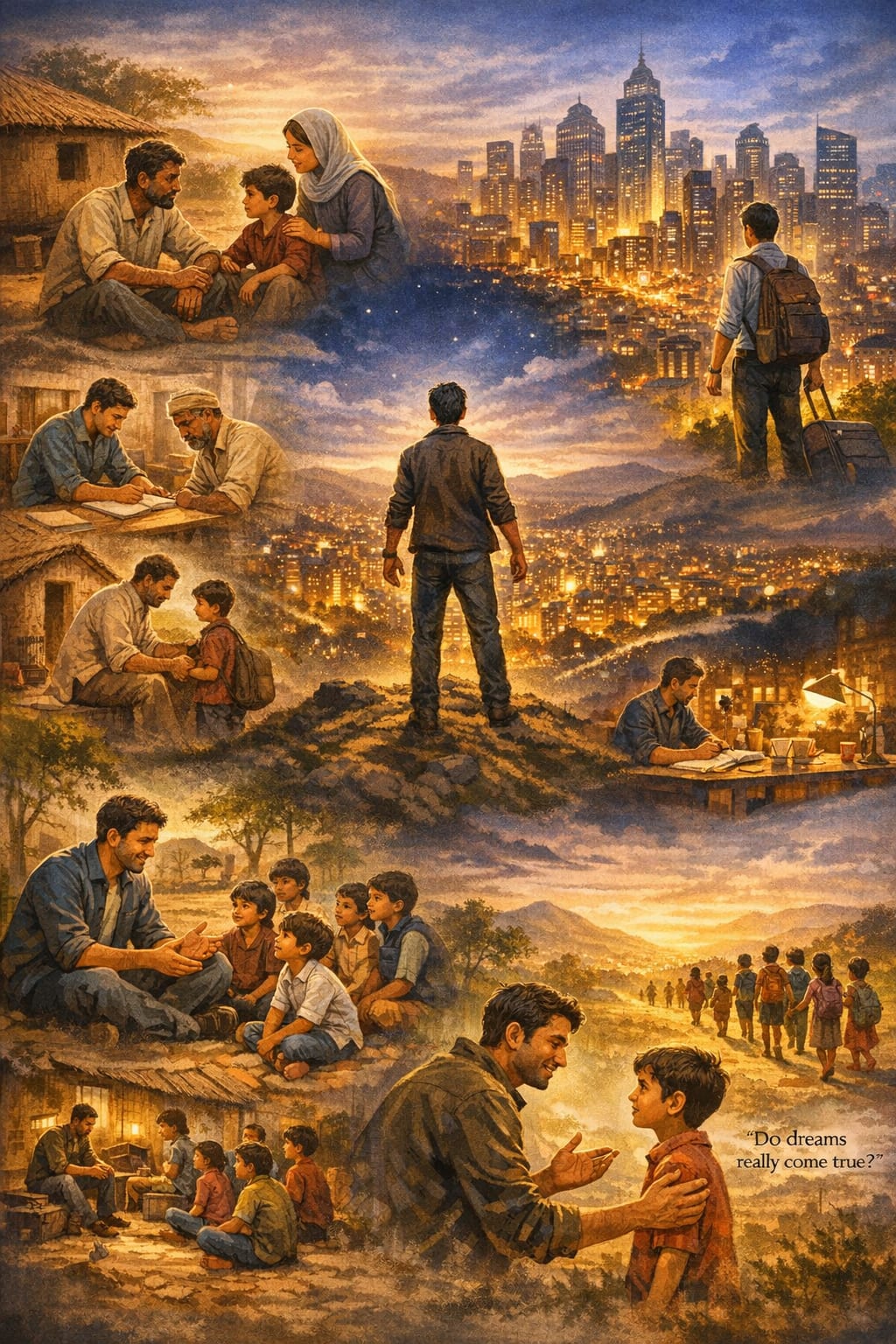
In the village of Ali Pur, the air was often thick with the scent of dry earth and the weight of tradition. Life there functioned like a clock with a rusted spring—steady, predictable, and slow. The villagers lived by a singular philosophy: Kismet, or destiny. They believed that a man’s path was carved into his palm before he was even born. To challenge one's lot in life was seen not just as foolish, but as an affront to the natural order.
Ayaan, however, carried a secret that didn't fit within the village boundaries. Every night, his sleep was visited by a recurring vision. He would find himself standing atop a windsore hill, looking down at a sprawling valley of electric stars—a city made of light. It wasn’t just a dream; it was a physical yearning that made the silent fields of Ali Pur feel like a cage.
The Conflict of Hands and Hearts
Ayaan’s father, a man whose skin was etched with the geography of the fields he plowed, noticed his son’s distant gaze. One evening, as the sun dipped below the horizon, painting the mud walls of their home in shades of bruised purple, Ayaan spoke his truth.
"I want to go to the city to study," Ayaan said, his voice barely a whisper. "I want to be more than a shadow in these fields. I want to build things that help people."
His father sighed, looking at his calloused, soil-stained hands. "Son, look at these hands. They belong to the earth, just as mine did and yours do. Dreams are like the morning mist—they look beautiful, but they vanish when the sun gets hot. Our destiny is here, in the dirt."
The words felt like a cold rain on a flickering flame. Yet, at school, Ayaan found a different kind of fuel. His teacher, Mrs. Rahman, saw the way he clung to his tattered textbooks as if they were maps to a buried treasure. Sensing his internal struggle, she pulled him aside after a lesson on geography.
"The world is wider than the horizon you see from your porch, Ayaan," she said firmly. "Talent is a seed, but courage is the water. Don't let the fear of the village elders decide the size of your world."
The Breaking Point
As Ayaan entered his final year of school, the "sun" of reality grew scorching. His father fell ill, his lungs weary from decades of dust. The family’s meager savings evaporated into medicine and prayer. Ayaan stood at a crossroads: he could surrender to the "destiny" of the plow to support his family, or he could chase the ghost of a dream.
It was Mrs. Rahman who brought the catalyst—a scholarship application for a prestigious college in the capital.
"I can't leave them now," Ayaan told her, his heart heavy. "What if I fail and lose everything?"
"Failure is a bruise," she replied. "Regret is a scar. Which would you rather carry?"
Ayaan applied. When the acceptance letter arrived, it felt less like a piece of paper and more like a key. To his surprise, his father did not argue. The old man looked at the letter, then at his son, and whispered, "Perhaps destiny isn't a destination. Perhaps it is a choice we are given."
The City of Shadows and Light
The transition was brutal. The city was a chaotic symphony of iron and glass, indifferent to a boy from Ali Pur. Ayaan lived in a cramped room that smelled of damp concrete, working 12-hour shifts in a kitchen to pay for his books. He failed his first chemistry exam. He spent nights shivering under a thin blanket, wondering if his father had been right all along.
Was he chasing a mirage?
One evening, exhausted and nearing a breakdown, Ayaan climbed a steep trail on the outskirts of the city to clear his head. He reached the summit and turned around. The breath left his lungs.
Below him, the city sparkled exactly as it had in his sleep for fifteen years. The grid of golden streets, the pulsing lights, the infinite energy. He wasn't looking at a dream anymore; he was standing inside it. He realized then that the dream wasn't a "message" that success would be handed to him—it was a compass showing him where he was supposed to fight.
The New Destiny
Ayaan didn't just graduate; he excelled. He used his education to become a rural development specialist, bridging the gap between the modern city and the forgotten villages. He returned to Alipur not as a stranger, but as a builder. He helped install solar grids and built a library that bore Mrs. Rahman’s name.
Years later, a young girl from the village approached him, looking at his laptop and his blueprints with wide eyes. "Sir, do you believe our lives are already written?"
Ayaan looked out at the fields, then at the bright, eager face of the child. "I think the first page is written for us," he said. "But we are the ones holding the pen for the rest of the book. Dreams show you the road, but your feet must do the walking."
That night, Ayaan slept without the dream of the city. Instead, he saw a thousand different lights flickering across the dark fields of his home, each one a different dream starting to wake up.
About the Creator
Keep reading
More stories from writers in Motivation and other communities.
One Hard Thing
Stop me if you’ve heard this one before: You have the number, you know your schedule- you’ve even picked out the perfect day and time to make this appointment. Shoot, you’ve even picked out alternative days and times just in case their schedules can’t accommodate you!
By Taylor Rigsby14 days ago in Motivation


Comments
There are no comments for this story
Be the first to respond and start the conversation.