
The Clockmaker’s Last Gift
When Time Runs Out, What Truly Matters

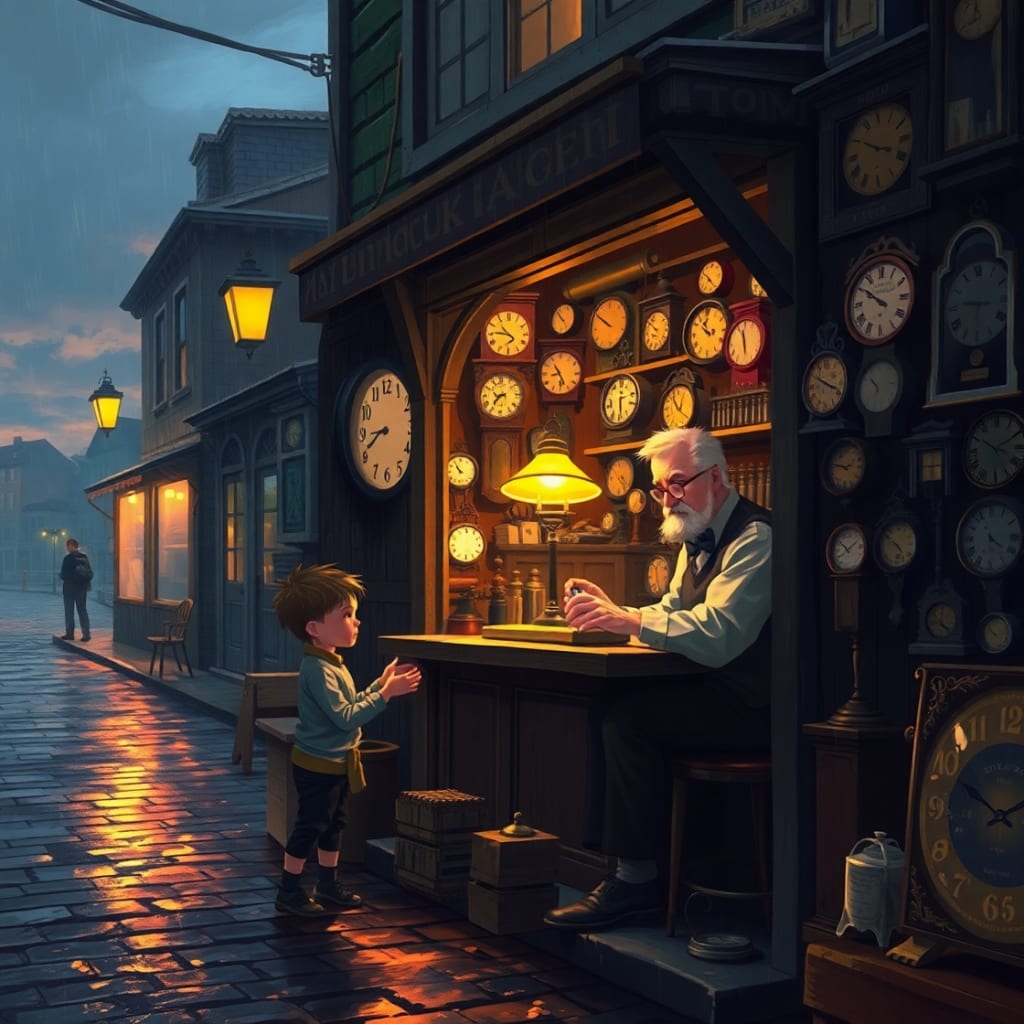
On the edge of a quiet seaside town, where gulls cried over the waves and the cobblestone streets smelled faintly of salt, there stood an old shop with a sign that read Everhart Clocks. Its windows were dusty, its doorbell tinkled softly when someone entered, and the air inside smelled of oil, brass, and memories.
Thomas Everhart was the last clockmaker in town. He had been fixing clocks for fifty years—grandfather clocks, pocket watches, cuckoos, even the small wristwatches children brought in as gifts for their parents. People said he could mend time itself with his hands. Yet lately, his own time felt like it was slipping away. His doctor had warned him: his heart was weak, and every day from now on was borrowed.
But Thomas wasn’t afraid. He had lived a long life. What gnawed at him was a promise he had never kept—a promise to his daughter, Emily, who had left town fifteen years earlier after a terrible argument. They hadn’t spoken since.
On a rainy afternoon, as Thomas sat at his workbench, polishing the gears of a pocket watch, the shop door creaked open. A young boy, no older than ten, entered hesitantly. “Are you the clockmaker?” the boy asked.
Thomas nodded. “I am.”
The boy set a broken watch on the counter. “It was my dad’s. He said it’s special. Can you fix it?”
Thomas picked up the watch. It was old, but beautifully made—engraved with initials on the back. “This belonged to someone important,” he murmured.
“My dad,” the boy said. “He passed away last year.”
Something in the boy’s eyes—sorrow mixed with quiet hope—made Thomas’s chest ache. “I’ll fix it,” he said softly. “Come back in a few days.”
That night, Thomas stayed up late at his bench, the rain tapping against the window. He disassembled the watch carefully, tiny screws and gears scattered like stars across the table. He thought about Emily, wondering where she was, whether she still remembered the way the shop smelled in the morning.
By dawn, the watch was working again. But Thomas added something extra—a tiny inscription on the inside plate: Time heals, but love mends.
When the boy returned three days later, his eyes lit up as the watch ticked steadily. “It’s perfect,” he whispered. “Thank you.”
Thomas smiled. “Take care of it.”
As the boy left, Thomas felt something shift. Fixing that watch had felt different—like he wasn’t just mending gears but stitching together invisible threads of love and loss. He wondered if it was still possible to fix his own broken time with Emily.
That night, Thomas wrote a letter. In it, he apologized for the years of silence and told Emily about the boy, about the watch, about how he wished they could speak once more before his own clock ran out. He sent it to the last address he had.
Weeks passed. The shop grew quieter. Thomas worked more slowly. Yet every day, he wound and polished the clocks, their ticking like a chorus of hearts.
One morning, the doorbell tinkled, and Thomas looked up to see a woman standing in the doorway, her hair streaked with gray but her eyes unmistakable.
“Emily,” he whispered.
She stepped forward, holding the letter. “I got your note,” she said. “I wasn’t sure if I should come. But then I thought… maybe we’ve lost enough time already.”
Thomas’s hands trembled. “I’m sorry,” he said. “For everything.”
Emily’s eyes glistened. “Me too, Dad.”
They embraced, the clocks ticking all around them like applause.
Over the next weeks, Emily helped Thomas in the shop. She dusted the shelves, wound the clocks, and listened to her father’s stories about the town and its people. They didn’t speak much about the past. They simply moved forward, minute by minute.
One evening, Thomas handed Emily a small wooden box. “Open it,” he said.
Inside was a delicate clock, unlike any she had seen. Its face was mother-of-pearl, and its hands were golden feathers. On the back, engraved in tiny script, were the words: The Last Gift.
“I made it for you,” Thomas said softly. “It’s yours when I’m gone.”
Emily clutched it to her chest. “Don’t talk like that,” she said.
But Thomas only smiled. “Time runs out for everyone. What matters is what we do with it.”
A month later, Thomas passed away peacefully in his sleep. The townspeople gathered to honor him, filling the shop with flowers and memories. Emily stood behind the counter, tears sliding down her cheeks, the small clock ticking softly in her hands.
She decided to keep the shop open. Every time she fixed a clock for someone, she felt her father’s hands guiding hers. And on the back wall, above the workbench, she hung a framed note that read: Time heals, but love mends.
The shop became a place where people didn’t just repair clocks—they repaired pieces of their own lives. And though Thomas Everhart was gone, his last gift kept ticking on, a heartbeat echoing through time.
About the Creator
Alexander Mind
Latest Stories
Keep reading
More stories from Alexander Mind and writers in Motivation and other communities.
How to Stop Waiting for Motivation (The Secret Most People Miss
Leo stared at the blank page. The cursor blinked back at him, a tiny, metronome of mockery. Tap. Tap. Tap. It seemed to echo the hollow feeling in his chest. The deadline for his novel’s next chapter was a specter looming over tomorrow, but tonight, he felt nothing. No spark. No divine wind of inspiration. Just the crushing weight of expectation and the utter absence of motivation.
By Alexander Mind5 months ago in Motivation
One Hard Thing
Stop me if you’ve heard this one before: You have the number, you know your schedule- you’ve even picked out the perfect day and time to make this appointment. Shoot, you’ve even picked out alternative days and times just in case their schedules can’t accommodate you!
By Taylor Rigsby9 days ago in Motivation
Why Consistency Beats Talent
I used to believe talent was everything. If you were born gifted, doors opened. If you weren't, well, you just had to accept your limits. I watched the naturally talented people around me—the ones who made everything look effortless—and felt a familiar sting of envy mixed with resignation.
By Fazal Hadi6 days ago in Motivation
One Unchecked Box
"Republished" because it was the only way to add the embed for the newly recorded audio version of this story due to the Top Story badge. Plus it serves as a nice, informal announcement of the podcast's revival for another season (go subscribe!):
By Stephen A. Roddewig7 days ago in Fiction



Comments
There are no comments for this story
Be the first to respond and start the conversation.