
The Comedian Who Survived Three Years in a Car: The Brutal Reality of Steve Harvey’s Success
Before the tailored suits, the global television empire, and the millions in the bank, there was a man freezing in a Ford Tempo, relying on gas station sinks, and enduring the darkest phase of the creator’s journey. Here is the raw truth about the price of a dream

Turn on a television almost anywhere in the world today, and you are likely to see Steve Harvey.
He is an undeniable force of modern entertainment. With his signature tailored suits, booming laugh, and razor-sharp wit, he commands stages, hosts globally syndicated game shows, and writes bestselling books. His net worth is estimated in the hundreds of millions. He is the picture of a man who has completely mastered his domain, projecting an aura of untouchable confidence.
But success of this magnitude is rarely born in comfort. It is usually forged in the dark.
For creators, writers, and entertainers, the journey to the top is heavily romanticized. We love the highlight reels. We love the triumphant moments when the crowd goes wild, the metrics skyrocket, or the contract is signed. But what we rarely discuss is the crushing, agonizing gap between the moment you commit to your dream and the moment the world finally decides to care.
Long before Steve Harvey was a global icon, he experienced a level of suffering and public humiliation that would have permanently broken most people.
This is not just a story about a comedian getting a big break. It is a harsh, philosophical look at the true cost of mastery. It is a story about the agonizing "unrewarded phase" of the creative grind—the years where effort exists, but results do not.
The Illusion of the Leap
In the mid-1980s, Steve Harvey was a man living a life of quiet desperation. He had worked a string of unfulfilling, grueling jobs. He had been an autoworker, an insurance salesman, a carpet cleaner, and a mail carrier. He was making a living, but he was dying inside.
He had a singular, burning conviction: He believed he was meant to be a comedian.
Society tells us that taking the leap is the hardest part. Motivational speakers often claim that once you quit your day job and commit to your passion, the universe will rise to meet you.
Harvey took that leap. He quit his stable job. He burned his boats. He walked away from the guaranteed paycheck to step into the spotlight, armed with nothing but his belief that he was funny enough to make it.
Reality violently disagreed.
The transition from a dreamer to a professional is a brutal awakening. When Harvey first started hitting the comedy club circuit, the reception was ice-cold. He quickly learned that being the funniest guy in the breakroom at the Ford plant did not translate to commanding a room of paying strangers who dared him to make them laugh.
Early performances were agonizing. Some nights, a few people chuckled. Most nights, they stared at him with blank, unforgiving faces. Every artist knows the sinking feeling of putting your soul into a piece of work—a video, an article, a performance—only to be met with deafening silence.
But in stand-up comedy, the rejection is not just silent; it is a public execution.
The Nightmare on Stage
There is a specific kind of trauma reserved for performers who fail in real-time. If a writer publishes a piece that flops, it simply fades into the background of the internet. If a video doesn't get views, it just sits quietly on a channel.
But when a comedian bombs, there is no hiding.
One night, early in his career, Harvey stepped onto the stage, took the microphone, and completely lost the room. His timing was off. The jokes didn't land. The silence quickly morphed into restless murmurs, and those murmurs escalated into outright hostility.
The crowd turned on him. The boos started rolling in—loud, aggressive, and deeply personal.
He was booed completely off the stage.
Imagine the psychological weight of that moment. He had given up his income, his stability, and his security for this. He had traded a respectable life for a public humiliation. As he walked off the stage, the adrenaline fading into a cold sweat, the reality of his situation set in. He had no backup plan. He had no safety net.
He was a man standing over a terrifying abyss. And very soon, he would fall in.
The Three-Year Wilderness
By 1990, the consequences of Harvey’s relentless pursuit of his dream had caught up with him. The comedy gigs were sporadic, paying mere pennies when they paid at all. The bills piled up until there was nothing left.
Steve Harvey became officially homeless.
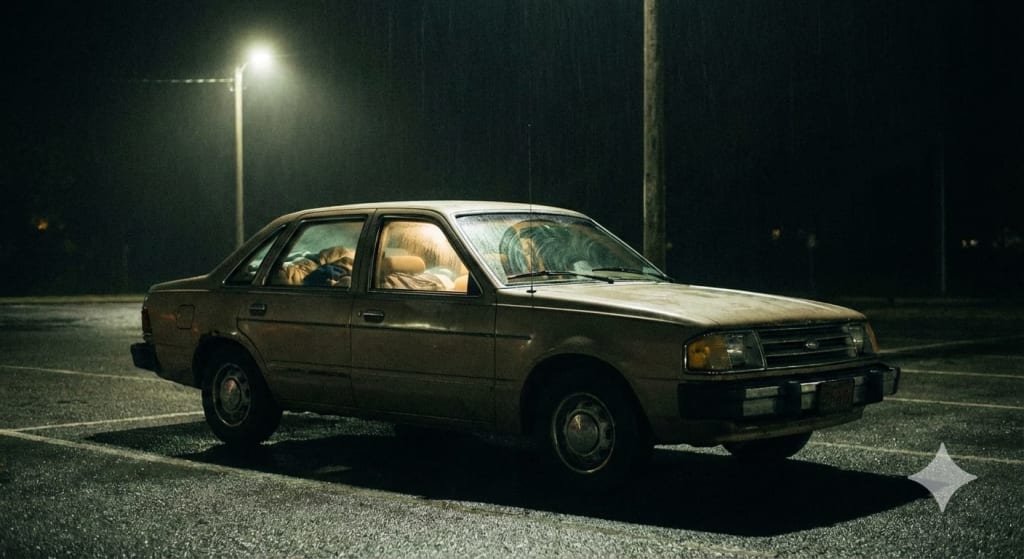
He didn't live on a park bench. He lived in his car—a 1976 Ford Tempo.
For nearly three years, this compact car was his entire world. It was his bedroom, his dining room, and his dressing room. He kept his few remaining suits neatly hung in the back. He fashioned a makeshift refrigerator out of an Igloo cooler, filling it with ice to keep bologna and cheese cold.
The glamour of the entertainment industry was stripped away, leaving only the raw, visceral grit of survival.
Every day was a logistical nightmare. He washed up in hotel bathrooms, gas station restrooms, and public swimming pool showers. He would wait until the coast was clear, strip down in a tiny stall, and desperately try to make himself look presentable enough to walk into a comedy club later that night and pretend everything was fine.
Winter nights were a specific kind of hell. As the temperatures dropped, the inside of the Ford Tempo turned into an icebox. He would wake up shivering, the windows frosted over from the inside due to his own breath.
But the physical discomfort paled in comparison to the psychological warfare of those three years.
There were days when he had to make a choice between buying a cheap meal or buying enough gas to get to the next comedy gig. Sometimes he went hungry just to make it to a stage where he might perform for free, all in the hope of being seen.
He later confessed that those nights felt absolutely endless. He would sit in parking lots, staring through the windshield of his freezing car, watching other people live normal lives. He watched men in suits drive home to warm houses. He watched families go to restaurants.
The hardest battle a creator fights is not against the algorithm, the publishers, or the audience. It is the battle against their own rationale.
When you are starving in a car, quitting isn't a sign of weakness; it looks like the most logical, responsible thing a human being could do. Everyone around you—society, your bank account, your aching stomach—is screaming at you to stop.
Give up, the world says. You tried. It didn't work. Go get a real job.
To continue creating under those conditions requires a belief that borders on the irrational. It requires a stubborn, almost terrifying commitment to a vision that literally no one else can see.
The Breaking Point and the Breakthrough
After three years of washing in public sinks and sleeping upright in the driver's seat, Harvey reached his absolute limit.
He was parked outside a hotel in Florida, preparing for a gig. He was exhausted, broke, and emotionally bankrupt. He sat in his car and finally broke down. He wept. He asked God why this was happening to him, why he was being put through such an agonizing trial just to share his gift.
He was ready to quit. He was ready to walk away from the microphone forever and surrender to a normal, safe, unfulfilled life.
But then, the universe blinked.
He received a message about a massive opportunity: the Johnnie Walker National Comedy Search. It was a high-stakes competition. If he could make it, it would put him in front of industry heavyweights.
He didn't even have the money to travel to the gig. But through a sheer stroke of luck and the kindness of a club owner, he managed to secure a flight.
When Steve Harvey walked onto that stage, he was not just performing a routine. He was fighting for his actual life. He performed with a desperate, electric energy—the kind of raw power that can only be harnessed by a man who has absolutely nothing left to lose.
He destroyed the room. He was flawless.
That single performance cracked the door open. It led to an invitation to host It's Showtime at the Apollo, one of the most prestigious and ruthless stages in America. At the Apollo, if you aren't funny, the crowd literally chases you off the stage. Harvey didn't just survive the Apollo; he conquered it.
The momentum shifted. The years of grinding in the dark finally caught fire. The Apollo led to acting roles. The acting roles led to his own sitcom, The Steve Harvey Show. The sitcom led to The Original Kings of Comedy, a record-breaking stand-up tour.
Eventually, it led to Family Feud, syndicated talk shows, and the global empire that stands today.
The Real Lesson: The Cost of Mastery
When we look at Steve Harvey today, it is easy to assume that his success was a foregone conclusion. We look at the final product and forget the agonizing assembly process.
Harvey did not succeed because he was immune to failure, or because his journey was uniquely blessed. He succeeded because he survived the exact phase where 99% of people quit.
We live in a culture that demands immediate ROI (Return on Investment). If we start a business, write a book, or launch a channel, we expect to see the watch hours, the followers, and the revenue within a few months. When it doesn't happen, we become disillusioned. We assume we are on the wrong path.
Steve Harvey’s story is a violent rejection of that mindset.
His journey proves that dreams often look entirely irresponsible before they look visionary. For three years, Steve Harvey looked like a failure. To anyone walking past his Ford Tempo, he was just a homeless man with a delusion.
But Harvey understood a profound philosophical truth: Stopping in the middle guarantees failure. Continuing is the only thing that keeps possibility alive.
He later reflected on his darkest days with a piece of profound advice: "If you’re going through hell, keep going. Why would you stop in hell?"
The Endurance of the Creator
If you are reading this right now, and you are in the middle of your own unrewarded phase—if you are putting in the hours, writing the scripts, filming the videos, or building the business, and all you are getting back is silence—you must understand that you are not failing. You are simply paying the toll.
Success is rarely a sudden explosion of genius. More often than not, it is a war of attrition. It belongs to the person who can endure the discomfort, the anonymity, and the doubt longer than their competitors.
Sometimes, progress isn't glamorous. It doesn't look like a montage with upbeat music. Sometimes, progress looks like washing your face in a gas station sink, looking in the mirror, and choosing to walk back onto the stage anyway.
The world does not owe you an audience. You have to earn them. And sometimes, the price of admission is surviving your own personal Ford Tempo.
Keep driving.
About the Creator
Frank Massey
Tech, AI, and social media writer with a passion for storytelling. I turn complex trends into engaging, relatable content. Exploring the future, one story at a time
Keep reading
More stories from Frank Massey and writers in Motivation and other communities.
The Man Who Threw a $400,000 Dream in the Trash: The Real Stephen King Story
If you walk into any bookstore in the world today, you will see an entire section dedicated to a single man. Stephen King is a titan of modern literature. He has published over 60 novels, sold more than 350 million copies worldwide, and seen dozens of his works adapted into massive Hollywood films. His name is synonymous with suspense, imagination, and unparalleled literary success. He is a multi-millionaire, a cultural icon, and a master of his craft.
By Frank Massey about 14 hours ago in Motivation
One Hard Thing
Stop me if you’ve heard this one before: You have the number, you know your schedule- you’ve even picked out the perfect day and time to make this appointment. Shoot, you’ve even picked out alternative days and times just in case their schedules can’t accommodate you!
By Taylor Rigsby30 days ago in Motivation




Comments
There are no comments for this story
Be the first to respond and start the conversation.