
The Silence Between the Bells
For Luca Ferrand, silence was more familiar than sound.

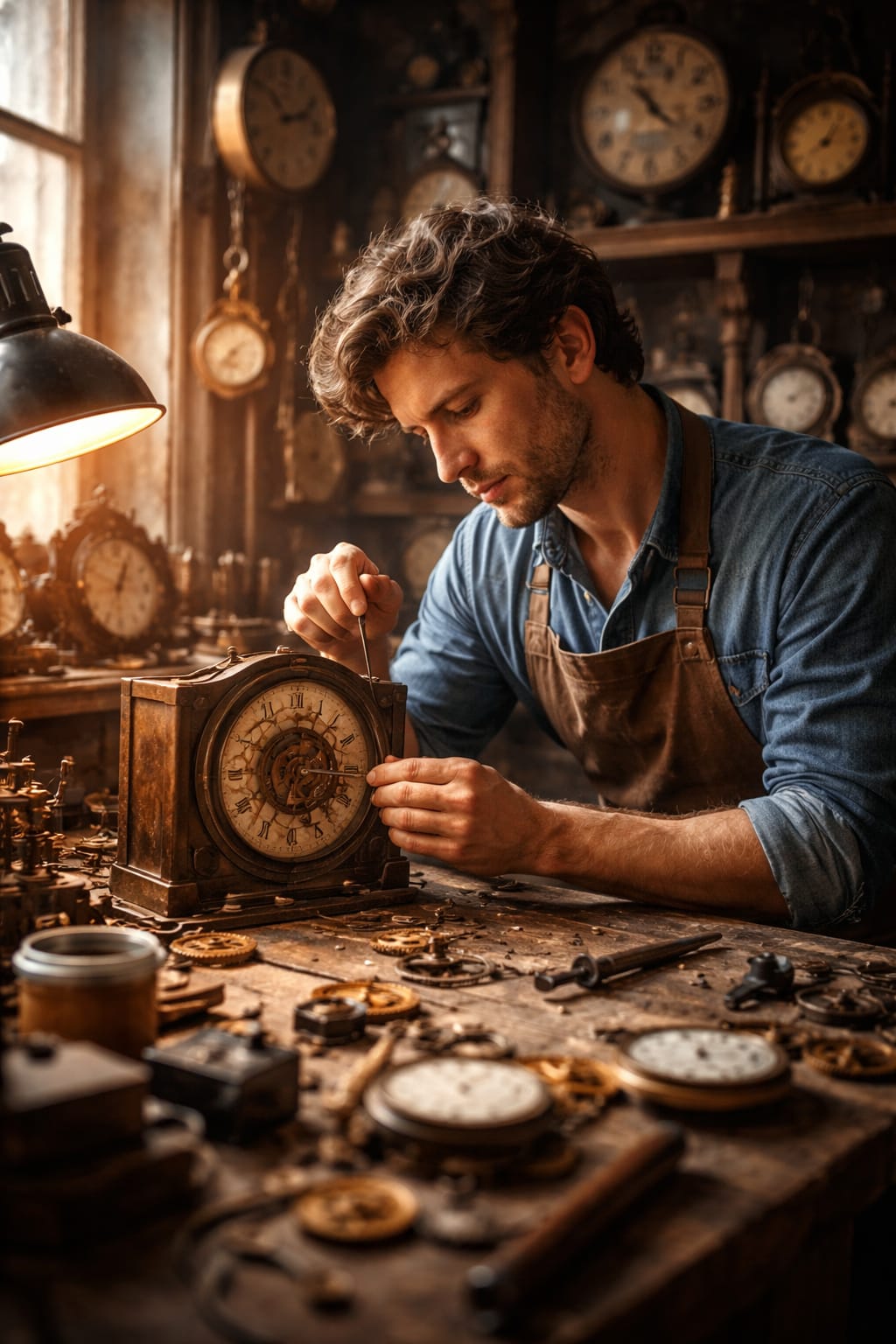
In the mountain village of San Rivo, the church bells rang every morning at seven and every evening at six. Between those hours, the town lived quietly — farmers worked their fields, bakers sold bread still warm from the ovens, and tourists came only in summer.
At twenty-eight, Luca was the youngest clockmaker in the region. His workshop sat beside the square, a narrow room filled with wooden shelves and the smell of oil and dust. Inside, dozens of broken clocks waited patiently for repair: wall clocks, pocket watches, even a few ancient tower mechanisms removed from abandoned villages.
Most people believed clockmaking was a dying craft. Luca knew it already was.
He had learned the skill from his grandfather, who taught him how to listen to machines the way others listened to music. “Time speaks,” his grandfather used to say. “If you’re quiet enough, it tells you what’s wrong.”
But listening did not pay the rent.
Every month, fewer customers came. Watches were digital now. Phones replaced everything. Tourists wanted souvenirs, not repaired heirlooms. Luca’s friends had left San Rivo years ago — some to Milan, some to Berlin, some to places whose names sounded like opportunity.
Luca stayed because he believed in something slower.
Yet belief does not stop bills.
One cold evening, Luca counted his earnings and realized he had just enough money for two more months. After that, he would have to close the shop and find work in the city — maybe in a factory, maybe behind a desk.
That night, he could not sleep. The bells rang outside his window, and he wondered if this village would remember him at all.
The next morning, an elderly woman entered the workshop holding a wooden clock wrapped in cloth.
“It belonged to my husband,” she said. “It stopped last winter.”
Luca opened the case carefully. Inside, the gears were rusted, the springs tired. Repairing it would take days.
“I can fix it,” he said. “But it won’t be cheap.”
She nodded. “Some things are worth more than money.”
When Luca returned the clock a week later, the woman cried when it began ticking again. She paid him and kissed his cheek. Then she said something that stayed with him:
“My grandson lives in Amsterdam. He studies design. He says people miss real things. Things made by hands.”
That sentence echoed louder than the bells.
That evening, Luca took photos of his workshop: the gears, the springs, the cracked wooden cases, his oil-stained hands. He uploaded them to a small social media page with a simple caption:
“I repair time.”
He expected nothing.
Within days, strangers began commenting. A woman from Prague asked if he could restore her grandmother’s clock. A man from Copenhagen wanted a custom-made wall clock using reclaimed wood. A museum in Vienna requested help restoring a 19th-century mechanism.
Luca stared at the messages like they were written in another language.
For the first time, his craft felt visible.
Orders arrived by post. He worked late into the night, wrapping repaired clocks in brown paper and writing handwritten notes to customers across Europe. His workshop filled again — not with silence, but with purpose.
But success is not simple. As demand grew, so did pressure. Luca’s hands ached. His eyes burned from staring at tiny gears. He feared making a mistake on something irreplaceable.
One afternoon, he broke a fragile spring inside a rare Dutch clock. The owner had warned him: there were no replacement parts.
Luca sat alone in the workshop, holding the broken piece. For hours, he did nothing. Then he remembered his grandfather’s words: “Time speaks.”
He melted a new spring by hand, shaping it slowly, testing its tension with patience rather than tools. When he placed it inside the clock, the ticking returned — soft, precise, alive.
He realized then that success was not about how many orders he received.
It was about mastery.
Months passed. Tourists began stopping outside his shop, curious about the line of packages and the sound of ticking through the window. The mayor invited Luca to restore the village bell mechanism — something no one had touched in decades.
When the bells rang after the repair, the entire square applauded.
San Rivo was no longer just a quiet village. It became known for its clockmaker.
A journalist from Lyon wrote an article titled: “The Man Who Repairs Time in the Mountains.” Luca laughed when he read it, but the story spread. Visitors arrived not just to buy bread or wine, but to see his workshop.
One summer evening, Luca stood in the square and listened to the bells. He thought of the city lights he had once dreamed of, and the factory job he had nearly accepted.
He had not escaped his village.
He had transformed it.
Luca never became rich in the way people imagine success — no luxury cars, no grand houses. But he earned something better: control over his time, pride in his work, and respect from strangers who trusted him with their memories.
In a fast world, he chose to be slow.
And in that slowness, he found his future.
About the Creator
Iazaz hussain
Start writing...
Keep reading
More stories from Iazaz hussain and writers in Motivation and other communities.
The Glassmaker of Alderport
In the coastal city of Alderport, where gray waves met stone harbors and gulls cried like restless souls, lived a woman who believed her life had already ended at twenty-six. Her name was Elara Voss. Alderport was famous for its old glass workshops. For centuries, artisans there shaped fire and sand into glowing bowls, windows, and delicate figures. Elara grew up inside one of those workshops, watching her father breathe life into molten glass with steady hands and patient eyes. “You must listen to the glass,” he used to say. “It tells you when it’s ready.” Elara listened. She learned. By eighteen, she could shape vases smoother than many older workers. People said she would one day inherit the workshop and become a master glassmaker. Then came the accident. One winter evening, while carrying a tray of cooling glass, Elara slipped on the icy floor. The tray shattered. A shard sliced deeply into her right hand. Doctors saved her fingers, but the nerves were damaged. Her grip weakened. Her touch lost precision. For a glassmaker, it was a quiet disaster. When she tried to work again, her hands trembled. Bowls warped. Edges cracked. Fire revealed every mistake. The customers stopped coming. Her father died the following spring from a sudden illness, leaving her alone with a failing workshop and a broken confidence. Bills piled up. The furnaces grew cold. By summer, Elara locked the workshop doors and placed a sign in the window: FOR SALE. She took work cleaning rooms at a small harbor hotel. Tourists came and went, carrying cameras and laughter, while she scrubbed floors and avoided mirrors. Every night, she dreamed of fire and shattered glass. Failure had become her identity. One afternoon, while emptying trash near the docks, she noticed a boy sitting beside a pile of sea glass — smooth pieces of broken bottles shaped by water and time. He arranged them into patterns: blues in spirals, greens in waves, whites like stars. Elara stopped. “What are you making?” she asked. “A map,” the boy replied. “Of places I want to go.” She knelt beside him and picked up a piece of glass. It was imperfect, cloudy, scarred — but beautiful in its own way. That night, she carried a pocketful of sea glass home. She laid the pieces on her kitchen table and stared at them. They weren’t flawless like her old work. They were shaped by storms, by collisions, by patience. For the first time in years, she didn’t feel anger toward broken glass. She felt curiosity. Using simple tools, Elara began setting sea glass into wooden frames. She made small mosaics: harbors, birds, suns rising over water. Her weak grip mattered less. The glass did not demand perfection — only intention. She placed one piece in the hotel lobby with a small note: Made from Alderport sea glass. Tourists stopped to look. One woman asked if it was for sale. Elara named a price without confidence. The woman paid without hesitation. A week later, the hotel owner asked for more. Elara returned to her closed workshop and unlocked the door. Dust floated in the air like forgotten memories. She didn’t light the furnace. She used the tables, the old tools, the sunlight through the tall windows. Her art changed. She created scenes from broken glass: fishermen in blue fragments, lighthouses in white shards, storms in green and gray curves. Each piece carried the story of damage transformed into meaning. At first, she sold only locally. Then travelers posted photos online. A small magazine wrote about “The Glassmaker Who Doesn’t Melt Glass.” Orders came from Denmark. From France. From Italy. But the true change was inside her. She no longer measured herself by what she had lost. She measured herself by what she could still create. One autumn morning, Elara received an invitation to display her work at a coastal art festival. She hesitated. Public spaces frightened her now. Failure still whispered in her thoughts. You will disappoint them again. But she went. Her booth stood between painters and woodcarvers. Her mosaics reflected sunlight in fractured rainbows. People stopped. They asked questions. They listened to her story. A journalist asked, “Do you still wish your accident never happened?” Elara looked at her hands — scarred, imperfect, steady enough. “If it hadn’t,” she said, “I would never have learned how to make something from what was already broken.” That evening, as the festival closed, she walked back toward her workshop. The sea was dark, but lights shimmered on the water like scattered glass. She opened the old furnace room and stood before it. For years, she had feared fire. Now, she didn’t need it to define her. Failure had not been the end of her story. It had been the material of her second beginning. And in Alderport, where waves never stopped reshaping what they touched, Elara Voss became known not as the girl who lost her skill — but as the woman who learned a new one from the pieces of her past.
By Iazaz hussain8 days ago in Motivation
One Hard Thing
Stop me if you’ve heard this one before: You have the number, you know your schedule- you’ve even picked out the perfect day and time to make this appointment. Shoot, you’ve even picked out alternative days and times just in case their schedules can’t accommodate you!
By Taylor Rigsby26 days ago in Motivation
The Law of Attraction: Proven Ways to Make it Work for You
Friends of mine have a little boy who battled leukemia. Holding this three‑year‑old child in my arms made me reflect deeply on the power of prayer. The laws of karma, it seems, are no trivial matter. For two years, we prayed fervently, and today this boy is healed and healthy. But those years were difficult, testing our faith in God again and again.
By Jeanne Jess 4 days ago in Motivation
I Don't Need My Phone... Wait, Is That Actually True?
My parents gave me my first cell phone when I was twelve years old. It wasn't a fancy iPhone or anything, not even close. Just a simple black flip phone for when I needed to call or text them after school.
By Madison "Maddy" Newton7 days ago in Humans


Comments
There are no comments for this story
Be the first to respond and start the conversation.