fish
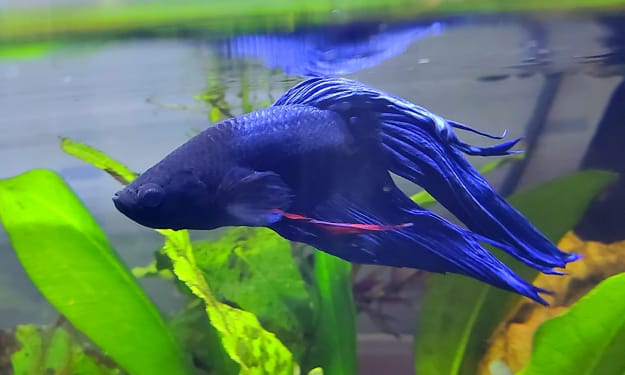
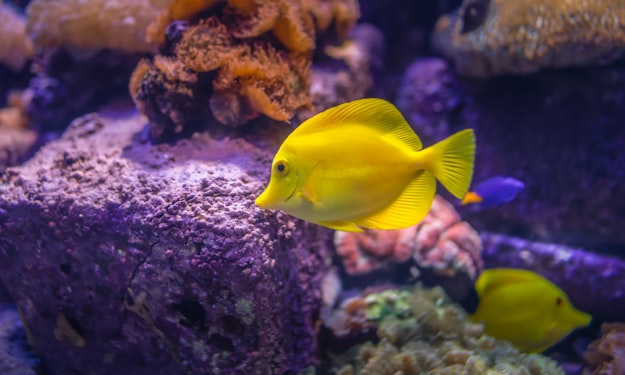
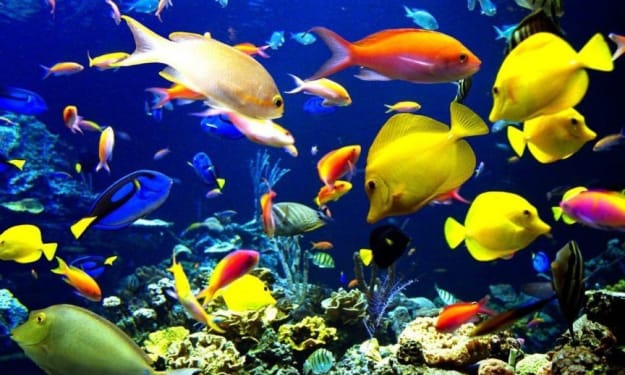
The fact that fish live only in the water make them different from all other animals.
Dog
Selecting a well balanced and healthy diet for your dog can be a difficult albeit challenging task if you let it. The colorful branding and trendy packaging can easily get the best of you and obscure your discernment of a dog food product. The dog's diet is one best secret to keep your pet healthy and vibrant for many years to come. It's therefore important that you purchase a diet that will supply your pet with vital nutrients and enable it to thrive.
By Biswajit Dey3 years ago in Petlife
DOG
You may all know the importance of daily brushing and flossing for regular good health of your teeth and gums, but that's as humans and also thanks to dental health education being so updated today. But, did you stop to consider the fact that since science has revealed oral health benefits us by lowering our risk of cardiac problems, it could well be the same for our canine pals? Keeping this medical fact in mind, pet owners are advised to pay extra attention to cleaning their dog's teeth regularly to keep diseases such as plaque and tartar at bay; even a simple swipe across Fido's gums with a clean damp cloth should do the trick!
By Biswajit Dey3 years ago in Petlife
I Spent $1000+ on a $7 Fish . Top Story - August 2022.
The dollar store near our home always had an eclectic selection of amazing things I didn't know I needed. I'd stopped in for a few household items but, of course, by the time I made it to the checkout counter, my basket was overflowing with an assortment of hair products, glassware, unusual candies, and decorations for a future birthday celebration.
By Nancy Gwillym4 years ago in Petlife
How to Increase Co2 In An Aquarium
If the fish in your aquarium are sharing their living space with plants, you are likely aware that they require Co2 if they are going to grow and flourish. You may be surprised to learn, however, that about 40% of a plant is composed of carbon. Yet if C02 levels in the water become too high, that can be disastrous for your fish. That is why you must be careful to maintain the fragile balance that will be beneficial to both your fish and plants.
By Monica Pocelujko4 years ago in Petlife
Ammonia Advice For Fish Tanks and Aquariums
Home aquariums have become increasingly popular as accessibility and general quality has improved with products like the biOrb taking the aquatic world by storm. For those dipping their toes into the world of aquatic upkeep for the first time, they may be taken aback by the variety of options available as well as the various filters that are needed for the proper maintenance of an aquarium.
By Life and Chat4 years ago in Petlife
"Catfish" as a Pet
I have an algae eater fish that looks like a catfish. She is huge as you can probably see. She sharp pins or spikes in her fins as her defense. I know this because she had accidentally flipped herself out of the aquarium before one day. Luckily she was soon put back in the tank with no harm done. She was fine.
By Regina Mauldin4 years ago in Petlife
Classifying invertebrates is hard. Butts can help
When French biologist Jean-Baptiste Lamarck set out to categorize the animal kingdom in 1801, he divided it into two groups: vertebrates, those with spines, and invertebrates, those without. The terms have stuck around for more than 200 years, but around 1900, scientists realized that they’d been categorizing wildlife wrong. Plenty of animals without spines—like starfish, invertebrates that extrude their own stomachs to eat—are more closely related to us than to their shellfish prey. Certainly, some animals have spines, and others don’t. But the spineless world is defined by much more than what it lacks. The real line that separates humans from insects, slugs, and shellfish? The answer lies partly in the anus. According to more recent thinking, the development of butts has become a key question for taxonomists cataloguing the diversity and evolution of the animal kingdom. All animals begin life as a rapidly dividing bundle of cells. Early in that process, the embryo is just a tiny sphere of cells. But to develop a gut, the round blob needs to somehow turn itself into a donut. To do so, a dimple forms on the sphere, and eventually pushes its way to the opposite wall. In humans and starfish, that dimple becomes the anus, working its way back to a second opening—what becomes the mouth. In shellfish or crabs, these openings develop in reverse; the original dimple usually becomes the mouth. That distinction separates most animals into two categories: deuterostomes, or “mouth second,” and protostomes, or “mouth first.” While all vertebrates are butt-first, not all invertebrates fit into either bucket. Even the textbook Invertebrates: A Synthesis distances itself from the word “invertebrate,” writing on the first page, “The distinction [between vertebrate and invertebrate] is hardly natural or even very sharp.” So-called invertebrates aren’t categorized by their lack of spine, so much as their approach to the anus. Or so it used to be. “It is true that deuterostomes were classically said to be defined by the development of the anus,” says Imran Rahman, a paleontologist at London’s Natural History Museum, “but we now know that some protostomes also develop in the same way.” More recently, researchers realized that certain mouth-first animals, like some species of brachiopods, a type of shellfish, developed butt-first. Others develop both at the same time, where the spherical embryo hollows out and rolls over on itself like a burrito. In 2016, a team demonstrated that the shape of the gut is actually an artifact of a more subtle process: The embryo transforms from a sphere into a stretched out, shrimp-like shape. That would mean that our common ancestor may have evolved the shrimp-like physique first, and then figured out how to build its guts. The findings, the researchers argued, suggest that anuses (or in some cases, mouths) have evolved over and over again. That could explain the case of the comb jellyfish, which branched off long before the ancestors of starfish and humans had evolved a waste disposal system. Most jellies have what are called “blind guts”—an entrance with no exit. Most gulp down food, digest it, then spit up the remains. But in 2016, an evolutionary biologist recorded footage of translucent comb jellyfish eating tiny, glowing plankton. As the animal digested, the video captured the food moving through the jellies’ bodies, and then, after a few hours, out a pair of pores on the back of their “heads.” (When the biologist played the video at a conference, the audience reportedly gasped out loud.) This ability had gone undiscovered for more than a century because the jellyfish have what researchers describe as a “transient anus”—a temporary booty that only appears when the animals really have to go. It’s possible that the anus is much older than scientists realize, and comb jellies are evidence of a common ancestor with a through-gut. But it’s also plausible that the butt is just so valuable that jellyfish have come up with it on their own. And indeed, the oldest purported ancestor of humans, starfish, and all so-called “mouth second” animals is, intestinally speaking, a lot like a jellyfish. The creature was a seafloor-dwelling animal, called Saccorhytus coronarious, or “crowned wrinkly bag.” It was about the size of a pinhead, and had a huge, gaping mouth on top of a round body. It had no anus, but was covered in pores that its discoverers believe to be a precursor to gill slits. “However, not everyone is convinced by this interpretation,” says Rahman. The name deuterostomes has stuck around, though. More recent genomic work has demonstrated that we still evolved alongside animals that basically share our intestinal toolkit, letting us know that the animal kingdom is defined as much by butts as by spines.
By Zulqarnain Haider4 years ago in Petlife
Whaling Stories
Songs About Whales And Whaling My Vocal friend Caroline published a story on whales that you can read below and it contains a poem and a trailer for “In The Heart Of The Sea”, and I thought maybe I could actually do a playlist of songs that have a whale or whaling connection.
By Mike Singleton 💜 Mikeydred 4 years ago in Petlife