art
Art of an introspective nature; a look at artwork that reveals the artist's psyche and comments on the inner workings of a chaotic mind.
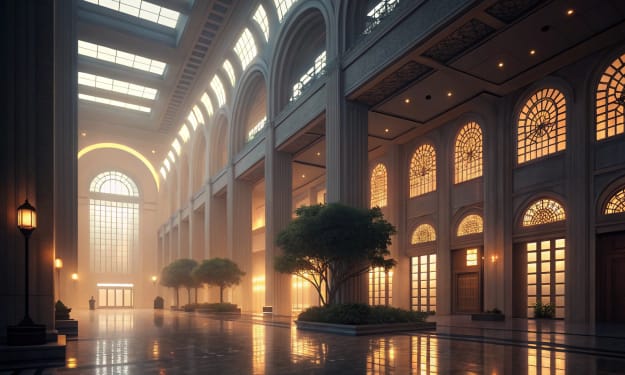
The Hidden Power: How Architectural Design Informs Human Feeling
Introduction: Places That Talk Without Words We too often do not think about how a building impacts us. But every time we enter a building—our own house, an office complex, a school complex, or a public plaza—we're silently impacted by it. High ceilings can make us feel expansive, full of promise. Narrow passageways can make us tense up or focus. Natural light in a window can enhance the mood, but dull or harsh light can cause tiredness or agitation. The surfaces we touch, the hues we see, the interaction of walls and ceilings—these unseen communications shape our mood, our behavior, even changes in our bodies.
By The Chaos Cabinet5 days ago in Psyche
Essence, Embodiment, and Relational Reality
The Failure of Reduction and the Need for Synthesis There is a persistent failure in many modern attempts to explain what a human being is. Some frameworks reduce the person entirely to matter, insisting that identity, consciousness, morality, and meaning are nothing more than emergent properties of physical processes. Other frameworks move in the opposite direction, detaching spirit from reason and grounding belief in intuition alone, often at the cost of coherence or accountability. Both approaches fail because both misunderstand essence. One denies that essence exists at all. The other treats it as something vague and undefinable.
By Peter Thwing - Host of the FST Podcast7 days ago in Psyche
Resistance Is Not the Enemy
Iron sharpens iron. Brakes save lives. Friction preserves form. Modern culture treats resistance as failure. Anything that slows momentum is framed as obstruction, anything that introduces friction is assumed to be opposition, and anything that interrupts progress is labeled a setback. But this instinct misunderstands how both physical systems and human growth actually work. Resistance is not inherently hostile. In many cases, it is the only thing preventing collapse.
By Peter Thwing - Host of the FST Podcast8 days ago in Psyche
The Refiner’s Fire Is Not the Whetstone
There is a difference between being sharpened and being transformed, and confusing the two leads to frustration when growth does not feel productive. Sharpening implies refinement of existing form. Fire implies change in composition. Both processes are uncomfortable, but they operate on different levels and for different purposes. When people expect sharpening and receive fire instead, they often assume something has gone wrong, when in reality something deeper is taking place.
By Peter Thwing - Host of the FST Podcast8 days ago in Psyche
You See From Where You Stand
"The room remains full whether you can see it or not." One of the most persistent misunderstandings about perception is the assumption that seeing is the same as knowing. People often believe that if something feels clear, it must be complete, and if something feels obscure, it must be absent. But awareness does not work that way. What you perceive at any moment is not a measure of what exists. It is a measure of what your current position allows to pass through.
By Peter Thwing - Host of the FST Podcast8 days ago in Psyche
You Are Not Empty, You Are Overloaded
You are not empty. You are not broken. You are not dull. - You are overloaded. - People often describe certain mental states as “having nothing in their head,” but that description is almost always inaccurate. What feels like emptiness is usually saturation. The mind has not stopped producing content. It has lost spare capacity. The system is busy allocating energy toward coping, regulating, or enduring, and there is little left over for reflection, synthesis, or creativity. This distinction matters, because mistaking overload for emptiness leads people to judge themselves harshly for conditions that are largely structural and biological.
By Peter Thwing - Host of the FST Podcast8 days ago in Psyche
Different, Not Better
My sister used to make comments about how I dressed, how I did my makeup, and how I colored my hair. She said I was trying to look different, not better. From her perspective, ‘appearance was a hierarchy, something measured by how closely you matched what others admired, what drew approval, what signaled success or desirability.’ Looking “better” meant aligning with those expectations.
By Alicia Melnick 11 days ago in Psyche
The Color We Learned to Fear
Black is a color that refuses to be neutral. It enters a room with history on its shoulders and silence in its wake. For some, it is elegant, powerful, and endlessly modern. For others, it is heavy—too heavy—with meanings they did not choose but inherited. The dislike of black is rarely about the color alone. It is about what black has been taught to represent, the emotions it awakens, and the stories people carry inside them.
By LUNA EDITH14 days ago in Psyche
Whimsy as Gentle Rebellion
Whimsy isn’t escape — it’s a reminder that color, kindness, and imagination still has power. In a world that often values efficiency over wonder, seriousness over softness, whimsy is frequently misunderstood. It’s mistaken for immaturity, distraction, or avoidance. But for me, whimsy has never been about turning away from reality. It has been about meeting reality with an open heart and refusing to let it harden me.
By Alicia Melnick 20 days ago in Psyche