book reviews
Book reviews by and for those seeking to understand the human mind for all its strengths, quirks and shortcomings.
10 Books to Read That will Make you Sound Smart
Ten little books to make you smart! Books to read to become smarter, Reading can make people smart, reading can broaden one's horizons, reading can cultivate sentiment, and reading can change destiny. So we still have to read more and read well.
By Muhiuddin Alam5 years ago in Psyche
“The Future of an Illusion”: Allelu-Freud
Peter Gay points out that “Freud was a consistent, aggressive, dogmatic atheist, a child of the Enlightenment who saw a world at war to the death between science and religion. To study religion, he was convinced, one must take a stand outside it: only the unbeliever can truly understand belief” (Gay 429). In other words, Freud felt that in order to evaluate any religion, one had to be an atheist. It is a powerful statement that follows a specific pattern of logic that beautifully reverberates in the saying: All the thoughts of a lizard are lizard. Still, should we take this notion for granted? I think that this essay will answer the question quite clearly, for I will deal with four critics and their views vis-à-vis The Future of an Illusion, but also with their position towards religion. Furthermore, I shall analyze the text of The Future of an Illusion in order to ascertain any relationship between its rhetorical devices and the proposition of this essay.
By Patrick M. Ohana5 years ago in Psyche
Freud’s “Totem and Taboo”
Like mathematics, every field of knowledge would love to pride itself on being peerless and free from any other influential sphere of study. Anthropology was heading in that direction when it encountered Freud, or when Freud went out of his way to encounter it. Of course, most fields owe something, directly or indirectly, to the exact science of mathematics and or to the more subjective sphere of philosophy, but can still voice their adopted independence. Freud changed all that for anthropology. Although he was specifically studying the human psyche, he was also examining all the developmental and cultural aspects of humans, thus stepping into the realm of anthropology and creating psychoanalytic anthropology.
By Patrick M. Ohana5 years ago in Psyche
Book Review: "The Sleeping Beauties" by Suzanne O'Sullivan
I remember when I was at school and university and first started to read the books of Oliver Sachs. I was amazed to see what people were afflicted with and yet, how they managed to still keep in touch with themselves and try their best not to isolate themselves or lose hope. His writings were often narratives with emotional outpourings and stories which resonate with the empathy that one human being has towards another. I cannot say that this is exactly the same type of book but it follows the same guidelines of medical narratives and explorations in science. This book entitled "The Sleeping Beauties" traces one of our more modern ideas concerning health and wellbeing and that is psychological health. The health of the mind in times of chronic stress and/or trauma, the theories surrounding something called 'resignation syndrome' and the way in which the people around the suffering person become confused, riddled and often helpless when having to care for the person with the condition.
By Annie Kapur5 years ago in Psyche
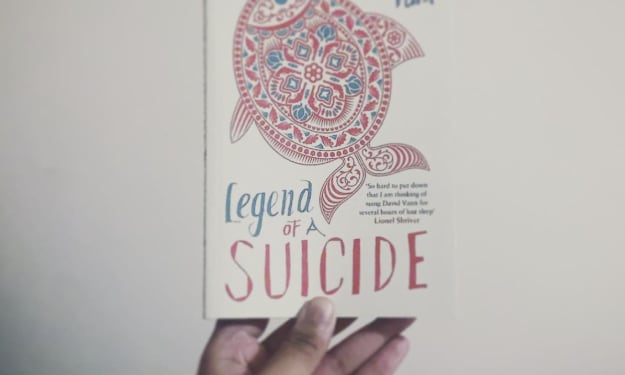
Book Review: "Legend of a Suicide" by David Vann
I have read quite a few books about people killing themselves or contemplating suicide. There seems to be this narrative of having been overtly depressed so to that it is reflected in the language whether it is narrated by the victim or not. But there is something different about “Legend of a Suicide” in the sense that there is not this sense of desperate grief but instead this question of why. There is this question of why because of the fact the victim of the suicide is someone whom the protagonist and narrator viewed as not only successful financially but also as a person who was moving on with their lives. Now, there is an argument of the fact that people commit suicide when they believe people least expect it as to not worry anyone in advance, but the scene in which the fact does kill himself is something else entirely. There is this sense of time stopping, but there seems to be none of this helplessness that surrounds it. In actuality, the scene is pretty disgusting. The father shoots himself in the head and his own brother finds him later on when the birds have already been pecking at him and the flies, eating him. His desecrated corpse is then reported to the child (narrator) and his mother. We then get this flashback upon the parents and why the marriage crumbles into nothingness.
By Annie Kapur5 years ago in Psyche
The Five Best Self-Help Books to Make Life Fun Again (PART I)
Seven years ago my life changed in an instant. I awoke in the middle of the night, sweating, heart racing, thinking I may be having a heart attack at 27 years old. I had been heavily drinking earlier that night, which was normal for me back then. My entire body was seizing up and I had tears in my eyes. For the first time in my entire life, I experienced a suicidal thought that I couldn’t pass off as just a silly part of the human experience. I thought the thought, and for the first time it felt like a viable choice in that terrifying moment. That evening set my life in a new direction that I never could have predicted.
By T.K. Sanders5 years ago in Psyche
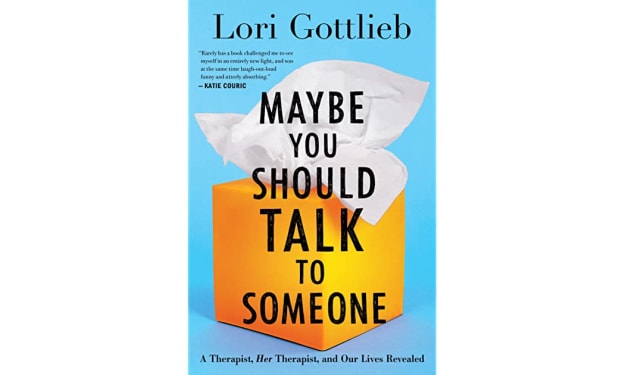
Book Review: Maybe You Should Talk To Someone By Lori Gottlieb
This article was originally published on rochizalani.com Maybe You Should Talk To Someone is Lori Gottlieb’s behind-the-scenes life as a therapist, as a patient, as a writer, as a mother, and as a person.
By Rochi Zalani5 years ago in Psyche
The Bell Jar By Sylvia Plath Book Summary: An Autobiographical Insight Into Depression And Emptiness
This article was originally published on rochizalani.com It is impossible to read The Bell Jar by Sylvia Plath without her real-life context coloring the story. Sylvia Plath published this semi-autobiographical work under a pseudo-name, but she wasn’t there to witness it when the work gained widespread momentum under her real name. Plath had killed herself less than a month after The Bell Jar hit the shelves.
By Rochi Zalani5 years ago in Psyche
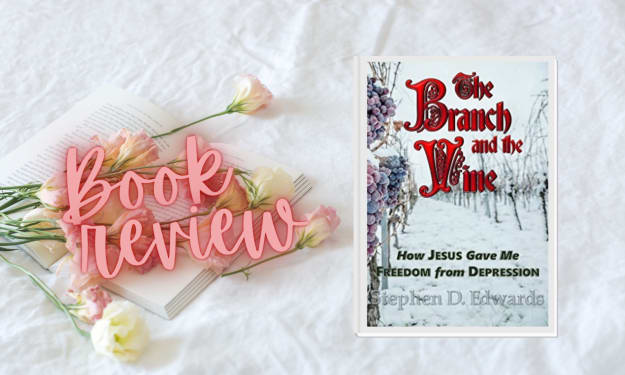
The Branch & The Vine by Stephen D. Edwards
What’s the book about? The book is about how the author got over decades of depression through Jesus Christ. It’s a combination of a memoir and a self-help book. It’s available in most major e-book stores and on hardcover with Amazon. As of writing the hardcover is £21.99. The e-book prices fluctuate depending on which store you choose. On Amazon its £0.99, Google books it’s £2.92 and Kobo it’s £5.06. It’s also availible on the author’s own website for $14.99 in Canadian dollars. So there are quite a lot of options to get this book.
By Chloe Gilholy5 years ago in Psyche
Push by Sapphire
How I came across it? Even though the book has been out for a while, I didn’t know anything about it until I saw the film Precious. I thought the film was amazing and it had some brilliant acting performances. Really loved Mariah Carey’s role as the therapist. Poignant how she got to redeem herself after her film Rainbow was critically panned.
By Chloe Gilholy5 years ago in Psyche