humanity
Mental health is a fundamental right; the future of humanity depends on it.
What does Losing your mind look like?
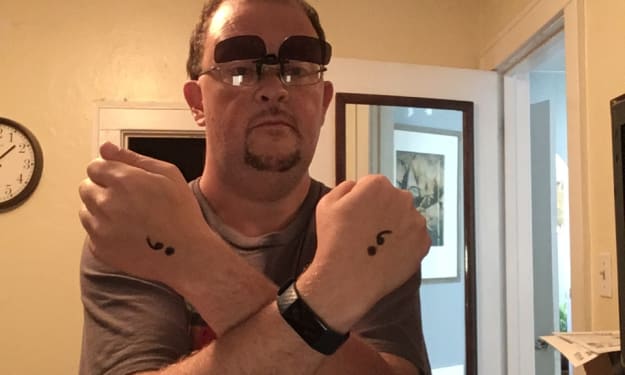
What is it supposed to look like when you lose your mind? Are you sleeping? Do you eat? In my case it's a personality change. I was always a nice person. My past was very violent, no pity ME's here but I spent most of my life trying to be a better person. I didn't want to be the one who was rude, drunk, or obnoxious. Stress manifests itself in many ways, I started blocking things out and then people and then ideas. I became so tired with myself and the world around me. I stopped speaking to people and started missing work and needing to de-stress. Nothing helped and trips to my psychologist are becoming more frequent with the non-urgent thought of actually hurting myself as I have now hurt others. I changed as a person because the usual happy, content, personality changed to a mean, insulting, and degrading individual. I called out another associate at my work out on the floor without any reason and really upset her which is not like me at all. When I realized that I was stressed to be hurting so bad that I started lashing out it was time for a change. Being physically damaged to the point that I could not work was starting to sound more appealing.
By Linda Stanfill4 years ago in Psyche
Obedience as a Psychological Concept
Obedience is a type of social influence that entails carrying out an activity on the directions of a superior. It is distinct from compliance (which is adjusting your behavior at someone else's request) and conformity (which involves altering your behavior in order to go along with the rest of the group).
By Ikram Mustafa4 years ago in Psyche
Unstable Energy and Trust
We had the oddest interaction with a would-be filmmaker the other night. This “former addict” who claims to be six years clean, was, I am told, decidedly not clean when he approached a certain publicist just three years ago and told us on THIS call he’d just “had a Xanax” so he’s calm, anxiety in check. Um. That’s the drug he’s claiming to be clean from.
By Martha Madrigal4 years ago in Psyche
The Dark Side of Personality Classification Systems
People classification systems based on some set of pyschological traits are wildly popular with the general public and mainstream psychologists alike. The reasons for their popularity are, ironically enough, rooted in psychology and the desire or need in humans for systemization/classification as a way to understand the world we live in. This is all well known, heavily studied, and much commented upon and I have nothing of value to add to that discussion. However, in those discussions, one question that is almost never asked is what is the value of such classifications. Are they on balance a net negative or net positive for humanity? It seems obvious, that for some classifications, particularly those based on scientific principles that are useful for understanding the natural world, the desire to classify has been a huge net positive. To take just one example, without the phylogenetic classification system of Linnaeus, it would have been nearly impossible to have recognized the relationships that exist between all living beings on our planet. Darwin's theory of evolution may have never come to pass. However, the value of classifications of people based on psychological traits is much less clear. Certainly, it can be fun to determine what Myers-Briggs personality type you are, and even more fun to compare it with the types of your friends and family. And, perhaps there are some relationships that have been saved when the partners both read the five love languages and finally learned the secret ways they had never known before to make their lover happy. I must say I am more than a bit skeptical about that second one but I myself have had a lot of fun with Myers-Briggs and its many offshoots. Beyond just fun, some have claimed improved employee-employer relationships have resulted when all parties in a given business took the time to assess each others personality types and then attempted to adjust behaviors and expectations to accommodate. I did search the scientific literature for a published paper actually showing this, but was unsuccessful. Most likely this is because designing a set of controlled experiments to measure something as fuzzy as "improved employee-employer relationships" is about as easy as designing a set of experiments to show that ghosts can fall in love. Essentially, it is impossible though scads of papers are still published which purportedly measure this very thing.
By Everyday Junglist4 years ago in Psyche
Are our choices really ours?
In today's world, the truth is defined by google. Suppose you want to know which movie is trending or which is the best place to go on vacation. You will simply take out your phone and ask google about it. In today's world, we trust technology even more than ourselves. From which clothes to wear to which car you should buy, you take the help of technology. Our choices don't come from the blue they are the result of biochemical processes which happen in the brain these choices are highly volatile and are shaped by our surroundings like our society, friends, schooling. A person living in a tribal area will be more concerned about how to make it through the day rather than the looming danger of global warming so the decisions he will take will be centred around it, he will vote for a political party that will promise him employment rather than a political party that will reduce carbon emission.
By Aviraj Singh4 years ago in Psyche