stigma
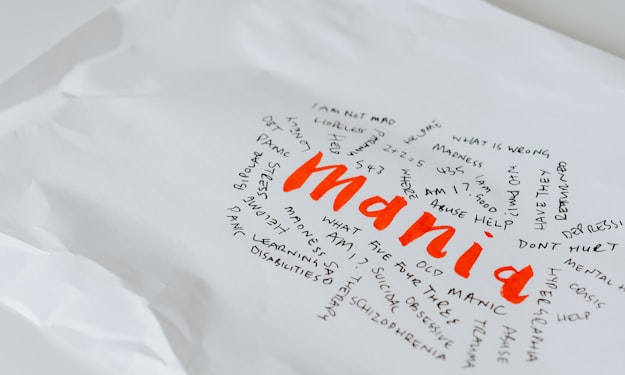
People with mental illness represent one of the most deeply stigmatized groups in our culture. Learn more about it here.
Ride the Lightning
I do not recall the exact date or month, or even a really coherent narrative of how I found myself an inpatient at a psychiatric hospital in the Borough of Queens, city of New York. However, I do know that it was not the first hospital I was admitted to. Nor were any of the events transpiring not of my choice. I have for some time been realizing that things, somethings, then everything, were somehow not quite right. Part of the recipe here was the fact that I was involved in a near fatal motor vehicle accident, upon my ejection from my vehicle a good Samaritan at the scene thought it proper to drape a blanket over me as she was convinced there was a dead body on the side of the road, and the decent thing to do would be to shield others from such a sight.
By Michael Capriola4 years ago in Psyche
Men and Depression
Studies show that men are less likely to report a depressive episode than women. Men are less likely to be diagnosed with depression than women. Because of the stigma, they are also less likely to seek treatment. Men are more likely to exhibit anger or aggression than sadness or hopelessness when depressed. Clinical depression can affect men just as it does women and should not be taken lightly. If you're a man struggling with depression, do not hesitate to reach out for help.
By Matthew Angelo4 years ago in Psyche
Episodic Meltdown of Nothing
Going through motions. Silence, pressure, nothing. That's what it feels like. Nothing. Waking up to the confines of self. Not pressured, not rejuvenated. Motivation escapes this mind as the clouds of lost freedom drags me through its atmosphere. Not really living but neither dying as well. A sense of limbo that is just as is. You stay in stagnation for a wave to move by. No hope but the interest of what will take me away. What will change my mind and flip this switch where my mind goes in silence. Triggered by the thought you move around this weight of existence to understand the state you're in. You move your hands around the objects.
By The Kind Quill4 years ago in Psyche
How a Lipstick Named Gabrielle Fixed My Broken Self
If I’d broken my leg, things would have been entirely different. What is it about a plaster cast that allows strangers to ask what happened? A broken arm, from a slip on the ice. A fractured femur, the result of a skiing accident. Suddenly, the boundary of appropriate questioning breaks down into curiosity, then sympathy. Or the sharing of a similar experience, and comments about healing times and rehabilitation.
By Catherine Kenwell4 years ago in Psyche
The Dark Side of the Writer's Mind
On April 18th, 1941, the body of a woman was found floating lifelessly in the Ouse River in Sussex England. The woman — later identified by her husband as famed author Virginia Woolf — was 59 years of age when she took her life. Eventually shared was a note left behind, which painted the picture of an artist exhausted from her struggle with mental illness, seemingly swallowed whole by the very mind that proved to be so prolific in writing.
By Alan Thompson4 years ago in Psyche
Mental Illness
In the World we know as it is, there is a thing called mental illness. It is something that has been known to people as far back as Ancient China and Greece. Even more or less therapeutic methods has been available to treat mental illness. However, it wasn't until 1883 when mental illness had been properly recorded and diagnosed.
By Lovely Lucia4 years ago in Psyche
Op-Ed: A Third Culture Kid in Pursuit of Clinical Psychology and Three Themes in Chinese Mental Health Research
As a British-born Chinese girl, the idea of entering Psychology as a profession was something that I never considered. However, when I was in secondary school Psychology, it was something I thought about. My family didn't discuss emotions or have discussions about mental health. My parents weren't particularly strict about my academic pursuits. However, I recall having conversations with them about whether I wanted to go into medicine or law. My parents were influenced by my older brother, who studied Psychology. Psychology is a stable and rewarding career. They have been supportive of my desire to become a Clinical Psychoologist.
By Hannah Wilkins4 years ago in Psyche
ADHD Ask: Why Do You Make ‘Nests’ Around the House With Your Stuff?
I was tempted to use a photo of my own workspace for this article, but honestly, I was too embarrassed. Although I have an ‘office room’ with a desk, I move about the house to different places, like some sort of house-nomad (homad?).
By Kristy Westaway4 years ago in Psyche