stigma
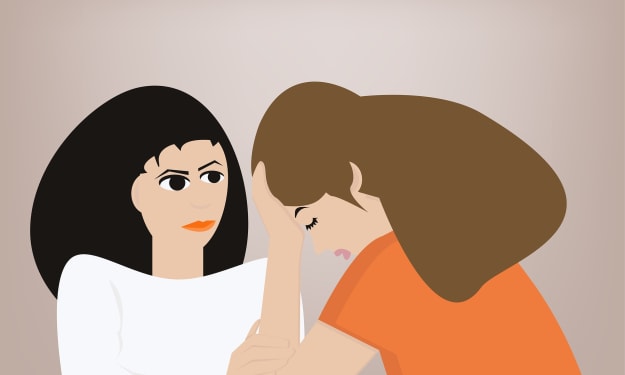
People with mental illness represent one of the most deeply stigmatized groups in our culture. Learn more about it here.
Disability, Learning the Truth
It was around 1987, and I was working in my first job since leaving school. I was a trainee Pharmacy Technician in a small town called Padiham. A change in health policy meant that many people who had been in-patients were discharged from a hospital called Calderstones and placed into something being called care in the community. Calderstones was one of several hospitals classed at the time as being for the mentally ill. It was home to people who society over the years classed as outcasts. Some of the patients, a term I use loosely, were deaf people who struggled to speak; placing young women in an institution after giving birth and some people who had a variety of mental illnesses. I remember the re-homing of a couple of people in communal accommodation not far from the chemist where I worked.
By Nic Castle6 years ago in Psyche
Airports, Rail Companies, and Supermarkets Are Supporting People with Hidden Disabilities in a Lovely Way
So, I recently discovered something that could potentially work incredibly well, providing it gets the attention it deserves. I saw an article online, which went into detail about the new Hidden Disability Sunflower Lanyard Scheme.
By Lewis Jefferies6 years ago in Psyche
Labelling Theory
Though we think that our generation is full of labels, and the that effects can be noticed as universal effects shared among people from different walks of life, it not very much of a new field that we are going into; as the theory of labelling had its origin since 1897 when a French author Emile Durkheim first suggested that behaviours are deviant only when society labelled them as deviant. The effects of labelling people can be observed in numerous wide spectrums, as the variables can vary among different people and the society they are in, such as different effects on labelling of gay people may vary from country to country, or how the effects can vary from labels associated with the person’s socioeconomic status or mental health. Even though these labels may be deemed negative, it is pretty much an undeniable fact that they are essential and pretty much incorporated in our social daily life, and to have them dismissed from our lives are just impossible.
By Ashrul 'Bob' Saifudin6 years ago in Psyche
This Too Shall Pass!
I know some of you have heard someone say “this too shall pass.” I remember being a little girl in church with my mom, she’d be upset or sad about something, and an elder of the church would hug her so tight and whisper “this too shall pass!” My mom would cry a little and shake her head like they had a secret, they just knew she was going to be alright.
By LaLa "The Life Coach" Bullock6 years ago in Psyche
72 Hours in the Loony Bin
Loony bin, nuthouse, funny farm, insane asylum, madhouse. These are just a few of the derogatory monikers given to psychiatric hospitals. In July of 2015, I was unfortunate enough to find myself in the back of an ambulance, tethered to a gurney, being transported to such a place. My crime was attempting to commit suicide by overdosing on opioids. My punishment was a court ordered 72-hour incarceration in the Spring Mountain Treatment Center of Las Vegas. Based on the name, it doesn’t sound all that bad. Let me assure you, there was nothing spring like or mountain like about this establishment.
By Tiffany "Texas Wine Woman" Proske6 years ago in Psyche
Black Men, #YouGoodMan?
The emotional stoicism of Black men is something that few doctors, authors, families or society have talked about. While there are not many published works regarding this topic, the most notable of the few is We Real Cool: Black Men and Masculinity (2004) by Gloria Jean Watkins, better known by her writing name, bell hooks. The emotional crisis that is created by the lack of love and acceptance that Black men face is a mainstay in hooks' work.
By Markus Tyree7 years ago in Psyche
Why I Write
If you’ve ever read my blogs, you know I write a lot about mental health. I write about my journeys and experiences with both my physical and mental illnesses, and it’s something I’m very passionate about. About a week ago, I sat down to write. I wanted to share my story, my whole story, but I only got a few paragraphs in before I hit a “writer’s block,” and my mind went blank. I had no idea what I wanted to say, or where I wanted to start, but after a while, I came to the conclusion that I was having a hard time continuing to write, because I was scared. I had no idea how that piece was going to turn out, or if I was really ready to unfold the chaos in my life and write it out, and that scared me. So instead, I want to write about why I write what I write about (mainly mental illness). I want to talk about why I write.
By Abbey Smith7 years ago in Psyche
Recognizing Mental Illnesses in Adolescents
An essay I wrote in high school. I was given an assignment where I could write on any subject I wanted to bring awareness to. Since a young age, I've realized teens and children’s mental health is so important, and they always need to be listened to.
By Airika Lewis7 years ago in Psyche