
Peace Must for the World
From Division to Unity — A Global Call for Harmony

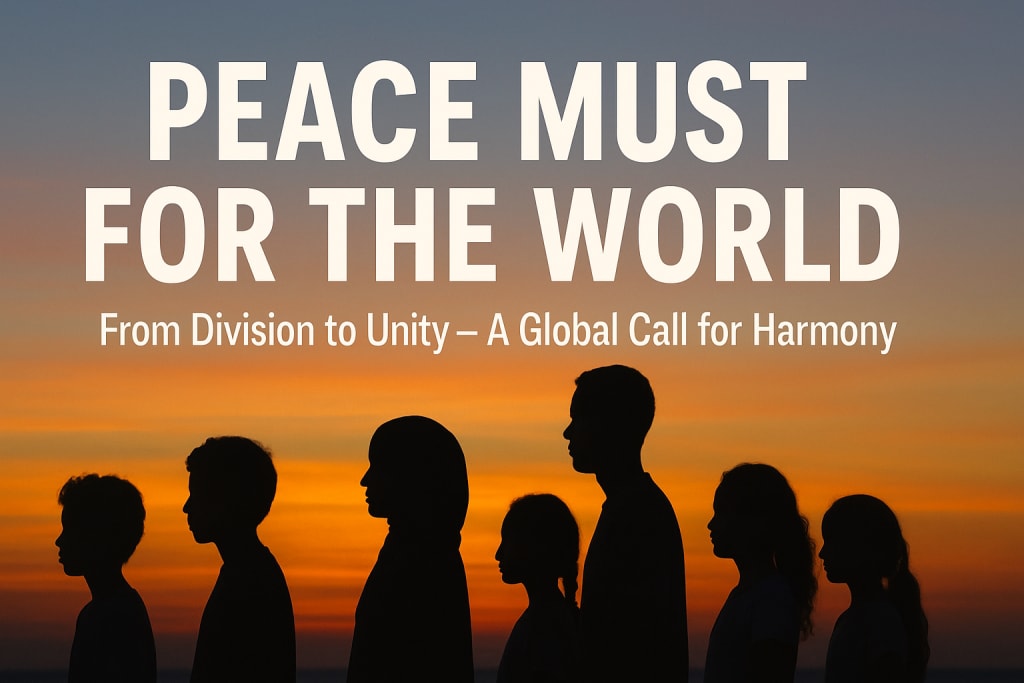
The world has long been divided by borders, beliefs, and battles. For centuries, nations have fought wars over power, resources, and ideologies.
But what has war truly given us?
Loss. Suffering. Broken families. Displaced lives. And a world that often forgets the value of peace.
In a quiet village between two conflict-ridden countries lived a woman named Amina. She was a teacher, but more than that, she was a believer — in peace, in hope, and in humanity.
Amina’s school was small. The roof leaked when it rained. Her classroom had more children than chairs. Yet, it was full of light, laughter, and dreams.
She welcomed every child, regardless of where they came from. Religion, ethnicity, and nationality did not matter. What mattered was the heart.
One day, she asked her students a question. “What does peace mean to you?”
One child said, “It means I can sleep without hearing bombs.”
Another replied, “Peace means I don’t have to hide when I go to school.”
Their answers were heartbreaking but honest.
That week, Amina had an idea. Her students would write a play. Not a play about war, but a play about what peace looks like through the eyes of children.
They called it “The Same Sky.”
In the play, children from different lands realize that no matter their language or religion, they all sleep under the same sky, dream the same dreams, and cry the same tears.
The performance was recorded and uploaded online. It went viral.
People from around the world saw the children’s message. It was simple, pure, and powerful. Peace is not an option. Peace is a necessity.
Soon, reporters visited Amina’s school. Peace workers came to listen. Even world leaders took notice.
But this was just the beginning.
Inspired by the children, other communities began sharing their peace efforts. In Colombia, former rivals built a garden together. In Palestine and Israel, mothers who had lost children in the conflict hugged for the first time.
In South Africa, youth marched through cities chanting, “No more hate!” Their voices echoed through streets that once knew only pain.
A movement was forming — a movement not of governments, but of people.
Peace became the conversation on every corner. In churches, mosques, schools, and homes, people asked the same question: How can we make peace permanent?
Social media played its part. Hashtags like #PeaceIsPower and #HealTheWorld trended worldwide. Stories of forgiveness, understanding, and bravery filled timelines.
At the United Nations, a summit was held. But this time, it was different. Not just politicians, but students, teachers, farmers, and poets were invited.
A young boy named Tariq, one of Amina’s students, spoke to the assembly.
“We are taught history through wars,” he said. “Why not teach it through peace?”
His speech moved the room to tears. Leaders stood and applauded. The message was loud and clear: peace is possible.
Following the summit, a global Peace Curriculum was created. Schools around the world began teaching conflict resolution, empathy, and global understanding.
Children learned not just about their country’s victories but also about shared human struggles and successes.
In places once known for violence, music and art returned. Walls that had divided people were painted with messages of unity.
Amina’s village became a center for peace education. People traveled from far away to learn how her small school had sparked a global shift.
Years passed. Her students grew up. Many became peace builders, educators, and bridge-makers.
One of them, Leila, started a program to bring children from enemy nations together for cultural exchange. Another, Samir, built a peace radio station that aired voices from both sides of conflicts.
Though the world still faced challenges, something had changed.
The culture of revenge began to fade. In its place, a culture of conversation grew.
Instead of picking up weapons, people picked up words. They talked. They listened. They forgave.
And slowly, the world healed.
Peace was no longer a dream or a distant hope.
It became a daily choice.
It began in classrooms. In homes. In the hearts of people like Amina.
The world had finally learned that peace does not wait for governments to sign treaties.
Peace begins with us. And peace must be for all.
About the Creator
SAHIB AFRIDI
Su
Writer of real stories, bold thoughts, and creative fiction. Exploring life, culture, and imagination one word at a time. Let’s connect through stories that matter.
Let me know if you want it to lean more toward a specific genre or tone!
Keep reading
More stories from SAHIB AFRIDI and writers in The Chain and other communities.
Decentralized Stablecoin and the Quiet Reinvention of Digital Money
For years, the promise of cryptocurrency has been financial freedom—borderless, permissionless, and independent of centralized institutions. Yet volatility has remained the biggest barrier to real-world adoption. It is difficult to treat an asset as money when its value fluctuates dramatically within hours. This is where the decentralized stablecoin enters the conversation, not as a loud disruptor, but as a quiet reinvention of how digital money can function.
By Siddarth D4 days ago in The Chain


Comments
There are no comments for this story
Be the first to respond and start the conversation.