
The Evolution of White Label Perpetual DEX Platforms in Crypto Markets
White Label Perpetual DEX

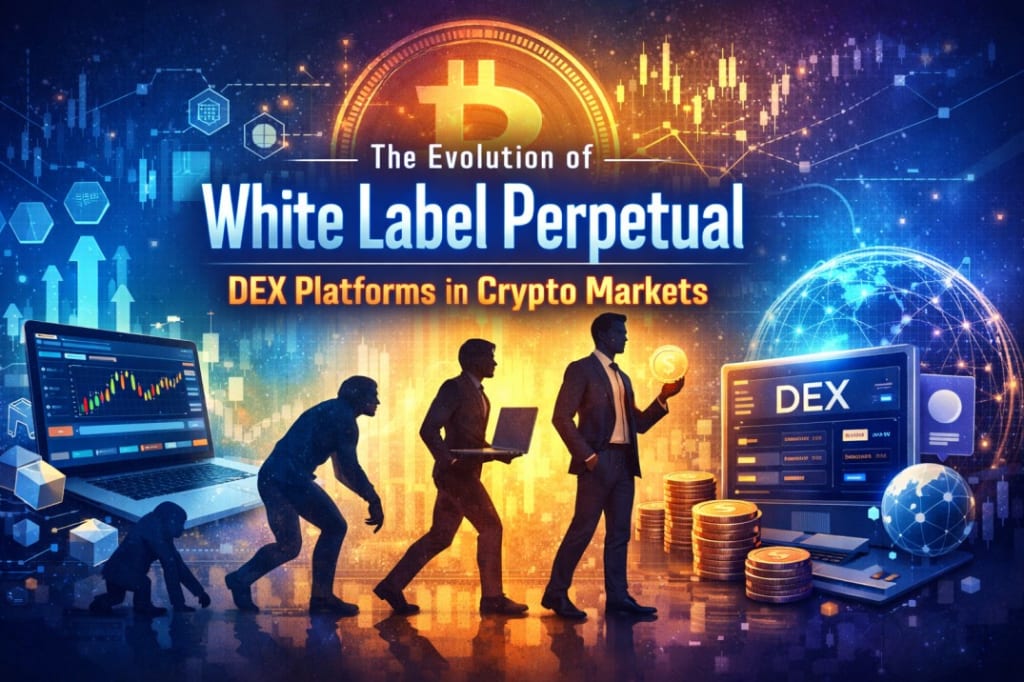
The cryptocurrency market has undergone multiple transformation cycles from the early days of simple peer-to-peer transactions to the rise of centralized exchanges, and eventually to decentralized finance (DeFi). Among the most significant developments in recent years is the rapid growth of decentralized derivatives, particularly perpetual futures trading. What began as an experimental financial primitive has matured into a multi-billion-dollar segment of the digital asset ecosystem.
At the center of this transformation stands the White Label Perpetual DEX Platform a modular, ready-to-deploy infrastructure solution that enables businesses to launch decentralized perpetual exchanges efficiently. These platforms represent more than a technical shortcut; they symbolize a structural shift in how trading infrastructure is built, distributed, and scaled in crypto markets.
The evolution of white label perpetual systems reflects broader industry trends: increasing demand for non-custodial trading, heightened regulatory scrutiny of centralized exchanges, technological innovation in scalability, and institutional participation in decentralized markets. This article explores how the White Label Perpetual Futures Trading DEX Platform has evolved, the forces driving its growth, and its expanding role in shaping the future of crypto derivatives.
The Emergence of Perpetual Futures in Crypto
Perpetual futures contracts, originally popularized in centralized crypto exchanges, allow traders to speculate on price movements without an expiration date. These instruments quickly became dominant in the derivatives space due to their flexibility, capital efficiency, and ability to facilitate leverage.
In traditional finance, futures contracts are time-bound and regulated. Crypto perpetuals, however, introduced funding rate mechanisms that maintain price alignment with the underlying index while enabling continuous trading. As derivatives trading volumes often exceed spot volumes in crypto markets, perpetual futures became the primary driver of liquidity and price discovery.
However, centralized exchanges (CEXs) controlled this market for years. Custodial risk, opaque liquidation practices, and counterparty exposure created friction for traders. The collapse of several high-profile exchanges intensified the demand for decentralized alternatives.
This demand laid the groundwork for the first decentralized perpetual exchanges, which eventually led to the emergence of the White Label Perpetual DEX Solution model.
First-Generation Decentralized Perpetual Exchanges
Early decentralized perpetual platforms faced significant technical constraints. Blockchain throughput limitations and high gas fees made real-time order book trading nearly impossible on Layer-1 networks. Developers responded with automated market maker (AMM) models and synthetic liquidity pools to simulate derivatives trading.
While innovative, these first-generation protocols struggled with liquidity depth, slippage, and limited scalability. Their architectures were largely monolithic, making customization and rapid deployment difficult for new entrants.
As demand grew, businesses recognized that building a perpetual DEX from scratch required extensive expertise in smart contracts, risk modeling, liquidity provisioning, and blockchain infrastructure. This complexity created an opportunity for turnkey solutions—leading to the rise of the White Label Perp DEX Launcher platform.
The Birth of White Label Perpetual DEX Platforms
The concept of white labeling in financial technology is not new. Forex brokers and traditional trading platforms have long used white label models to accelerate market entry. In crypto, this model evolved naturally as decentralized trading became more sophisticated.
A White Label Perpetual Exchange Platform offers pre-built infrastructure, including smart contracts, matching engines, liquidity modules, and risk management systems. Instead of constructing every component independently, businesses can customize branding, trading parameters, and token listings while leveraging battle-tested architecture.
This innovation significantly reduced time-to-market. What once required months—or even years—of development could now be deployed in a fraction of that time.
More importantly, white label systems introduced modularity. Rather than rigid monolithic designs, modern platforms are built with interchangeable components that allow scaling and feature upgrades without disrupting core functionality.
Technological Advancements Driving Evolution
The evolution of White Label Perpetual DEX Platform Development closely mirrors advances in blockchain technology. Several breakthroughs accelerated adoption:
Layer-2 Scaling Solutions
Layer-2 networks dramatically reduced transaction costs and improved throughput. By migrating execution layers to rollups or sidechains, perpetual DEX platforms achieved near-centralized exchange performance while preserving decentralization.
This shift enabled hybrid models combining off-chain order matching with on-chain settlement—a model increasingly integrated into modern Perpetual Futures Trading DEX Platform Solutions.
Oracle Infrastructure Improvements
Accurate price feeds are essential for derivatives trading. Early oracle vulnerabilities created liquidation risks. However, advancements in decentralized oracle networks improved price integrity and redundancy, strengthening the risk management capabilities of white label platforms.
Cross-Chain Compatibility
As the crypto ecosystem expanded across multiple blockchains, perpetual DEX platforms adapted by integrating cross-chain bridges and multi-wallet compatibility. This expanded liquidity pools and diversified collateral options.
Institutional Participation and Market Maturity
The maturing crypto derivatives market has drawn institutional interest. Hedge funds, proprietary trading firms, and crypto-native funds increasingly seek decentralized exposure to leveraged markets.
White label perpetual platforms evolved to meet these demands by introducing:
- Advanced margin systems (cross-margin, portfolio margin)
- Sophisticated analytics dashboards
- API integration for algorithmic trading
- Enhanced compliance-ready architecture
These features transformed the White Label Perpetual Futures Trading DEX Platform from a retail-focused tool into a robust financial infrastructure capable of handling institutional-grade volumes.
Liquidity Evolution: From Incentives to Aggregation
Liquidity remains the cornerstone of any exchange. Early decentralized platforms relied heavily on token incentives to attract liquidity providers. While effective in the short term, this model often proved unsustainable.
Modern White Label Perpetual DEX Solutions incorporate diversified liquidity strategies:
- Integration with professional market makers
- Aggregation from multiple liquidity sources
- Dynamic funding rate adjustments
- Insurance funds to stabilize volatility
These mechanisms improve capital efficiency and enhance trader confidence. The evolution from purely incentive-based liquidity to sophisticated market-making ecosystems marks a significant milestone in decentralized derivatives maturity.
Risk Management: A Core Evolutionary Shift
Perhaps the most critical transformation in white label perpetual platforms has been the refinement of risk engines.
In early iterations, liquidation cascades posed systemic threats. Insufficient oracle updates or delayed margin calculations could destabilize entire protocols. Today, advanced risk models integrate real-time monitoring, automated liquidation bots, and multi-tier insurance funds.
Modern White label perpetual dex platform development emphasizes stress-testing frameworks that simulate extreme volatility scenarios. These systems ensure solvency even during sudden market crashes, strengthening the reliability of decentralized perpetual trading.
Governance and Tokenomics Integration
Another evolutionary milestone is the integration of governance mechanisms. Many perpetual DEX platforms now incorporate decentralized governance tokens that allow stakeholders to vote on fee structures, leverage limits, and protocol upgrades.
White label platforms increasingly offer governance-ready modules, enabling businesses to deploy community-driven ecosystems from day one. This integration aligns incentives between platform operators, traders, and liquidity providers.
Tokenomics design has also matured, shifting from inflation-heavy reward systems toward sustainable revenue-sharing models.
Security and Audit Standards
Security practices have evolved significantly. Early DeFi protocols were often launched without rigorous audits, resulting in high-profile exploits.
Modern White Label Perpetual Exchange Platforms prioritize multi-layer security frameworks, including:
- Comprehensive smart contract audits
- Real-time monitoring tools
- Bug bounty programs
- Role-based administrative controls
This professionalization of security standards has been instrumental in attracting institutional liquidity and long-term user trust.
Competitive Landscape and Market Differentiation
As more businesses adopt white label solutions, differentiation becomes crucial. Modern launcher platforms enable customization at multiple levels:
- UI/UX personalization
- Trading pair configuration
- Fee model adjustments
- Regional compliance adaptations
- Collateral type expansion
This flexibility allows operators to target niche markets, including region-specific traders, DAO communities, or sector-focused derivative products.
The ability to rapidly deploy and iterate gives white label platforms a competitive advantage in fast-moving crypto markets.
Case Study Insight: Hybrid Execution Models
Hybrid execution—combining off-chain matching with on-chain settlement—illustrates how white label platforms evolved to address performance bottlenecks.
In such models, trades are matched in a high-speed environment but settled periodically on-chain. This reduces gas costs while maintaining transparency. The integration of these hybrid systems within a Perpetual Futures Trading DEX Platform demonstrates the maturation of decentralized trading architecture.
By blending speed and decentralization, white label platforms now rival centralized exchanges in performance metrics.
The Future: Modular Finance and Composability
The next phase of evolution lies in composability. As DeFi protocols become increasingly interoperable, perpetual DEX platforms will integrate seamlessly with lending markets, yield aggregators, and structured product platforms.
For example, traders may use yield-bearing tokens as collateral or hedge DeFi positions using perpetual derivatives within a unified interface.
A future-ready White Label Perp DEX Launcher platform will likely incorporate:
- AI-driven risk monitoring
- Cross-chain unified margin systems
- On-chain analytics dashboards
- Tokenized real-world asset derivatives
The infrastructure will become more modular, allowing continuous feature integration without structural overhaul.
Conclusion
The evolution of White Label Perpetual DEX Platforms reflects the broader transformation of the crypto derivatives ecosystem. What began as experimental DeFi code has matured into scalable, secure, and institution-ready financial infrastructure.
By abstracting complexity while preserving decentralization, white label perpetual systems empower businesses to participate in a rapidly expanding derivatives market. Their growth mirrors advancements in blockchain scalability, risk modeling, oracle systems, and liquidity engineering.
As crypto markets continue to mature, the White Label Perpetual Futures Trading DEX Platform will play a pivotal role in democratizing leveraged trading and reshaping financial access.
The evolution is far from complete—but the trajectory is clear. White label perpetual DEX infrastructure is no longer a niche solution; it is becoming a foundational pillar of decentralized market architecture.
About the Creator
john
I focus on DeFi's disruptive potential via blockchain, crypto, and tokens. My interest: evolving NFTs into full metaverse economies.
How New Licensing Models Are Changing Stablecoin Issuance
The global regulatory stance on digital assets has matured significantly over the past few years. Stablecoins, once treated as experimental financial instruments, are now being positioned as regulated monetary tools. This shift is driven largely by new licensing models that redefine how Stablecoin Issuance is structured, governed, and supervised.
By Siddarth D8 days ago in The Chain
Utility Token Development: How to Add Staking, Governance, Rewards, and Access to Your Token?
A token without utility rarely maintains relevance beyond early interest. When users hold a token but cannot actively use it, motivation fades and trust weakens. Utility gives a token purpose by embedding it into the everyday functioning of an ecosystem. Instead of being just another asset to trade, the token becomes something users depend on for participation, benefits, and influence.
By Jennifer Atkinson4 days ago in The Chain




Comments
There are no comments for this story
Be the first to respond and start the conversation.